
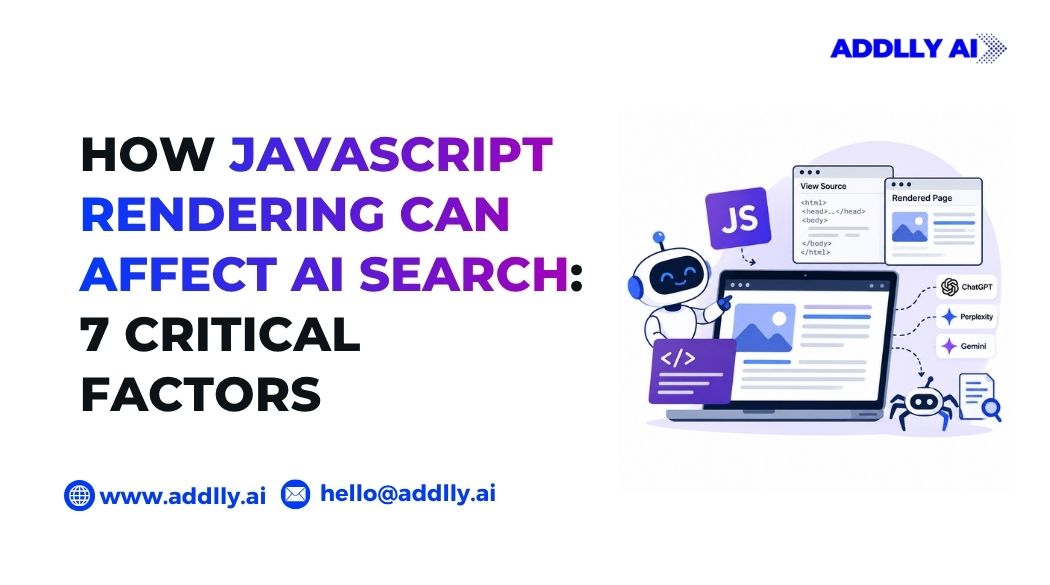
JavaScript rendering and AI search are closely connected because the way a page delivers its content can determine what an AI crawler is actually able to access. A user may see a complete, interactive page in a browser while the initial HTML response contains little more than a shell waiting for JavaScript to run.
If important content appears only after that process, some AI crawlers may not retrieve the same information that users see. This can affect content extraction, indexing, citations, and ultimately AI search visibility. The issue becomes more relevant as websites rely on JavaScript frameworks, client-side rendering, and dynamic content. A GEO audit can bring these technical visibility gaps into the same assessment as content and citation signals.
Quick Summary – JavaScript rendering and AI search
- JavaScript rendering and AI search are closely connected because crawlers may not access the same content users see.
- Content loaded through JavaScript can create crawlability and content extraction gaps.
- SSR and SSG can make critical content available earlier without relying heavily on JavaScript execution.
- Testing raw HTML, rendered HTML, and JavaScript-dependent content can reveal AI crawler accessibility issues.
- Strong AI search visibility requires making important content accessible, understandable, and consistently retrievable.
What Is JavaScript Rendering?
JavaScript rendering is the process of turning a webpage’s initial HTML, JavaScript files, styles, and other resources into the content users see and interact with. When a browser loads a web page, the server first sends an initial HTML response. Depending on how the site is built, that response may contain the complete page content or only the basic structure needed for JavaScript to populate the page.
With client-side rendering, much of the page content is generated in the browser after the initial request. JavaScript can fetch information, create page elements, load dynamic content, and control interactive elements without requiring the browser to reload the entire page. A product page, for instance, might use JavaScript to load product descriptions, prices, reviews, and recommendations after the initial page request.
This creates an important distinction between raw HTML and rendered HTML. The raw HTML is what a crawler or browser receives initially, while rendered HTML reflects the page after JavaScript execution has executed and potentially modified or added content. Google explains that its search systems can process JavaScript, but also notes that not all crawlers have the same rendering capabilities in its JavaScript SEO basics documentation.
For JavaScript rendering and AI search, this difference matters when critical content exists only in the rendered version of a page. An AI crawler may encounter less information than a user sees in the browser, depending on how that crawler handles JavaScript. That makes the way content is delivered an important technical consideration for AI search visibility.
Why JavaScript Rendering Matters for AI Search Visibility
JavaScript rendering and AI search intersect at a basic technical point: what a crawler can access is limited by what the page makes available to it. A browser can execute JavaScript, fetch additional resources, and build a complete page after the initial request. AI crawlers may use different approaches, so the content available to them can vary depending on how a website delivers its information.
This becomes particularly relevant when critical content is missing from the initial HTML and appears only after JavaScript execution. If a crawler cannot render the JavaScript needed to reveal that content, it may have less information available for retrieval and interpretation.
The relationship can be simplified into a few stages:
- Initial HTML: The server returns the first version of the page. If this contains the main content, crawlers can access it without waiting for JavaScript.
- JavaScript execution: Scripts may fetch data, generate page elements, or replace parts of the initial document.
- Rendered HTML: After the scripts run, the browser may contain substantially more page content than was present in the original response.
- Content retrieval: AI systems can only work with the information their crawlers or retrieval processes are able to access.
- AI search visibility: If important information is unavailable during that process, the page may have less content available to support an AI-generated answer or citation.
This is why AI search visibility should be considered alongside traditional technical SEO when evaluating JavaScript-heavy pages. An AI search visibility audit can examine these broader visibility factors rather than treating crawler accessibility as an isolated technical issue.
JavaScript Rendering vs. AI Crawling: What Happens Behind the Scenes?
When a user opens a JavaScript-heavy page, several things happen before the content is fully displayed. The server sends the initial HTML, JavaScript runs, the page changes, and the resulting content becomes available for extraction. AI crawlers may interact with these stages differently depending on their rendering capabilities.
| Stage | What happens | Why it matters |
|---|---|---|
| Initial HTML | The server delivers the first version of the page. | Important content available here can be accessed before JavaScript runs. |
| JavaScript execution | Scripts fetch data and modify or create page elements. | Content dependent on execution may not be accessible to every AI crawler. |
| Rendered DOM | The browser produces the final page structure. | It can contain more content than the original HTML. |
| Content extraction | Crawlers identify text, links, metadata, and structured data. | Poorly accessible content can be harder to process. |
| AI retrieval | AI systems use accessible content to generate responses. | Missing page content can create an AI search visibility gap. |
This is why the difference between raw HTML and rendered HTML matters. What appears on the visual page is not necessarily what every AI crawler can access or retrieve. A technical SEO audit tool can help surface issues involving crawlability, page elements, and how content is delivered.
7 Critical Ways JavaScript Rendering Can Affect AI Search
JavaScript rendering can affect AI search at several points, from how much content a crawler can access to how easily it can extract links, metadata, and structured information. These issues can become especially important on JavaScript-heavy websites where essential page content depends on client-side execution.
1. Important Content May Not Be Immediately Accessible
When important information appears only after JavaScript execution, some AI crawlers may not access the same content that users see in their browsers. This can affect how much of a page is available for retrieval and interpretation.
- Key paragraphs may be missing from the initial HTML.
- Product details, FAQs, or supporting information may load dynamically.
- AI crawlers with limited JavaScript rendering may process an incomplete page.
- Content hidden behind client-side rendering can create gaps in AI search visibility.
For a broader look at how crawlers process website content, see what happens after an AI crawler reads your page.
2. Dynamically Loaded Content Can Create Crawlability Issues
Many modern websites use JavaScript to load dynamic content after the initial HTML response. If AI crawlers cannot access these requests or execute the required JavaScript, important page content may remain unavailable for AI systems and retrieval processes.
- Product descriptions, reviews, prices, and FAQs may load only after JavaScript runs.
- AI bots may receive incomplete HTML when content is loaded asynchronously.
- Dynamic content can increase the complexity of JavaScript execution and content extraction.
- Missing content can reduce opportunities to appear in AI search results and AI-generated answers.
- This can be especially important for ecommerce sites where product information is dynamically rendered.
A useful technical check is whether your pages deliver complete HTML with critical content available without relying entirely on client-side JavaScript.
Don’t Miss: How to Structure Content So AI Engines Can Extract It Easily
3. Client-Side Rendering Can Limit Content Extraction
With client-side rendering, the initial HTML may contain only a basic page structure while JavaScript content is added through JavaScript execution. If AI crawlers cannot fully process that content, important information may be harder for AI systems to extract and use.
- Raw HTML may contain less core content than the final rendered page.
- AI bots can have different rendering capabilities from traditional search engines.
- Dynamic content loaded through client-side JavaScript may remain hidden from some crawlers.
- Missing text, page elements, or context can affect AI search visibility.
- JavaScript-heavy websites can create a gap between the visual page and the content available to crawlers.
This makes the relationship between page rendering and AI citations worth examining when assessing overall visibility.
4. JavaScript-Generated Internal Links May Be Harder to Discover
Internal links help search engines and AI crawlers understand the relationships between pages. When those links are generated only after javascript execution, some crawlers may have difficulty discovering them during the initial crawl.
- Links missing from raw HTML may require additional rendering.
- AI bots may process JavaScript-generated navigation differently.
- Important pages can become less accessible when client side rendering controls navigation.
- Poor link discovery can affect search visibility and AI search visibility.
- HTML-based links make important page elements easier for crawlers to identify.
A well-structured site architecture also supports how AI systems connect related content across your web pages.
5. Dynamically Generated Metadata Can Create Visibility Gaps
Metadata helps search engines and AI systems understand what a page is about. When titles, descriptions, canonical tags, or other signals are generated through JavaScript, they may depend on JavaScript execution before becoming available in the rendered HTML.
- Important metadata may be missing from the initial HTML response.
- AI crawlers may not process dynamically generated metadata consistently.
- JavaScript-heavy pages can create gaps between the metadata users expect and what crawlers retrieve.
- Missing or incomplete metadata can weaken AI search visibility and search visibility.
- The same issue can affect structured data when it is injected dynamically.
For a deeper look at structured data and AI visibility, see schema markup for AEO.
6. JavaScript-Dependent Structured Data Can Cause Problems
Structured data helps AI-powered search engines, Google Search, and other AI platforms understand the entities and relationships represented on a page. When schema markup depends entirely on JavaScript execution, crawlers may need to render JS before they can access those signals.
- Many AI crawlers may use different rendering capabilities from Googlebot.
- Googlebot can render JavaScript using a headless browser, while other major AI crawlers may use lighter crawling methods.
- Dynamically injected schema can create differences between static HTML and fully rendered HTML.
- Missing structured data can make it harder for AI systems to interpret important page content.
- JavaScript-dependent schema can add another processing step for crawlers that prioritize speed.
This is particularly relevant as AI Overviews, AI-generated answers, and other AI search experiences increasingly depend on machine-readable information.
Further Reading: Role of Schema Markup in AI Search Visibility: 2026 Guide
7. Rendering Delays Can Affect How Quickly Content Becomes Available
JavaScript rendering and AI search are also connected through timing. When a page depends on heavy scripts, slow hydration, or multiple rendering processes, critical content may take longer to become available to AI crawlers.
- Slow hydration delays can create inconsistencies in content retrieval.
- Delayed rendering can cause timeouts that affect AI search visibility.
- AI crawlers prioritize speed, so complex JS execution can increase processing demands.
- Running a headless browser for every JavaScript site can place additional strain on crawler infrastructure.
- Minimizing render-blocking resources can improve both user experience and AI readability.
Page speed and rendering can therefore influence both technical SEO and how efficiently content becomes accessible to AI systems.
Does Google Render JavaScript Differently From AI Crawlers?
A website appearing correctly in Google does not automatically mean JavaScript rendering and AI search will behave the same way. Googlebot has its own browser rendering and JavaScript processing capabilities, while most AI crawlers can use different approaches to retrieve and process web pages.
Googlebot and AI Crawlers Follow Different Paths
| Factor | Googlebot | AI Crawlers |
|---|---|---|
| JavaScript | Googlebot can process and render JavaScript. | Capabilities vary across web crawlers and AI platforms. |
| Browser rendering | Uses a browser-based rendering process. | Some crawlers may use lighter retrieval methods. |
| Dynamic content | Can process content generated through JavaScript. | Content dependent on JavaScript may not always be retrieved. |
| AI Overviews | Google can use processed page content for Google AI Overviews. | Other AI systems have their own retrieval processes. |
| Crawl process | Pages move through Google’s crawling, rendering, and indexing systems. | AI crawlers may have different crawl queues and processing constraints. |
Why This Matters for JavaScript SEO
A page that looks complete after browser rendering could initially return a blank page or minimal HTML when JavaScript is disabled. This is especially relevant for single-page applications and modern sites that rely heavily on client-side JavaScript to display content.
You can use Search Console and URL Inspection to check how Google processes a page, but that still does not establish how every AI crawler will access it. For this reason, server-side rendering or static site generation can provide another way to make important content available without requiring every crawler to execute JS.
The distinction also matters beyond search indexing. Content that AI systems can access may potentially contribute to retrieval, AI training, or training data, depending on the platform and its policies.
CSR vs. SSR vs. SSG: Which Rendering Approach Is Better for AI Search?
The rendering approach determines when page content becomes available to web crawlers and AI systems. CSR depends more heavily on JavaScript execution, while SSR and SSG can deliver static HTML earlier, reducing the rendering work required.
| Rendering approach | How content is delivered | AI search consideration |
|---|---|---|
| CSR | Content is generated primarily in the browser. | Can create accessibility issues when content depends on JavaScript. |
| SSR | HTML is generated on the server for each request. | Makes important content available earlier to crawlers. |
| SSG | HTML is generated before requests are made. | Strong option for relatively static content. |
| Prerendering | An HTML version is generated before delivery. | Can improve accessibility for crawlers and users. |
Choosing the right approach
Server-side rendering SSR can work well for dynamic websites, while static site generation and static generation are useful for content that changes less frequently. CSR remains practical for complex single-page applications, provided essential content remains accessible without excessive JavaScript dependency.
The key consideration for JavaScript rendering and AI search is how reliably critical content reaches crawlers. A rendering approach that delivers important information through accessible HTML can reduce dependency on crawler-side JavaScript execution and support stronger AI search visibility.
How to Check if JavaScript Is Hiding Your Content From AI Crawlers
You can test whether JavaScript rendering and AI search issues are hiding important content by comparing what crawlers receive with what users see in the browser.
- Check the raw HTML and compare it with the rendered page.
- Disable JavaScript and check whether critical content and page elements remain visible.
- Use URL Inspection in Search Console to review how Google processes the page.
- Inspect crawler access and server logs where available.
- Test key web pages, especially JavaScript-heavy pages and important landing pages.
These checks can reveal whether content depends too heavily on JavaScript execution before it becomes available to AI crawlers.
JavaScript Rendering and AI Search: Best Practices Checklist
Use this checklist to reduce rendering-related gaps and make important content easier for AI crawlers and search engines to access.
- ☐ Keep critical content available in the initial HTML where possible.
- ☐ Avoid relying entirely on client-side JavaScript to display core content.
- ☐ Test both raw HTML and fully rendered HTML.
- ☐ Check that important internal links are crawlable.
- ☐ Keep titles, metadata, and structured data accessible.
- ☐ Monitor rendering delays, hydration issues, and Core Web Vitals.
- ☐ Test important JavaScript-heavy pages with JavaScript disabled.
- ☐ Use server side rendering or static generation where appropriate.
- ☐ Review how different AI crawlers access your pages.
- ☐ Include rendering and crawlability checks in your broader AI search visibility assessment.
For enterprise websites, Addlly AI can bring technical visibility, content, and AI citation factors together through a broader GEO assessment, helping teams identify where website architecture may be limiting their presence in AI search.
Final Takeaway
JavaScript rendering and AI search are closely connected because a page that looks complete in a browser may not deliver the same content to every crawler. On client-side rendering sites, some sources suggest that 50–80% of content may be invisible to AI crawlers when important information depends on JavaScript execution. Claims such as 69% of AI crawlers cannot execute JavaScript should be treated carefully because crawler capabilities vary and continue to change.
Platforms such as ChatGPT and Perplexity may use lightweight retrieval methods that do not process JavaScript in the same way as browser rendering. When client-side setups introduce structural noise, content can become harder for AI systems to extract and interpret, potentially affecting AI search visibility, citations, and brand credibility.
The practical lesson is simple: test what crawlers can actually access, not just what users can see.

