
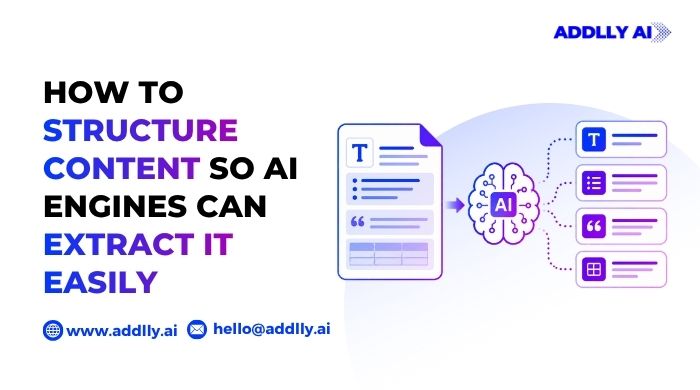
Welcome to the new era of search. Understanding how to structure content so AI engines can extract it easily is becoming essential for brands that want visibility in AI search engines and AI-powered search results. An AI-friendly content structure helps AI models easily parse web content, identify relevant entities, and surface your brand in AI-generated answers.
To structure content so AI engines can extract it easily, organize information with clear headings, direct answers, defined entities, concise paragraphs, and structured data. AI search engines prioritize content that is easy to parse, logically organized, and supported by strong contextual signals. Pages built this way are more likely to appear in AI-generated answers and AI-powered search results.
In this guide, you’ll learn how AI search engines read and interpret web content, which structural elements improve AI extraction, and how to optimize pages for AI-generated answers without sacrificing readability for human visitors. You’ll also see practical steps for improving content hierarchy, entity clarity, schema markup, and overall AI search visibility.
Quick Summary – How to Structure Content So AI Engines Can Extract It Easily
- Artificial Intelligence (AI) systems extract information fundamentally differently than traditional search engines.
- Proper hierarchy and entity definitions directly increase your citation likelihood.
- Using multiple formats like long-form text and FAQs boosts visibility significantly.
- Code markup communicates authority and context to language models.
- You can restructure your existing pages without needing complete rewrites.
What Is AI-Friendly Content Structure?
It is the specific organization of information that allows artificial intelligence models to extract and cite your answers accurately. This layout relies on clear hierarchies and semantic relationships rather than just keyword density.
To succeed today, you must focus on generative engine optimization. This means organizing your pages so machines understand exactly what you offer. Good content formatting for AI ensures your best insights do not get lost in a massive wall of text.
How AI Systems Read Content
Language models process the relationships between words. They do not just look for exact keyword matches. They look for logical flow and clear definitions to improve AI content extraction. When you use comprehensive layouts within a single page, these systems can confidently pull your answers.
AI bots do not read pages the same way human readers do. Instead, they break content into relevant chunks and evaluate the surrounding text to understand context. Pages that present one idea per section, provide supporting context, and use natural language are more likely to appear in AI search results and generated responses.
Why Structure Differs From SEO
Traditional Search Engine Optimization (SEO) focuses on different goals than modern answer engines. Here is how they compare.
| Feature | Traditional SEO | GEO (AI-Friendly) | Best Approach for 2026 |
|---|---|---|---|
| Primary Goal | Ranking on search pages | Citation in AI responses | Combine both methods |
| Core Metrics | Keyword density and links | Clarity and entity relations | GEO vs SEO hybrid strategy |
| Text Format | Long flowing paragraphs | Direct answers and tables | Multi-format layouts |
Business Impact of Proper Structure
Proper structure delivers measurable business results.
- Proper formatting yields 60 to 70 percent higher citation rates.
- Brands recover organic traffic AI search drops much faster than competitors.
- Clear formatting prevents models from paraphrasing your brand out of the picture.
AI search optimization can increase visibility by up to 40%, while AI search traffic converts at 4.4 times the rate of traditional search traffic. This makes proper structure a critical part of long-term search optimization.
Why Does Content Structure Matter for AI?
Structure matters because it dictates whether a language model can confidently pull and attribute your information. Without a clear layout, your brand gets ignored or paraphrased.
Systems prefer sources that offer clear and extractable answers. When you improve content readability for AI, you make it easy for the model to credit your brand directly. This directly impacts your AI search visibility across all major platforms.
Citation Frequency and Attribution
Models favor sources that answer questions clearly. Poor formatting reduces attribution and citation frequency.
Ninety-five percent of AI citations come from third-party sources rather than brand-owned content. Building relationships with authoritative publishers and earning mentions across the web remains essential for AI visibility.
E-E-A-T Signals in Structure
Experience, Expertise, Authoritativeness, and Trustworthiness (E-E-A-T) still matter deeply. You can communicate E-E-A-T signals AI systems trust by using clear author bios and citing your own research. Highlighting author attribution AI markers proves your credibility to the machine.
Knowledge Graph and Entity Visibility
Search engines build internal maps connecting concepts and relationships. If your brand lacks knowledge graph optimization, you will not connect to broader industry topics. Consistent naming helps the system map your brand correctly.
Core Elements of AI-Optimized Structure
AI-optimized pages rely on logical hierarchy, entity definitions, semantic relationships, and comprehensive topic coverage.
Clear Content Hierarchy and Headings
Your heading structure for AI must be perfectly logical. A clear layout tells the system exactly where to find the best answers.
- H1: States the main topic or question clearly.
- H2: Breaks the topic into major subtopics.
- H3: Provides specific examples or detailed steps.
Descriptive headings help AI systems identify key insights quickly. Each section should focus on a concise answer to a specific user query before expanding into additional detail. Keeping paragraphs concise improves AI extraction while making content easier to scan.
Use question-based headings to mirror search queries and natural language questions for subheadings whenever possible. This makes it easier for AI models to match your content to user intent and extract relevant answers.
Entity Definition and Specification
Entities are the people, places, products, or concepts central to your business. You must define them explicitly early in your text. This creates entity-based content that machines can categorize easily. Creating clear content for LLMs (Large Language Models) requires defining these terms without ambiguity.
Defining key entities early helps AI search optimization by reducing ambiguity. This is especially important when discussing products, services, proprietary data, or complex ideas that require additional explanation.
Semantic Relationships and Context
You must state how concepts connect to one another. Use comparative language to show differences between competing approaches. A strong semantic content structure helps models understand the exact context of your claims.
Comprehensive Topic Coverage Within URL
Answer engines prefer finding everything on one page. Instead of splitting details across multiple links, build a pillar page AI strategy. Deep pages on a single Uniform Resource Locator (URL) reduce the need for the model to pull from competing sites.
Implementation: Step-by-Step Structure
Use the following seven-step framework to improve extractability and citation performance.
Step 1: Audit Existing Content Structure
Start by reviewing your top pages for logical nesting. A proper content audit for GEO reveals where your headings fall flat. Look for missing author details or vague terminology.
Step 2: Prioritize Pages by AI Citation Value
Focus your energy on high-traffic pages first. You want to target core topics that have high AI search citation frequency potential. Do not waste time on niche pages with low search volume.
Step 3: Restructure Headings and Hierarchy
Fix your subheadings so they answer specific questions. Every H3 must relate directly to its parent H2. This is one of the most important content structure best practices you can follow.
Step 4: Define and Map Entities Explicitly
List all major concepts and define them in one or two sentences. Use consistent naming conventions throughout your text. This builds a topic cluster AI optimization framework that machines respect.
Step 5: Add Multi-Format Content Elements
A single block of text is not enough. You need a multi-format content strategy to succeed. Add an executive summary at the top and comparison tables in the middle. Include clear answers, succinct answers, comparison tables, FAQs, and summary boxes throughout your content. These formats help AI tools extract information efficiently when generating answers for users across AI-powered search experiences.
Utilize bullet points and numbered lists for clearer presentation of information. These formats create highly extractable content blocks that AI tools can reference directly when generating answers.
Step 6: Implement Schema Markup
You must add code that explains your page context. Using schema markup for AI helps the engine validate your facts. Implementing JSON-LD (JavaScript Object Notation for Linked Data) gives the system absolute confidence in your information. While markdown for AI content helps structure text visually, structured data code is better for factual verification.
Article schema is one of the most important forms of structured data because it helps AI engines understand publication details, authorship, and content hierarchy. Combined with accurate meta descriptions, it strengthens technical optimization and AI visibility.
Common schema types include Article, FAQPage, and HowTo. Implementing FAQ schema can increase citations by up to 350% because it provides direct question-and-answer structures that AI engines can easily interpret.
Step 7: Test and Measure Citation Changes
Finally, track your results carefully. Monitor which pages start appearing in modern answer engines. Re-audit your site every few weeks to catch new opportunities.
Common Structural Mistakes Blocking AI
Flat hierarchies, fragmented information, and missing schema markup will block machines from citing your work. Avoiding these errors ensures your content remains visible and extractable.
Even great writing fails if the machine cannot read it. You must ensure AI crawlers content access is completely unobstructed.
Flat Hierarchy and Vague Headings
Headings like “Overview” or “Details” confuse language models. They need specific descriptive titles to understand topic progression. A flat layout results in skipped or partial citations.
Fragmenting Information Across Multiple URLs
Do not answer half a question on one page and half on another. Complete coverage on a single page is crucial for LLM-friendly content. Fragmentation forces the machine to paraphrase instead of citing you directly.
Avoid complex PDFs for AI text parsing whenever possible. Many AI systems struggle to extract information from PDFs compared to accessible HTML pages with clear content hierarchy.
Inconsistent Entity Naming and Definition
Calling your product a “tool” in one paragraph and a “platform” in the next causes confusion. You must establish a primary term and stick to it. Consistency prevents the system from losing track of your brand.
Missing Multi-Format Elements (FAQs, Tables)
A massive wall of text offers poor extraction points. You must include a dedicated FAQ format for AI at the bottom of your articles. Missing these elements costs you valuable citation opportunities.
Missing or Incomplete Schema Markup
Failing to include background metadata hurts your credibility. Without structured data AI search systems struggle to verify your author or publication date. Complete your markup to signal true authority.
Advanced Tactics for Maximum AI Visibility
Advanced tactics include mapping entity relationships, creating persona-based variations, and formatting original research clearly. These methods push your visibility beyond basic optimization.
Once your foundation is solid, you can implement higher-level strategies to dominate answer engines.
Entity Relationship Mapping for Knowledge Graphs
Explicitly state how your products connect to broader industry concepts. Good entity relationship mapping helps the machine place you in the right category. Use internal links to reinforce these connections.
Persona-Based Content Variations and FAQs
Structure your answers to address different user types. Frame one answer for beginners and another for executives. This creates rich citation-worthy content that appeals to various prompts.
Original Data and Research Presentation
Machines heavily favor unique statistics. Present your fact-based content AI systems crave in distinct callout boxes. Clear methodology sections make your data highly attractive for extraction.
Citation-Ready Summary Boxes and Callouts
Place short takeaways after major sections. These boxes act as perfect AI content summarization points. Keep them to two or three sentences so they can be extracted without editing. This naturally leads to better AI-generated summaries featuring your brand.
Platform-Specific Citation Preferences
Different platforms want different things. A ChatGPT content citation usually comes from comprehensive long-form hierarchies. Meanwhile, Perplexity AI content relies heavily on recent dates and comparative tables. Google AI Overviews optimization requires intense focus on E-E-A-T signals.
Google AI Overviews often favor pages with direct answers near the top of the content, while other generative AI tools may rely more heavily on content depth and supporting context.
Adding publication and update dates enhances content relevance for AI systems. AI engines generally prefer content updated within the last six months, and cited sources in AI answers are often significantly fresher than traditional search results.
Using Addlly AI for Content Restructuring
Addlly AI automates content restructuring and AI visibility analysis at scale. Updating hundreds of pages manually takes too long. You need a dedicated GEO content strategy that scales. Addlly AI offers a GEO Audit Tool that simulates over one hundred prompts to find your exact visibility gaps.
Addlly AI agents can rewrite your pages into proper formats in just thirty minutes.
Building an AEO content strategy is easier with the right tools. You can easily integrate this with your CMS content for AI publishing workflows. It helps you maintain AI content visibility without requiring any prompt engineering skills.
FAQs – How to Structure Content So AI Engines Can Extract It Easily
Can I Optimize Content for Both Traditional SEO and AI Search with the Same Structure?
Mostly, yes. A strong layout naturally improves traditional search performance while supporting AI answer engine optimization. Structure for machines first, then layer in your keywords naturally. Clear headings, entity definitions, and structured data help both search engines and AI systems understand your content more effectively.
How Does Addlly AI’s GEO Audit Tool Identify Which Pages Need Restructuring?
The tool simulates prompts to see how your brand is framed and where you lack content for AI citations. It flags high-traffic pages missing from AI responses. You get a prioritized roadmap showing exactly what to fix. This helps teams focus on the pages most likely to improve AI visibility and citation rates.
What’s the Difference between Fixing Heading Hierarchy and Adding Schema Markup?
Heading hierarchy creates a logical flow using semantic HTML for AI to understand topic progression. Schema markup explicitly defines metadata behind the scenes so systems can parse factual data instantly. Both are important, but schema provides machine-readable context while headings improve content organization and extraction.
How Long Does It Take to Restructure an Existing Page for AI Readability?
Manual updates take two to four hours per page. Using Addlly AI agents with semantic chunking content capabilities reduces this to thirty minutes. This saves enterprises massive amounts of time at scale. Results can often be implemented across large content libraries without disrupting existing publishing workflows.
Will Restructuring for AI Readability Hurt My Human-Readable Writing?
No, it actually improves it. Clear hierarchies and a zero-click search strategy make your writing easier to scan. Removing vague filler text benefits both human readers and machines. Most organizations find that better structure improves engagement, readability, and information retention at the same time.
When Should I Prioritize Fixing Structure vs. Creating New GEO-Optimized Content?
Prioritize restructuring your high-traffic pages first to compound existing visibility. Then, split your effort between new answer engine optimization content and mid-traffic updates. Addlly AI automatically ranks these priorities for you. This approach delivers faster gains while building a stronger long-term content foundation.