
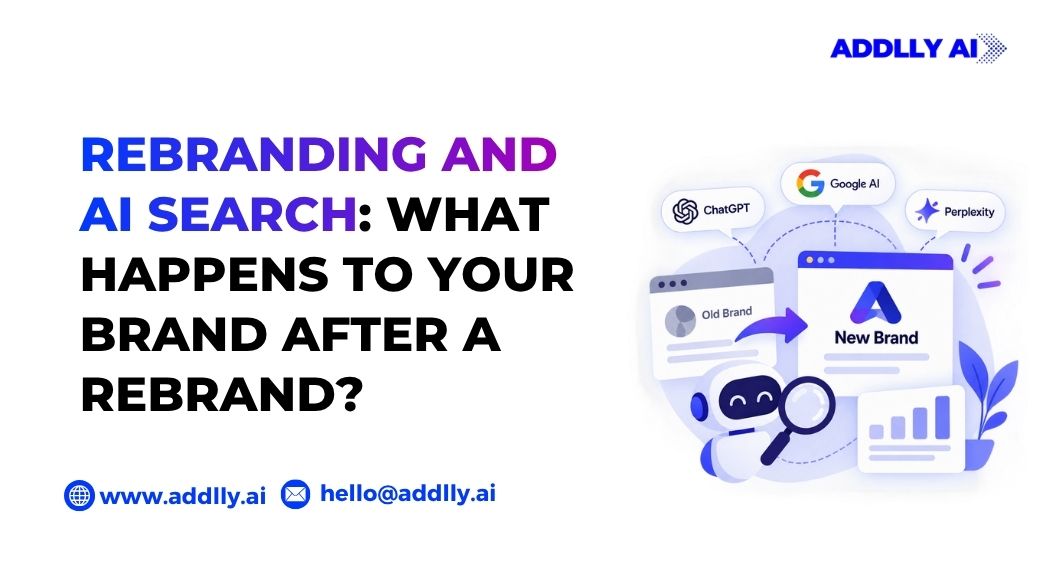
A rebrand is usually planned around people. Will customers recognize the new name? Will the new identity feel right? Will existing customers make the connection? But there is another audience businesses now need to consider: AI systems.
As more people use ChatGPT, Google AI Overviews, Perplexity, and other AI search tools to discover brands, a change in name, domain, positioning, or messaging can affect how a company is understood online. This is where rebranding and AI search become closely connected.
A brand may successfully migrate its website and preserve its traditional rankings, yet still find that AI systems rely on old information, miss the connection between the two identities, or describe the company incorrectly. A GEO audit can help identify these gaps by examining how AI systems currently interpret and represent a brand.
A rebrand, in other words, changes more than how your business looks. It can change how AI understands your brand.
Quick Summary – Rebranding and AI Search
- A rebrand can change how AI systems understand and represent your brand across search experiences.
- Consistent brand information across your website and third-party sources helps strengthen AI visibility.
- Structured data, content, and external mentions can help connect your old and new brand identities.
- Track citations, brand mentions, share of voice, and branded searches to measure the transition.
- Treat rebranding and AI search as an ongoing strategy, not a one-time website migration.
How Rebranding Can Affect AI Search Visibility
Rebranding can change how AI systems understand your brand, especially when the old and new identities continue to appear across different sources. A new name may be live on your website, while older web pages, business listings, reviews, or third-party mentions still reference the previous identity. These inconsistencies can affect how your brand appears in AI-generated answers and how confidently AI search engines connect the two names.
Old Brand Information Can Continue to Surface
A rebrand does not erase years of existing information. AI models can encounter the old brand name across web pages, industry publications, review sites, social profiles, and other online sources. If those sources are not updated, AI search engines may continue associating the company with its previous name, positioning, or products.
This makes brand entity consistency particularly important. AI systems need enough consistent information to understand that the old and new names represent the same business.
A New Brand May Take Time to Build Recognition
The new identity also needs supporting signals. Your website can introduce the new name immediately, but AI-powered search looks at information from multiple sources when generating answers. Consistent mentions, clear brand messaging, structured information, and authoritative third-party references can all help reinforce the new identity.
This is where entity optimization for GEObecomes relevant, particularly when a company needs AI systems to connect its brand with the right products, services, and categories.
Domain Changes Can Add Another Layer
Changing the domain at the same time as the brand can make the transition more complicated. Redirects and updated internal links can help preserve traditional search signals, but AI search visibility depends on more than technical migration. AI responses can also reflect older information that exists outside your website.
For marketing teams, this means rebranding, and AI search should be considered together. The objective is not simply to launch the new identity, but to make the relationship between the old and new brand clear across the web.
Why AI Systems May Not Recognize Your New Brand Immediately
AI search engines do not understand a rebrand simply because a company announces it. They piece together information from web pages, brand mentions, structured data, third-party sources, and other signals to determine what a business is and how it relates to a particular query. When those signals still point to the old identity, the transition can take time.
How AI Search Engines Understand Brands
AI search engines look beyond individual keywords when interpreting a brand. They consider the context surrounding a company, including its products, services, industry, reputation, and relationships with other entities. This helps AI systems understand whether different references across the web describe the same business.
Entity Recognition and Semantic Relationships
A brand is more than its name. AI systems use entity recognition and semantic relationships to connect a company with its products, services, categories, and related organizations. During a rebrand, changing the name without reinforcing these relationships can make the new identity harder to recognize.
The way AI search engines decide which brands get seen depends on a combination of relevance, context, authority, and information available across the web.
Cross-Web Consensus Matters
AI systems can draw information from multiple sources rather than relying only on your website. If your new website uses the new name but industry publications, review sites, or business listings still use the old one, the signals are inconsistent. A stronger cross-web consensus makes it easier for AI platforms to establish which information is current and how the two identities are connected.
Training Data and Multiple Sources
Training data can also play a role, particularly for information that AI models have encountered previously. Older references to the brand may continue to exist alongside newer information. This is one reason AI responses may not immediately reflect a recent rebrand consistently across different platforms.
Brand Mentions and External Signals
Brand mentions provide additional context around an entity. Consistent mentions across authoritative third-party sources, media coverage, industry publications, and relevant platforms can reinforce the new identity. During a rebrand, maintaining these external signals helps create a clearer picture for AI systems and supports stronger brand visibility in AI search.
The Difference Between Traditional SEO and AI Search After a Rebrand
A rebrand can go smoothly from an SEO perspective and still create problems in AI search. Traditional search is heavily concerned with crawling, indexing, redirects, links, and rankings. AI search adds another layer: whether AI systems understand that the old brand and the new brand are the same entity and whether they have enough reliable information to describe it correctly.
Why a Successful SEO Migration Isn’t Enough
A well-executed migration can preserve much of your existing search visibility. Pages are redirected, URLs are updated, internal links are fixed, and search engines can follow the new site structure. But AI platforms work with a much wider information environment.
An AI-generated answer may draw from your website alongside review sites, news coverage, business listings, social platforms, and other third-party mentions. If those sources still use the old brand identity, the new website alone may not be enough to establish continuity.
301 Redirects and Traditional Search Rankings
301 redirects remain important during a rebrand, particularly when the domain or URL structure changes. They help search engines understand that an old URL has moved to a new location and can help preserve established search signals.
But redirects primarily address the relationship between web pages and domains. They do not automatically update every external reference to your old brand.
| Traditional SEO | AI Search |
|---|---|
| Focuses heavily on URLs, crawling and indexing | Looks at information and context across multiple sources |
| 301 redirects help establish page relationships | External references may still reinforce the old identity |
| Rankings can be monitored through search results | Brand mentions and AI responses also need monitoring |
| Keywords and links remain important | Entity clarity and semantic relationships become important |
| Domain migration is a major technical concern | Domain and brand identity need to remain connected |
This difference between AI search engines and traditional search becomes especially important during a rebrand, because maintaining rankings does not necessarily mean maintaining the same representation across AI platforms.
Branded Searches and Search Visibility
Branded searches can also change after a rebrand. People may continue searching for the old name while gradually adopting the new one. That transition can create a period where both identities appear in search results.
The same thing can happen in AI answers. Someone may ask about the old brand and receive information associated with the previous identity, while another query using the new name produces a different result. Tracking both old and new branded searches can therefore reveal whether the transition is happening consistently.
How AI Platforms Interpret Brand and Domain Changes
AI platforms do not simply see a new domain and assume everything has changed. They assess information from different sources and try to establish the relationships between entities, topics, and claims.
That makes consistency particularly important. If your website, business listings, media coverage, social profiles, and other sources all establish the same connection between the old and new identities, AI systems have stronger signals to work with. This is one reason rebranding and AI search require attention beyond the technical SEO migration itself.
How Structured Data Supports Brand Recognition After a Rebrand
A rebrand gives your website a new identity to communicate, but AI systems still need enough context to understand what that identity represents. Structured data helps provide that context in a format machines can interpret. Instead of relying entirely on the words visible on a page, schema markup gives search systems explicit information about an organization, website, content, and other entities connected to the brand.
Making the New Brand Easier to Interpret
When a company changes its name, structured data should reflect the new identity across relevant pages. Organization and WebSite schema can establish the relationship between the business and its website, while properties such as sameAs can connect the organization with its official external profiles.
For marketing teams, this is particularly useful when the old and new names are still appearing across the web. The website becomes a consistent source of information about the current brand.
Key details to review after a rebrand include:
- Organization name and URL
- Logo and brand information
- sameAs profiles
- WebSite relationships
- Organization @id
- Product and service associations
- Author and publisher information
The wider role of schema markup for AEO also shows why structured data is becoming relevant beyond conventional search features. It gives search systems clearer signals about what a page represents and how different entities relate to one another.
Connecting the Old and New Brand Identities
Structured data should not be treated as a replacement for updating your website and external mentions. Its value comes from being part of a consistent set of signals.
If your visible content uses the new name, your Organization schema reflects the new identity, and your official profiles point to the same entity, there is a much clearer relationship for AI systems to interpret. This becomes particularly important when older references to the business continue to exist.
Schema can therefore support entity clarity during the transition, while other parts of your digital presence establish the same relationship in plain language.
Improving Content Extractability
There is another benefit that is easy to overlook. Well-structured pages are easier for machines to interpret. Clear headings, descriptive page content, logical internal links, and structured data all contribute to a website that communicates its information clearly.
The role of schema markup in AI search visibility is therefore not about inserting as much markup as possible. It is about giving search systems accurate, consistent information that supports the meaning already present on the page.
For a company going through a rebrand, that consistency matters. The new brand should look, sound, and identify itself the same way across the website and the structured information behind it.
How to Protect AI Search Visibility During a Rebrand
Protecting AI visibility during a rebrand is largely about making the transition easy to understand. The new name, messaging, website, social profiles, and external references should tell the same story. This is where AI search optimization becomes part of the wider brand strategy, alongside technical improvements, content strategy, and digital PR.
Connect the Old Brand to the New One
Do not assume that changing the name everywhere is enough. For a period of time, explicitly connect the old identity with the new one on important pages. Phrases such as “formerly known as” or “previously known as” can provide useful context in natural language.
The same relationship should be reflected across relevant profiles and authoritative sources. The goal is to make AI discovery easier by giving AI engines consistent signals about who the company is and what it is now called.
Keep Your Brand Messaging Consistent
Your new identity should sound consistent wherever it is mentioned online. If the website describes the company one way while social profiles, articles, and industry listings use different descriptions, large language models have more conflicting information to reconcile.
This matters for both brand discovery and AI-driven discovery. Clear descriptions of your products, services, expertise, and category create stronger trust signals and make it easier for AI tools to provide relevant answers about the business.
Consistency also matters when producing new content after the rebrand. Your articles, landing pages, and other content should reflect the same tone, terminology, positioning, and brand values rather than gradually developing different versions of the new identity.
An AI Blog Writer can support this process by helping teams maintain a consistent brand voice while creating new content for the updated brand.
Update the Web and Your External Presence
A rebrand should trigger a wider content and profile review, not just a website update. Check:
- Older web pages and internal links
- Business listings and review profiles
- Social media accounts
- Industry directories
- Author bios and publisher information
- Press releases and media coverage
- Product and service descriptions
- Relevant third-party references
These updates are equally critical because AI crawlers can encounter information from many parts of your digital footprint. Leaving outdated information in place can make the new identity less consistent across AI surfaces.
External sources deserve particular attention. If authoritative websites continue describing the company under its old name without connecting it to the new identity, AI systems may have less context for understanding that both names represent the same business.
Keep Creating Content in the New Brand Voice
The transition does not stop when the new website launches. Your ongoing content strategy should reinforce the new positioning through useful, natural content rather than relying on repeated brand-name mentions.
This is also where E-E-A-T becomes important. Content that demonstrates genuine experience, expertise, authority, and trust gives AI engines stronger signals when they assess a brand and its claims. A consistent brand voice matters, but so does demonstrating that the information behind that voice is credible and useful.
A strong generative engine optimization approach therefore combines useful content with clear brand signals. Content should answer relevant queries in natural language, provide direct answers where appropriate, and give AI crawlers enough context to understand the subject.
For a deeper look at how credibility factors into generative search, E-E-A-T in generative engine optimization provides useful context.
The same content can also support AI discovery beyond traditional search. As people increasingly use AI tools for research and recommendations, useful and credible content can contribute to brand discovery, referral traffic, and visibility across different AI surfaces.
Track the Transition Over Time
A rebrand should be measured as an ongoing transition rather than a one-time launch event. Marketing teams can track mentions, monitor AI-generated responses, compare old and new branded searches, and watch for changes in branded search lift and referral traffic.
These signals can show whether AI systems are gradually adopting the new identity or whether the old brand is still dominating the conversation.
The goal of rebranding and AI search is not simply to make the new name appear online. It is to establish a clear, consistent understanding of the new brand across the sources that influence AI-generated answers.
Why Third-Party Mentions Matter for AI Search After Rebranding
A company’s website is only one part of its digital identity. When rebranding and AI search come together, third-party sources become especially important because AI systems can use information from across the web to understand what a brand is, what it offers, and how it has changed.
During a rebrand, your website may adopt the new brand identity immediately, while external sources continue using the old name. That gap can create confusion for AI systems and affect how your brand appears in AI generated answers.
This is why third party mentions matter. AI search engines can encounter information about a company through multiple sources, not just its own web pages. Consistent information gives AI systems more context to understand that the old and new names belong to the same brand.
Industry Publications
Industry publications can provide useful context around a company. Articles, interviews, contributor profiles, and industry mentions can establish what a business does and where it fits within its category.
This becomes particularly relevant when rebranding and AI search are part of the same transition. If respected publications refer to the company by its new name while connecting it to its established expertise, AI search engines have more information to work with.
For example, a company that changes its name but continues receiving coverage for the same products, expertise, and industry focus creates a clearer connection between the old and new identities. These consistent mentions can also support entity clarity across multiple sources.
Review Sites
Review sites can be another important source of brand information. Customer reviews often contain the company’s name, products, services, location, and descriptions of customer experiences.
If review profiles continue displaying the previous brand name after a rebrand, rebranding and AI search can become more complicated. AI systems may encounter two versions of the company without enough context to confidently connect them.
Updating relevant review profiles and business listings can help maintain a consistent brand identity. This also gives AI models clearer information when they encounter the company through different sources.
Authoritative Third-Party Sources
Not every mention carries the same contextual value. Authoritative third party sources can help establish a brand within a specific industry, topic, or area of expertise.
This is one reason rebranding and AI search should not be treated as a website-only project. The new identity needs to appear consistently wherever people and AI systems encounter information about the business.
These sources can include:
- Industry associations
- Business directories
- Partner websites
- Research publications
- Expert profiles
- Relevant knowledge platforms
- Industry-specific websites
The objective is not to create as many mentions as possible. It is to establish credible sources that reinforce the same brand identity, products, services, and category.
Media Coverage
Media coverage can help establish the relationship between an old and new brand. A company announcement, founder interview, news article, or feature can naturally explain why the business changed its name and what remains the same.
This gives AI systems additional context that may not exist in a simple website update. When rebranding and AI search are considered together, media coverage can reinforce the story behind the transition rather than leaving AI platforms to infer the relationship themselves.
The same principle applies to digital PR. Coverage that connects the previous identity with the new one can provide additional context for AI engines and support the brand’s broader search visibility.
Digital PR and Strategic PR
This is where digital PR and strategic PR can become part of the rebranding process. PR activity can introduce the new identity through credible external sources while maintaining the company’s existing reputation and associations.
The goal should not be to generate mentions simply for the sake of mentions. Instead, PR should reinforce the information that AI engines need to understand:
- Who the company is now
- What the company was previously called
- What products or services remain the same
- What has changed in the positioning
- Which industry or category the brand belongs to
- Where authoritative information about the company can be found
A coordinated approach makes rebranding and AI search easier to manage because the new identity is supported by more than the company’s own website.
Consistent Brand Mentions Across the Web
Ultimately, consistency is what ties these signals together. Your website may say one thing, but if media coverage, review sites, industry publications, social profiles, and directories say something else, AI systems have to reconcile those differences.
Consistent brand mentions across the web create a stronger foundation for brand discovery and can help improve brand visibility across AI-powered search experiences.
This is why it is useful to understand the difference between brand mentions and backlinks. A third-party reference does not always need to link back to your website to contribute useful context around your brand.
That makes third-party mentions an important part of rebranding and AI search, particularly during the months immediately following a brand transition. The more clearly the wider web establishes the relationship between the two identities, the easier it becomes for AI search engines to understand the new brand.
For marketing teams, the path forward is not to chase every possible mention. It is to build a consistent information ecosystem around the new identity. That means keeping your own web pages accurate while strengthening external references, content, PR, and other signals that contribute to visibility in AI search.
How to Measure AI Search Visibility After a Rebrand
A rebrand should be measured beyond traditional rankings and website traffic. The real question is whether the new identity is gaining brand visibility across AI-generated answers and other AI-powered search experiences.
Brand Mentions
Track how often the new brand is mentioned across AI responses and compare this with mentions of the old identity. Look at both the number of mentions and how accurately AI systems describe the brand.
Citation Rate
Citation rate shows how often your content or web pages are referenced in AI answers. Monitoring this over time can reveal whether your updated content is gaining visibility.
A useful way to assess this is by running a GEO audit, which can help identify which pages are being cited and where citation opportunities exist.
Share of Voice
Share of voice measures your brand visibility compared with competitors in AI answers. Tracking this across important queries can show whether the new identity is gaining ground in your category.
AI Referral Traffic
AI referral traffic shows whether visibility is leading people back to your website. However, zero click search means users may receive the information they need without visiting your site, so traffic should not be your only measure of success.
Branded Search Lift
Monitor branded search lift by comparing searches for the old and new brand names. Increasing searches for the new identity can indicate growing awareness and stronger brand visibility.
Tracking AI Responses Over Time
AI responses can change as new information becomes available. Track important queries regularly, including searches for your brand, products, services, and competitors.
For a broader view of visibility in AI search, a GEO audit can help identify how your brand is currently represented and where you can improve brand visibility.
The goal is to measure whether the new brand is simply being mentioned or building meaningful AI visibility over time.
AI Search Rebranding Checklist: What to Do Before and After Launch
A rebrand does not end when the new website goes live. To maintain brand visibility and strengthen AI visibility, marketing teams need to manage the transition before launch, during the rollout, and well after the new identity is introduced.
Before the Rebrand
- Audit how the current brand appears across AI search engines.
- Record existing brand mentions, citations, and important AI responses.
- Identify outdated or inconsistent information across third-party sources.
- Map old URLs, domains, internal links, and redirects.
- Review structured data, Organization information, and sameAs references.
- Document the current brand visibility so you have a baseline for comparison.
During the Rebrand
- Clearly connect the old brand name with the new identity.
- Update website copy, metadata, structured data, and internal links.
- Keep product, service, and category descriptions consistent.
- Update social profiles, business listings, directories, and review sites.
- Coordinate digital PR and media coverage around the transition.
- Check that important third-party sources are using the correct brand name.
Immediately After Launch
- Test the new brand across major AI search engines.
- Check how AI systems describe the company, products, and services.
- Look for incorrect associations between the old and new identities.
- Monitor citations and brand mentions.
- Check whether important pages are appearing in AI answers.
- Fix inconsistencies found across your website and external sources.
30 to 90 Days After Launch
The first few weeks show whether the transition is working, but the 30 to 90-day period provides a better view of sustained AI visibility.
Track:
- New versus old brand mentions
- Citation rate
- Share of voice
- Brand visibility across important queries
- AI referral traffic
- Branded search lift
- Changes in AI-generated answers
If visibility is weaker than expected, revisit your content, external mentions, structured data, and generative engine optimization efforts rather than assuming the rebrand itself is the problem.
Testing Your Brand Across AI Search Engines
Do not rely on one AI platform. Test your brand across ChatGPT, Google AI Overviews, Google AI Mode, Perplexity, and other relevant AI platforms.
Use the same set of branded and non-branded queries each time. This makes it easier to see whether your new identity is being recognized consistently and whether your visibility in AI search is improving over time.
The Path Forward: Building a Consistent Brand Identity for AI Search
A successful rebrand goes beyond changing your name, logo, or website. It also requires making your new identity clear and consistent across the sources that influence AI search. Your website, content, structured data, social profiles, third-party mentions, and media coverage should all reinforce the same brand story.
That makes rebranding and AI search a strategic imperative, not a task that ends at launch. Regularly monitor brand visibility, citations, mentions, and AI responses to identify gaps and opportunities to improve visibility.
This is where Addlly AI can help marketing teams manage SEO, GEO, content creation, social media, and AI search efforts in one place.
Ultimately, consistency gives AI systems clearer signals about your brand and creates a stronger foundation for long-term AI visibility.
FAQs – Rebranding and AI Search
How Long Does It Take for AI Systems to Recognize a Rebranded Company?
There is no fixed timeline. Recognition can take weeks or months depending on how quickly the new identity becomes consistent across websites, publications, business profiles, and other online sources. Monitoring AI responses over time can help identify whether the transition is progressing.
Should You Keep Using Your Old Brand Name After a Rebrand?
Yes, temporarily and strategically. Using phrases such as “formerly known as” can help connect the previous identity with the new one. This gives AI systems additional context and can reduce confusion when older information is still available online.
Can Changing a Domain Name Affect AI Visibility?
Yes. A domain change can alter the signals AI systems encounter when evaluating your brand. Redirects are important, but updating external references, structured data, internal links, and brand information can also help maintain continuity.
How Can You Tell If AI Is Confusing Your Old and New Brand Names?
Search for both names across major AI platforms and compare the results. Look for differences in company descriptions, products, services, industry associations, and other information. Persistent differences can indicate that the relationship between the two identities needs stronger signals.
Does A Rebrand Affect Branded Search Queries?
It can. Customers may continue searching for the old name while gradually adopting the new one. Tracking both old and new branded searches can show how quickly awareness is shifting and whether the new identity is gaining traction.
Can E-E-A-T Help a Rebranded Brand Build Trust in AI Search?
Yes. Demonstrating experience, expertise, authority, and trust can provide stronger context around your brand. Credible authorship, useful content, authoritative references, and accurate information can all contribute to how AI systems evaluate and describe a business.
Can Addlly AI Help Monitor a Brand After Rebranding?
Yes. Addlly AI provides tools for GEO, AI search, content, and visibility monitoring that can help marketing teams understand how their brand appears across AI-powered search experiences and identify opportunities to strengthen their presence.

