
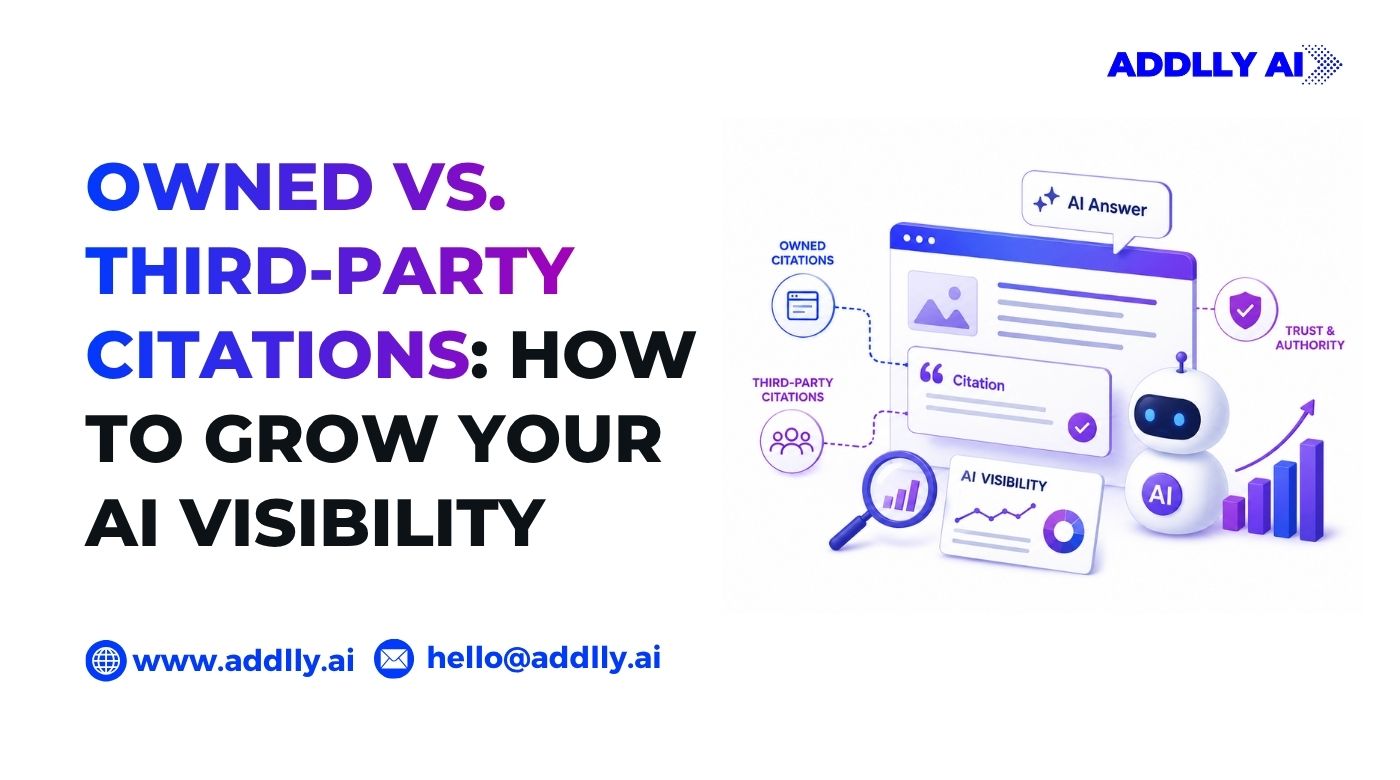
Owned vs third party citations play different roles in how brands build visibility across AI search. When ChatGPT, Gemini, Perplexity, or Google AI Overviews generate an answer, they can draw on a brand’s own website as well as reviews, industry publications, forums, and other sources across the web. That makes AI visibility broader than traditional SEO.
Owned citations give AI systems reliable information the brand controls, while third-party citations provide independent validation that can strengthen brand authority. Neither works as well in isolation. A strong AI visibility strategy connects both, ensuring that the information a brand publishes is reinforced by credible sources elsewhere on the web.
As AI-generated answers become a bigger part of discovery, owned vs third party citations becomes an important consideration for brands trying to increase their visibility in AI search.
Quick Summary – Owned vs. Third-Party Citations
- Owned citations establish foundational brand information, while third-party citations provide independent validation.
- AI visibility depends on contextual relevance, source credibility, unique information, and more than traditional search rankings.
- Strong AI search visibility requires both authoritative owned content and credible third-party references.
- Quality and contextual relevance matter more than simply increasing the number of citations.
- Brands should continuously audit, identify, create, earn, measure, and improve their AI citation visibility.
Owned vs. Third-Party Citations: How to Grow Your AI Visibility
Owned vs third party citations play different roles in how a brand appears across AI search. Owned citations come from properties you control, while third-party citations come from independent sources that discuss or reference your brand.
The important part is that AI systems can use both. Your own content establishes the facts about your brand, while external sources provide context and validation. Together, they give AI engines a broader picture of who you are, what you offer, and how your brand is perceived.
What Are Owned Citations?
Owned citations are references to information published on properties your brand controls, such as your website, product pages, research, documentation, and social profiles.
They are particularly useful for information such as:
- Product features and specifications
- Pricing and service information
- Original research and proprietary data
- Company expertise and official viewpoints
- FAQs and technical documentation
This makes owned content the foundational layer of AI visibility. It gives AI models a direct, authoritative source when they need information about your brand.
Clear structure also matters here. Structured data and schema markup can help search engines interpret the information and entities represented on your pages.
What Are Third-Party Citations?
Third-party citations come from sources your brand does not control. Think industry publications, review sites, news media, partner websites, forums, and independent research. Their biggest contribution is validation.
A brand can say it is an expert in a particular category. An independent publication, customer review, or industry source making the same association provides a different kind of signal.
This is particularly relevant when AI systems generate:
- Product recommendations
- Comparisons
- “Best” lists
- Brand evaluations
- Category overviews
Why Do AI Systems Need Both?
Neither citation type tells the complete story.
| Owned citations | Third-party citations |
|---|---|
| Establish brand facts | Provide independent validation |
| High level of control | Little or no control |
| Strong for direct-brand queries | Useful for broader discovery |
| Product and service information | Reviews and recommendations |
| Original research | Industry coverage |
The strongest AI visibility strategy connects the two. Your owned content gives AI systems something authoritative to retrieve, while credible third-party sources reinforce that information across the wider web.
That is also where Generative Engine Optimization goes beyond traditional SEO. The goal is not simply to rank a page, but to build the signals that help your brand appear accurately and credibly in AI-generated answers.
Owned Citations as Foundational Facts
Think of owned citations as the source of truth you control. If you launch a product, your website should clearly explain what it does, who it is for, and how it works. If you publish original research, the findings should be accessible in a format AI systems can understand and retrieve.
The goal isn’t to publish more content for its own sake. It is to create authoritative content with useful information, clear context, and original insights.
Third-Party Citations as Independent Validation
Third-party citations strengthen what your owned content says by showing that the wider web recognizes it.
A relevant industry publication, trusted review site, or respected expert can reinforce your brand’s authority in ways your own website cannot achieve alone.
The focus should therefore be on quality and contextual relevance, not citation volume. One highly relevant source can be more valuable than dozens of unrelated mentions.
In simple terms: Owned citations tell AI systems what your brand says about itself. Third-party citations help show what the wider web says about your brand.
What Are Owned Citations in AI Search?
Owned citations are references to information published on properties your brand controls, primarily your official website and product pages. They give AI systems a direct source for facts such as what your company offers, how a product works, its specifications, pricing, and areas of expertise.
They can also come from original research and authoritative content. Unique data, research findings, expert insights, and detailed resources give AI models information they may not find elsewhere. This makes owned content especially valuable when an AI-generated answer needs a specific, factual source rather than a general summary.
The technical foundation matters too. Structured content, schema markup, and technical SEO can make important information easier for AI systems to interpret and retrieve. Clear site structure, accessible content, and machine-readable information help establish your website as a reliable source when AI models are looking for information about your brand.
Further Reading: How to Audit Your Website AI Search Visibility: A Step-by-Step Guide
What Are Third-Party Citations?
Third-party citations are references to your brand from independent sources you do not control. Unlike owned citations, they add an outside perspective that can help AI systems understand your brand’s authority, relevance, and reputation.
1. Industry Publications and News Media
Industry publications and news media can strengthen brand authority by associating your company with a particular category, expertise, or topic. A relevant mention in a trusted publication can give AI models additional context when they evaluate which sources to include in an answer.
2. Review Sites and Customer Reviews
Review sites provide another layer of independent evidence. Customer experiences, ratings, and product reviews can influence how AI systems understand brand perception, particularly for queries involving recommendations, comparisons, and purchasing decisions.
3. Digital PR and Earned Media
Digital PR and earned media help brands build references beyond their own websites. Original research, expert commentary, proprietary data, and newsworthy insights give journalists and industry publications something substantive to reference.
This broader presence matters because AI search engines consider signals beyond traditional rankings when deciding which brands to surface.
4. Community Discussions and Independent Websites
Forums, communities, blogs, and other independent websites can add another layer of contextual relevance. These conversations can reveal how people actually discuss a brand, especially around experiences, comparisons, questions, and recommendations.
The important point is that not every third-party mention carries the same weight. A relevant discussion on a trusted industry website can be far more useful than a large number of unrelated mentions.
Why Brands Have Zero Direct Control Over Third-Party Citations
This is what fundamentally separates third-party citations from owned ones: you cannot control what an independent source says about your brand.
You can influence the information available about your company, build relationships with publishers, respond to reviews, and create research worth referencing. But you cannot dictate how a journalist, customer, reviewer, or community describes you.
That lack of control is also what makes these citations valuable. They give AI models evidence beyond the narrative your brand publishes about itself. AI search therefore looks at the broader web to build context around entities, authority, and relevance.
Owned vs. Third-Party Citations: What’s the Difference?
The key difference comes down to control and validation. Owned citations give AI platforms information directly from sources your brand manages, while third-party citations provide independent context. Both can influence AI search visibility, but they play different roles in how AI systems build an understanding of your brand.
| Owned Citations | Third-Party Citations |
|---|---|
| Controlled by the brand | Controlled by external sources |
| Establish foundational facts | Provide independent validation |
| Strong for direct-brand queries | Strong for broader discovery queries |
| Pricing, specifications, product information | Reviews, comparisons, recommendations |
| Official website and product pages | Industry publications and review sites |
| Original research and brand content | News media and community discussions |
The distinction becomes particularly important because AI search engines decide which sources to use based on the context of a query. A person looking for your pricing or product specifications may need an authoritative owned source, while someone asking for recommendations may receive AI-generated recommendations based on reviews, publications, and other independent sources.
This is why visibility in AI search cannot be measured through traditional search rankings alone. AI assistants and answer engines can synthesize information from multiple sources before producing an AI-generated response, meaning a brand may appear in AI answers even when its own website is not the cited source.
Identifying gaps across both sides is therefore an important part of an AI visibility strategy. A brand might have strong owned content but weak external validation, or plenty of brand mentions without enough authoritative information on its own website.
In simple terms, owned citations establish what your brand says about itself, while third-party citations help establish what the wider web says about your brand. Together, they can strengthen brand visibility across AI search results, AI responses, and AI-powered search experiences.
Why Third-Party Citations Matter More in AI Search
AI engines evaluate more than whether a page matches a keyword. They consider the context, credibility, and information surrounding a brand when selecting sources for AI-generated answers. This makes third-party references valuable because they give AI systems evidence beyond what a company says about itself.
Consensus also matters. When multiple independent sources discuss a brand in a similar context, those brand mentions can reinforce the associations that large language models and other AI systems build around the brand.
A single mention may provide context, but repeated references from credible sources can strengthen brand authority and contextual relevance.
This becomes especially important for AI-generated recommendations. When someone asks an AI assistant to compare products, identify leading companies, or recommend a solution, independent reviews, industry publications, and expert discussions can provide signals that owned content alone cannot.
This also makes tracking missing brand mentions in AI answers useful when assessing where your current AI visibility is falling short.
That is why backlinks alone do not explain AI citation visibility. A link can contribute to traditional search visibility, but AI platforms can also use sources because of their topical relevance, credibility, original information, and role in the broader conversation.
Brands looking to improve their presence therefore need to consider the wider ecosystem of content and mentions, not just their backlink profile.
How AI Search Engines Decide Which Sources to Cite
When an AI search engine generates an answer, it does not simply choose the pages that rank highest on a traditional search engine results page. It evaluates whether a source helps answer the specific question, how much useful context it provides, and whether the information appears credible and distinctive enough to include in the response.
Several signals can influence which sources AI systems retrieve and cite:
- Semantic meaning and contextual relevance: AI models look beyond exact keywords to understand the relationship between the query, the content, and the broader topic.
- Unique information and original insights: Original research, proprietary data, expert analysis, and information that adds something genuinely useful can make a source more valuable.
- Brand authority and source credibility: Established expertise, trustworthy references, and consistent information can strengthen a source’s credibility.
- Structured data and content clarity: Well-organized content and structured data make it easier for AI systems to understand what a page contains and which facts are important.
- Retrieval augmented generation (RAG): AI systems can retrieve relevant information from external sources and use it to construct an answer rather than relying only on information contained within the model.
- Training data and large language models: Information encountered through training and information retrieved at query time can both contribute to how an AI model understands entities, topics, and relationships.
This helps explain why AI citations do not always follow traditional search rankings. A page can rank highly in Google search but provide little unique context for an AI-generated response, while a less prominent page may contain precisely the information an AI system needs.
For a Comprehensive Reading: How AI Search Engines Decide Which Brands Get Seen?
Why Your Google Rankings Don’t Guarantee AI Visibility
A strong position in Google Search is still valuable, but it does not automatically translate into visibility across AI search. The relationship between traditional search and AI search is much less direct than many marketers assume.
The ranking gap
Research around AI citations highlights a significant disconnect:
| Traditional Search | AI Search |
|---|---|
| Rankings are heavily tied to search relevance and authority signals | Sources are selected based on relevance, context, credibility, and usefulness |
| Top-ranking pages have a stronger chance of receiving clicks | A cited source may come from far lower in traditional search results |
| Visibility is measured through rankings and organic traffic | Visibility includes citations, mentions, and inclusion in AI answers |
| Backlinks remain an important SEO signal | Unique information and contextual relevance can carry significant weight |
In fact, only 12% of URLs cited by AI appear in Google’s top 10, while approximately 80% of LLM citations don’t rank within Google’s top 100 results. These figures illustrate why AI citation visibility cannot simply be treated as another version of traditional SEO.
What changes with Google AI Overviews?
Google itself is also moving beyond the traditional results page through AI Overviews and other AI-powered search features. Instead of presenting users with a list of links first, these experiences can synthesize information from multiple sources into an AI-generated summary.
That changes the optimization question from “How do I rank?” to “How do I become a source AI systems consider useful enough to cite?”
What this means for SEO
Traditional SEO still provides an important technical and content foundation. But brands pursuing AI visibility need to expand their strategy beyond rankings.
Think of it as an evolution:
Traditional SEO → Search visibility → AI search visibility → Citation visibility
The goal is no longer to abandon SEO. It is to build on it with authoritative content, original information, structured content, and the third-party signals that help AI systems understand and trust a brand.
How to Build an AI Visibility Strategy With Owned Citations
Owned citations give your brand a foundation that AI systems can reliably reference. But simply having a website is not enough. The information needs to be authoritative, distinctive, easy to interpret, and useful for the questions people are asking AI platforms.
Create Authoritative, Answer-Focused Content
Create content that gives a clear answer instead of making readers or AI systems extract one from a long explanation. Address the questions your audience actually asks, provide useful context, and support important claims with evidence.
A strong GEO strategy from scratch brings these content principles together with the technical and structural foundations needed for AI search visibility.
Publish Original Research and Unique Data
AI systems have more reason to cite information that adds something genuinely new. Original research, proprietary data, surveys, expert analysis, and first-hand insights can give your content a stronger citation opportunity.
Instead of creating another article that repeats what already exists, ask what information your brand can provide that AI systems are unlikely to find elsewhere.
Strengthen Product and Service Pages
Your product and service pages should clearly communicate the information an AI system may need for a direct-brand query.
Make important details easy to find:
- What the product or service does
- Who it is designed for
- Key features and specifications
- Pricing or relevant commercial information
- Use cases and differentiators
- Supporting evidence and expertise
These pages can become foundational sources when AI platforms need accurate information directly from your brand.
Use Structured Data and Schema Markup
Structured data helps search engines interpret entities, relationships, and important information on a page. Schema markup can strengthen the technical foundation of your AI visibility strategy.
It should support clear, well-organized content rather than replace it. The information in your markup should accurately reflect what users can actually find on the page.
Build Clear Entity and Brand Signals
AI systems need to understand what your brand is, what it offers, and how it relates to the topics and entities around it. Keep your company name, descriptions, products, services, expertise, and other important information consistent across your owned properties.
A consistent entity footprint can make it easier for AI models to connect information about your brand across different sources.
Optimize Content for AI-Generated Answers
Finally, structure content around the way people increasingly consume information through AI-generated responses. Lead with the answer, use descriptive headings, keep important facts close to the relevant context, and avoid burying useful information beneath unnecessary filler.
The goal is simple: make it easy for AI systems to understand what you know, why the information is credible, and when it is relevant to a user’s question.
Content structure also matters when information needs to be extracted and understood by AI systems, particularly as AI-generated answers increasingly rely on clearly organized, context-rich content.
How to Earn Third-Party Citations for Your Brand
Third-party citations have to be earned. The goal is not to generate as many brand mentions as possible, but to create credible reasons for independent sources to reference your brand. This can strengthen AI brand visibility by giving AI platforms more external evidence about your expertise, relevance, and authority.
A practical approach includes:
- Build relationships with industry publications: Share expert insights, original data, and useful commentary that publications can reference in their content and AI systems can recognize as authoritative content.
- Use digital PR and earned media: Turn original research, proprietary data, and expert opinions into stories that can generate relevant citations and brand mentions across news media.
- Generate independent reviews: Customer reviews provide contextual signals around products and services and can contribute to AI-generated recommendations and broader brand perception.
- Create research worth citing: Original research, surveys, benchmarks, and unique datasets give AI engines information that may not exist across traditional search results.
- Build community presence: Participate in relevant discussions where your expertise can add genuine value. Community conversations can contribute to the broader context AI models use when generating AI answers.
- Strengthen brand mentions across authoritative sources: Seek references from sources that are relevant to your category, because contextual relevance can matter more than simply increasing citation volume.
- Focus on quality and contextual relevance over quantity: Only a handful of highly relevant, credible sources may contribute more to citation visibility than a large number of unrelated mentions.
The broader principle is simple: create content worth citing, build relationships that make those citations possible, and ensure those external references reinforce the information available through your owned content.
How to Balance Owned and Third-Party Citations
Owned citations should establish the information your brand wants AI systems to rely on. Your website can provide the facts, product details, expertise, and original research that form the foundation of your AI presence. Third-party citations then add another layer by showing how independent sources describe, evaluate, and reference your brand.
The balance depends heavily on search intent. For a direct-brand query such as “What does Brand X offer?”, an official page is usually the most useful source. For broader questions such as “Which brands are best for X?”, AI systems have more reason to consider reviews, comparisons, industry publications, and other independent sources.
This is why AI search visibility needs to be treated as an ecosystem rather than a ranking metric. Your owned content, brand mentions, third-party references, and citations should reinforce the same core associations across AI platforms. A broader AI visibility strategy can help connect these signals instead of treating each source in isolation.
Ultimately, the goal is to create an interconnected citation ecosystem. Your owned content establishes the facts, while credible external sources strengthen those facts through independent validation. When both sides consistently support the same brand narrative, AI systems have more context to work with when generating answers, summaries, and recommendations.
How to Find Gaps in Your AI Citation Visibility
Start by tracking how often your brand receives mentions and citations across different AI platforms. Looking at the actual AI responses can reveal whether your brand is being cited, merely mentioned, or left out entirely for important queries.
Next, identify which sources AI engines already trust. Comparing those cited sources with your own content can show where competitors have stronger citation visibility and which third-party publications, review sites, or industry sources you may be missing.
A useful AI search visibility checker can make this analysis more systematic by tracking brand visibility across AI-generated answers rather than relying on occasional manual searches.
You can then compare your citation profile with competitors and look for patterns. If the same independent sources repeatedly appear in AI answers for your category while your brand is absent, those sources represent potential gaps in your visibility strategy. A broader GEO audit can help uncover these content and visibility gaps before they translate into declining referral traffic or conversions.
The AI Visibility Strategy: A Practical Framework
A practical citation strategy can be reduced to six connected stages: Audit → Identify → Create → Earn → Measure → Improve. Each stage builds on the previous one, so the goal is not to treat citations as a one-time SEO activity but as an ongoing part of your AI visibility strategy.
Audit: Start by understanding your current AI search visibility. Check where your brand appears, which AI platforms cite it, and which queries produce mentions or citations.
Identify: Find the gaps between your owned content and the sources AI engines already trust. Look for missing third-party citations, weak brand mentions, and topics where competitors have stronger visibility.
Create: Build authoritative, answer-focused content that gives AI systems useful information to retrieve. Original research, unique data, clear product information, and structured content can strengthen your owned citation foundation.
Earn: Build independent validation through industry publications, reviews, news media, research citations, and relevant community discussions. The focus should be on credible sources with genuine contextual relevance.
Measure: Track AI responses, citations, mentions, cited sources, and changes in visibility across relevant AI platforms. This gives you a clearer picture of whether your content strategy is actually improving AI visibility.
Improve: Use what you learn to refine both sides of the citation ecosystem. Strengthen weak owned content, pursue missing third-party sources, update outdated information, and continuously adapt your strategy as AI.
Final Thoughts
AI visibility is no longer just about ranking your website. Brands need a stronger citation ecosystem where owned content establishes accurate information and third-party sources reinforce it with independent validation.
The goal is not to chase every mention, but to build credible, contextually relevant signals that AI systems can use when generating answers and recommendations.
This is where Addlly AIcan help. Its AI search visibility and GEO capabilities help brands identify where they appear in AI answers, understand which sources and competitors are being cited, uncover visibility gaps, and turn those insights into actionable recommendations.
By continuously auditing, creating, earning, measuring, and improving, brands can build a more resilient AI visibility strategy that keeps pace with how people discover information through AI search.
FAQs – Owned vs. Third-Party Citations
1. What Are Owned Citations in AI Search?
Owned citations are references to information published on properties a brand controls, such as its official website, product pages, documentation, and original research. They provide AI systems with foundational information about the brand.
2. What Are Third-Party Citations?
Third-party citations come from independent sources a brand does not control, including industry publications, review sites, news media, forums, and other websites. They provide external validation and contextual relevance.
3. Are Third-Party Citations More Important Than Owned Citations?
Neither is inherently more important. Owned citations establish reliable brand information, while third-party citations provide independent validation. A strong AI visibility strategy needs both.
4. Do Google Rankings Guarantee AI Search Visibility?
No. AI systems do not select sources solely based on traditional search rankings. They can consider contextual relevance, unique information, source credibility, and other signals when generating AI answers.
5. How Can Brands Increase Their AI Citation Visibility?
Brands can improve citation visibility by creating authoritative content, publishing original research, strengthening product pages, earning relevant third-party mentions, monitoring AI responses, and continuously addressing citation gaps.

