
How Does Addlly AI Identify GEO Content Gaps across Websites?
A GEO content gap is a missing or weak area in your site’s content that can limit how well your brand appears in AI-driven discovery. In many cases, the issue is not that a page does not exist at all. It is that the page lacks sufficient depth, support, structure, or clarity to help AI systems understand and surface it confidently.
Addlly AI helps identify these gaps by looking beyond basic keyword coverage alone. It can help teams understand where important topics are underdeveloped, where supporting content is missing, and where existing pages may need to be expanded, rewritten, or better connected. This gives brands a clearer view of what is holding back AI visibility across the site and what to improve first.
What Does a GEO Content Gap Include?
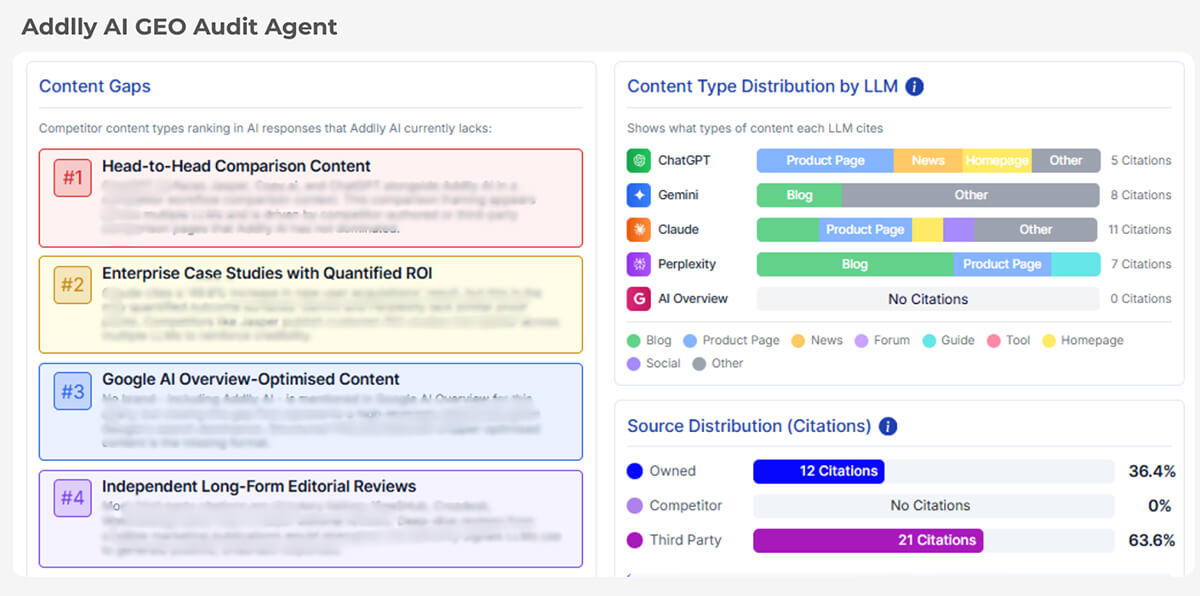
A GEO content gap is not limited to one type of issue. In practice, it can appear in several ways, depending on how your site is structured and how well your content supports key topics.
Common GEO content gaps include:
- Missing topic coverage: important themes, entities, or use cases are not covered at all
- Weak supporting content: a core page exists, but there are not enough related pages or blogs to strengthen it
- Outdated pages: older content no longer reflects current search behavior or AI-driven query patterns
- Unclear structure: content exists, but it is not organized clearly enough for strong interpretation
- Inconsistent language: product, category, or brand terminology varies too much across the site
- Thin topic depth: pages mention a subject, but do not cover it in enough detail to build authority
Understanding these patterns makes it easier to see why a site may still have weak AI visibility even with a significant amount of content.
How Addlly AI Identifies Geo Content Gaps?
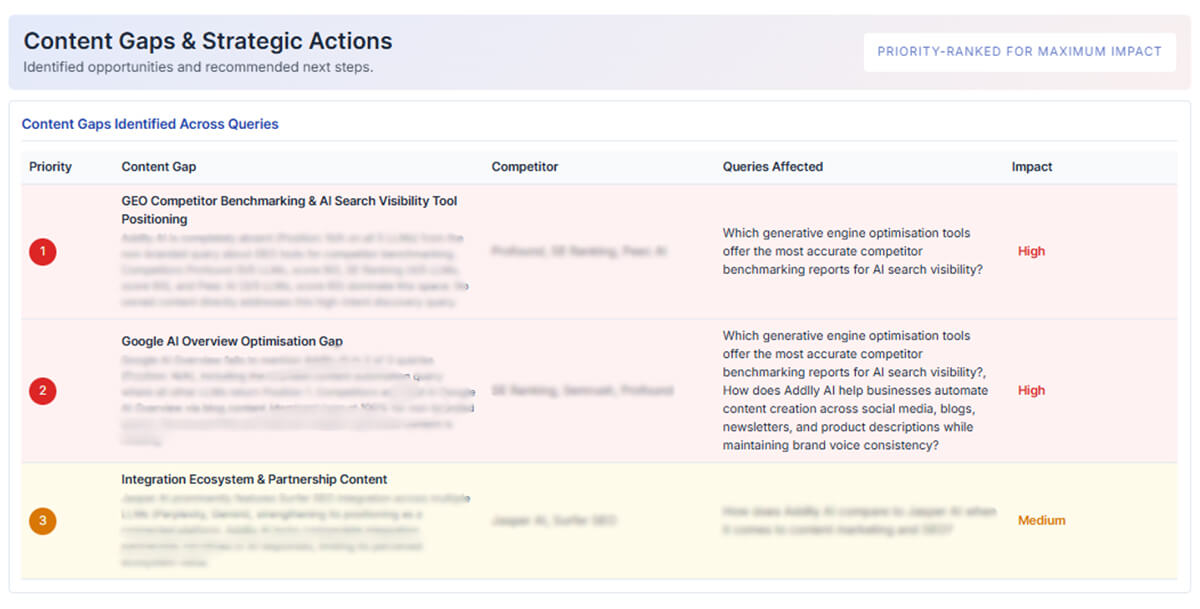
Addlly AI identifies GEO content gaps by reviewing how well your existing site content supports AI-driven discovery across important topics, pages, and content relationships. Instead of looking only for missing keywords, it helps surface where coverage is incomplete, where supporting content is missing, and where existing pages may not be strong enough to support AI visibility on their own.
1. Reviews Existing Site Content
The first step is understanding what content already exists across the site. Addlly AI helps assess whether important topics are supported by enough relevant pages, whether key pages are isolated, and whether content coverage is too shallow, too fragmented, or missing altogether.
This is important because many sites have a structural problem. The topic may appear in several places, but not in a way that builds clear authority.
2. Analyzes Visibility across AI-Driven Discovery
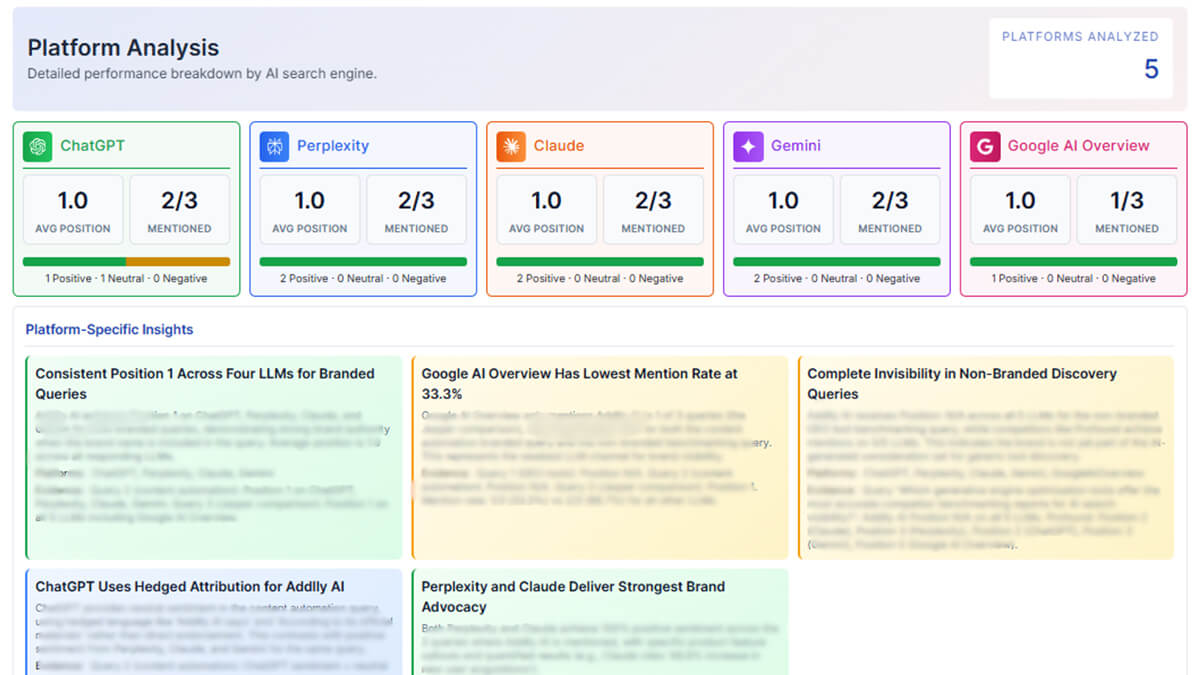
Addlly AI also helps teams understand where a site may be underperforming in AI-driven discovery environments. This means looking at how clearly the brand’s content supports the types of topics, questions, and entities that matter for AI visibility.
When content is too thin, too broad, or poorly connected, AI systems may lack sufficient confidence to surface it prominently. Addlly AI helps identify these weaker areas so teams can see where visibility gaps exist even when pages are already live.
3. Looks for Missing Topical and Supporting Content
A common GEO issue is that a site has one important page, but not enough surrounding content to support it. Addlly AI helps identify where those supporting gaps exist.
This can include:
- missing blogs around an important category or use case
- weak subtopic coverage around a core product or service page
- missing content that answers related audience questions
- gaps between a central page and the supporting content needed to strengthen it
This is often where GEO content strategy becomes more effective, because the solution is not always a better version of one page. Sometimes, it is a stronger supporting content structure around that page.
4. Flags Pages That Need Improvement
Not every gap requires a brand-new page. In many cases, the issue is that an existing page is not strong enough in its current form.
Addlly AI can help identify pages that may need:
- clearer structure
- better topic alignment
- expanded explanations
- stronger supporting sections
- updated phrasing or positioning
This helps teams separate pages that should be improved from pages that are already working well enough.
5. Connects Findings to Content Opportunities
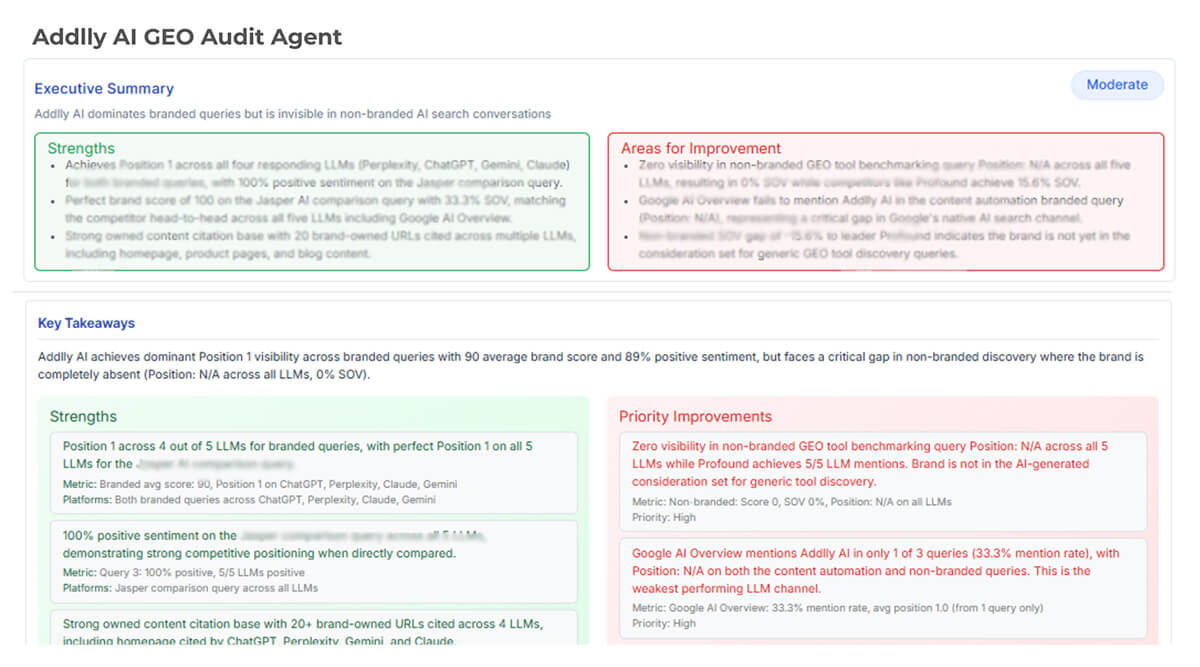
Once gaps are identified, Addlly AI helps translate them into action. That may mean creating new supporting content, expanding a weak page, rewriting outdated content, or improving the way related pages connect to each other.
This makes the output more useful because the goal is not only to detect weaknesses. It is to show where those weaknesses can become content opportunities that improve AI visibility over time.
What Teams Can Do after Content Gaps Are Identified?
Once GEO content gaps are clear, teams can use that information to decide which update will have the greatest value.
Common next steps include:
- Rewriting weak pages: improve existing pages that are underdeveloped or unclear
- Building supporting blog clusters: create related content that strengthens a high-priority topic
- Expanding key product or category pages: add depth where important commercial pages are too thin
- Improving answer structure and topic clarity: make content easier to interpret and summarize
- Connecting GEO findings to publishing priorities: use identified gaps to guide what content gets created next
This makes it easier to turn content gap analysis into a repeatable GEO workflow rather than a one-time review.
Common GEO Content Gap Patterns across Websites
GEO content gaps often follow a few repeatable patterns. Identifying these patterns can help teams understand whether the issue is missing content, weak structure, or poor support around an otherwise important page.
Strong Core Page, Weak Supporting Content
A site may have one main page for an important topic, product, or use case, but very little surrounding content to reinforce it. In this case, the page exists but lacks sufficient related coverage to build stronger topical authority.
Too Many Overlapping Pages, but No Clear Authority Page
Some sites publish multiple pages that touch on the same subject without clearly establishing which page should lead the topic. This can create fragmented coverage where no single page is strong enough to act as the main source for that theme.
Outdated Blog Library with Thin Topic Coverage
Older blog content may still exist on the site, but much of it may be too short, too broad, or no longer aligned with the way users search or ask questions today. This creates gaps even when the total content volume looks strong on paper.
Technical or Product Pages That Are Hard to Interpret
A page may contain useful information, but if the structure is unclear, the language is too dense, or the topic is not explained in a user-friendly way, AI systems may have difficulty surfacing it well.
Missing Content for High-Value Use Cases or Audience Questions
Sometimes the biggest GEO gap is not in the main page itself, but in the missing questions, examples, or scenarios around it. If a site does not address important use cases clearly, it may miss visibility opportunities even when the main offering is already covered.
Best Practices for Acting on GEO Content Gaps
- Start with high-impact pages: Focus first on the pages and topics most closely tied to visibility goals or business value.
- Prioritize business-critical topics: Product, service, and category pages often deserve attention before lower-priority informational content.
- Improve existing content before starting from scratch: In many cases, expanding or restructuring a page is more effective than replacing it.
- Build content clusters: Strong GEO coverage usually comes from connected topic ecosystems, not isolated pages.
- Review gaps regularly: AI-driven discovery changes over time, so it helps to revisit content gaps as your site and priorities evolve.

FAQs
What Is a GEO Content Gap?
A GEO content gap is a missing or weak area in your site’s content that can limit AI visibility. This may include missing topic coverage, weak supporting content, outdated pages, or content that is not structured clearly enough for AI-driven discovery.
How Is a GEO Content Gap Different From an SEO Content Gap?
An SEO content gap often focuses on keyword opportunity or ranking coverage. A GEO content gap is broader and can include topic depth, answer clarity, supporting content, entity coverage, and how well a page supports AI-driven interpretation and discovery.
Does Addlly AI Identify Gaps Across the Whole Site or Page by Page?
It can help teams understand gaps across the broader site structure and within specific pages. This makes it easier to see whether the issue is a weak page, a missing supporting page, or a larger topic coverage problem.
What Happens After a GEO Content Gap Is Identified?
Once a gap is clear, teams can decide whether to rewrite an existing page, expand it, create supporting blogs, or build new content around that topic. The goal is to turn the identified weakness into a clearer content improvement plan.
Do Content Gaps Always Require New Pages?
No. Some gaps are best addressed by improving or expanding an existing page. New pages are useful when the current site structure does not cover an important topic, subtopic, or audience question.
How Often Should Teams Review GEO Content Gaps?
It is useful to review them regularly, especially after major content updates, product changes, or shifts in visibility goals. GEO is not static, so content gap analysis works best as an ongoing process.
Can GEO Gap Analysis Support Both Product Pages and Blog Content?
Yes. GEO content gaps can occur across product, service, and category pages, as well as in blog content. In most cases, strong AI visibility depends on how well these content types support each other across the site.