
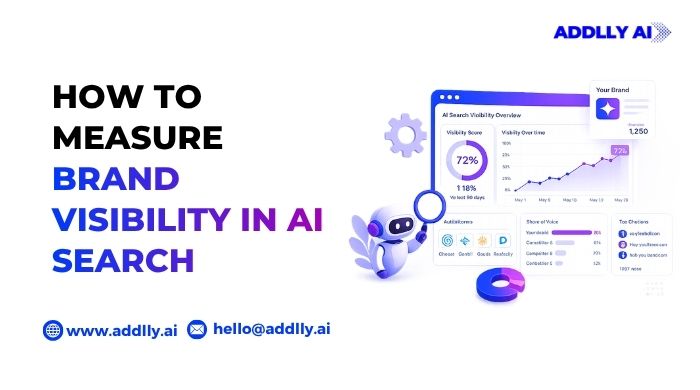
AI search has changed what “visibility” actually means.
You can rank on Google and still not appear in AI-generated answers. Tools like ChatGPT and Perplexity don’t list results the same way. They select, summarize, and recommend brands based on relevance, context, and citation patterns. This shift reflects the move from search engines to answer engines, where visibility is no longer about rankings but about being included in the answer itself.
This creates a new challenge. Traditional metrics like rankings, impressions, and traffic don’t fully capture AI search visibility. They don’t tell you whether your brand is being mentioned, cited, or recommended, especially when AI search engines decide which brands get seen based on signals most teams aren’t measuring yet.
So, how do you actually measure brand visibility in AI search?
In this guide, we break down the key metrics, tracking methods, and practical frameworks you need to understand your presence across AI systems, and how to turn that visibility into measurable growth.
Quick Summary: How To Measure Brand Visibility in AI Search
- AI search visibility is measured by brand mentions, citations, and presence in AI-generated answers.
- Traditional SEO metrics are not enough to track visibility across AI search platforms.
- Consistent prompt tracking is essential to understanding AI search performance.
- AI models prioritize relevance, authority, and structured content when selecting brands.
- Tools like Addlly AI help track, benchmark, and improve brand visibility in AI search.
What Does It Mean When AI Cites a Page?
What Is Brand Visibility in AI Search and How Is It Different from SEO?
Brand visibility in AI search is not about rankings. It is about whether your brand appears inside AI-generated answers when users search, compare, or ask for recommendations.
In traditional SEO, visibility is tied to keyword rankings, impressions, and clicks. You optimize for search engines, track positions, and measure traffic.
AI search changes that dynamic.
When a user enters a query, AI systems generate answers by analyzing content, identifying entities, and selecting which brands to mention or cite. There is no fixed ranking system. No guaranteed placement. Your brand is either included in the response or it is not.
This is where the gap begins.
Strong SEO performance does not automatically translate into AI search visibility. Even high-ranking pages may not be referenced if they are not structured for answer engines. The shift toward answer-focused optimization, often discussed under SEO vs AEO vs GEO, reflects how discovery is moving from search results to generated responses.
So what does visibility actually look like in AI search?
It typically shows up in three ways:
- Brand mentions: your brand is referenced in the answer
- Citations: your content is used as a source for the response
- Recommendations: your brand is suggested as a solution or option
These signals are not equal.
Mentions indicate presence. Citations reflect trust. Recommendations signal influence within the answer itself. Together, they define how visible your brand is across AI systems.
This also changes how we think about discoverability. Visibility is no longer about appearing in a list of links. It is about being selected, interpreted, and surfaced within the answer, which is central to AI search visibility.
Once you look at visibility through this lens, the real challenge becomes clear.
How do you measure brand mentions, citations, and share of voice when there are no rankings to track?
How Do You Measure Brand Visibility in AI Search Step by Step?
Measuring brand visibility in AI search is less about tools and more about discipline. You are trying to understand how often your brand appears across AI-generated answers, how it compares across AI platforms, and how that visibility changes over time. Without a structured approach, the data stays scattered and difficult to act on.
1. Build a Prompt Set That Reflects Real Search Behavior
Everything begins with how users ask questions. AI search is driven by conversational queries, not just keywords. If your prompts don’t reflect real user intent, your visibility in AI search will always look incomplete.
- Create a mix of informational, commercial, and comparison queries
- Include variations to capture different ways users phrase the same question
- Align prompts with actual AI conversations, not just search terms
- Keep expanding the list as new query patterns emerge
2. Test the Same Queries Across Multiple AI Platforms
AI search results are not consistent across platforms.
The same query can generate completely different AI-generated answers depending on the model. If you only test one platform, you only see part of the picture.
- Run identical queries across major AI search engines
- Compare how your brand appears across different AI responses
- Identify platforms where your brand is consistently visible
- Spot gaps where competitors appear but you do not
3. Turn AI Responses Into Structured Data
Raw AI responses are useful to read, but not to measure.
To track AI search visibility properly, you need to convert those responses into something you can analyze over time.
- Capture AI-generated answers for each query
- Extract brand mentions, AI citations, and recommendations
- Tag competitor domains appearing in the same responses
- Store everything in a consistent format for comparison
4. Analyze What the Data Is Actually Telling You
Once the data is structured, patterns start to appear.
This is where you move from observation to measurable insight and begin understanding your brand’s presence in AI search.
- Measure how often your brand appears across AI-generated answers
- Compare share of voice against competitors
- Identify visibility gaps across different query types
- Track positioning and sentiment within AI responses
5. Benchmark Your Visibility Against Competitors
Visibility in AI search is always relative.
It is not enough to know that your brand appears. You need to understand how often it appears compared to others in the same space.
- Identify competitor domains showing up in your query set
- Compare frequency of mentions and AI citations
- Analyze which brands dominate key AI search results
- Track how your position changes over time
6. Track Trends and Keep Refining Your Approach
AI search is constantly evolving, which means your measurement system cannot stay static.
What works today may shift as AI models update and new content enters the ecosystem.
- Monitor trends in brand mentions and AI visibility over time
- Track improvements in share of voice and positioning
- Identify new gaps as AI-generated results evolve
- Adjust your content strategy based on visibility data
Why Is Measuring Brand Visibility in AI Search So Difficult?
Measuring brand visibility in AI search sounds straightforward until you try to do it. The challenge is not just a lack of data. It is a lack of structure. Unlike traditional search engines, AI search platforms generate answers dynamically, which makes tracking AI search visibility far more complex and inconsistent.
1. There is no universal metric that defines AI search visibility.
In SEO, you track keyword rankings, impressions, and organic traffic. In AI search, you are dealing with brand mentions, AI citations, recommendations, and share of voice across AI-generated answers. These signals are fragmented and do not combine into a single measurable KPI.
This shift becomes clearer when you look at how visibility is evolving in generative engine optimization, where inclusion in AI answers matters more than ranking positions.
2. AI-generated answers are dynamic and context-dependent.
The same search query can produce different responses across platforms like ChatGPT or Perplexity, depending on prompt phrasing, user intent, and model updates. A brand may appear in one AI response but not in another.
This variability makes it difficult to measure brand visibility consistently, especially when inclusion depends on factors outlined in AI search ranking factors such as content relevance, entity recognition, and authority signals.
3. Attribution in AI search is still a black box.
While some AI systems provide citations, many AI-generated responses do not clearly reveal all the sources used. Your content may influence an answer without being directly credited as a source.
This makes it difficult to track AI citations, understand content influence, or measure why certain brands are mentioned while others are ignored.
4. Most analytics tools are built for website traffic, not AI-generated answers.
They measure sessions, clicks, and conversions, but they do not capture how often your brand appears in AI answers, how frequently it is recommended, or how it compares to competitors in AI search results. This gap becomes evident when exploring AI search monitoring tools, which are still developing and often lack depth in tracking AI visibility metrics like sentiment and positioning.
5. AI search visibility is highly dependent on prompt variations.
Unlike traditional keyword tracking, where you monitor a fixed set of keywords, AI search requires tracking multiple query formats, intents, and conversational variations. A slight change in phrasing can alter the entire response and the brands included.
This is why building a structured prompt set using conversational search queries for GEO content becomes essential for accurate measurement.
What Metrics Should You Track to Measure Brand Visibility in AI Search?
To measure brand visibility in AI search, you need to move beyond traditional SEO metrics like keyword rankings and organic search traffic. AI search platforms operate differently. They generate answers, not lists, which means visibility depends on how often your brand appears across AI-generated answers, AI responses, and AI search results.
Instead of a single visibility score, you are tracking a combination of signals across AI engines, including Google’s AI overviews, ChatGPT, and other major AI platforms. These metrics help you understand your brand’s presence in AI, identify visibility gaps, and benchmark performance against competitor domains.
1. Brand Mentions and AI Citations
Brand mentions are the foundation of AI visibility. They show whether your brand appears in AI-generated responses for relevant user queries.
AI citations add another layer. They indicate that your content is being used as a source by AI models, which strengthens your authority and increases your chances of appearing in future AI answers.
- Track how often your brand is mentioned across AI search platforms
- Monitor AI citations and citation quality in AI-generated answers
- Identify where your brand appears across major AI engines
- Compare frequency of mentions vs citations to evaluate trust
If you want to monitor AI brand mentions at scale, an AI visibility tool like the AI Search Visibility Checker helps track your brand’s presence across AI platforms and AI search results.
2. Share of Voice Across AI Search Platforms
Share of voice measures how visible your brand is compared to competitors across AI search engines and AI-generated results.
It helps you understand whether your brand performs strongly in AI conversations or if competitors dominate key queries.
- Calculate how often your brand appears across AI-generated answers
- Benchmark visibility against competitor domains in the same category
- Identify which brands are consistently recommended by AI assistants
- Track share of voice across different AI platforms like ChatGPT and Gemini
Using a GEO Audit Tool, you can uncover visibility gaps and understand why certain competitors receive more AI mentions across search platforms.
3. Positioning in AI-Generated Answers
Positioning measures where your brand appears within AI-generated answers and AI responses.
In AI search, placement matters. Brands mentioned early in AI answers are more likely to be noticed and trusted.
- Track whether your brand appears at the top, middle, or end of AI responses
- Identify inclusion in “top recommendations” within AI-generated results
- Analyze how often your brand is prioritized by AI models
- Monitor consistency of positioning across AI search platforms
Improving positioning often depends on how clearly your content is structured for AI engines, where tools like an AI schema markup generator can improve how your content is interpreted.
4. Sentiment and Brand Perception in AI Responses
AI visibility is not just about being visible. It is also about how your brand is perceived.
AI-generated answers often describe, compare, and evaluate brands. This directly impacts brand perception and trust.
- Analyze AI sentiment across mentions in AI-generated responses
- Track whether your brand is framed positively, neutrally, or negatively
- Compare sentiment against competitors in AI conversations
- Identify recurring narratives in how AI platforms talk about your brand
This metric helps you understand whether your brand is visible in the right way, not just how often it appears.
5. Sentiment and Brand Perception in AI Responses
AI visibility is not just about being visible. It is also about how your brand is perceived.
AI-generated answers often describe, compare, and evaluate brands. This directly impacts brand perception and trust.
- Analyze AI sentiment across mentions in AI-generated responses
- Track whether your brand is framed positively, neutrally, or negatively
- Compare sentiment against competitors in AI conversations
- Identify recurring narratives in how AI platforms talk about your brand
This metric helps you understand whether your brand is visible in the right way, not just how often it appears.
6. Prompt Coverage Across AI Queries
Prompt coverage measures how widely your brand appears across different user queries and AI conversations.
AI search is driven by natural language, which means visibility depends on how well your content aligns with real user queries.
- Track how many relevant queries include your brand
- Group queries by intent across informational and commercial searches
- Identify missing queries where competitors appear but your brand does not
- Expand coverage based on conversational search patterns
Scaling coverage requires consistent optimization across content marketing efforts, where tools like GEO AI Agent and SEO AI Agent can help align content with AI search behavior.
How Do AI Models Decide Which Brands to Mention or Cite?
Behind every AI-generated answer is a selection process.
AI models scan vast amounts of content, identify patterns, and decide which brands deserve to be included in a response. They are not ranking pages like traditional search engines. They are assembling answers, which is why visibility today is shaped by how AI search engines vs traditional search behave differently across platforms.
1. Relevance Comes Before Everything Else
If your content does not directly match the user query, nothing else matters.
AI models prioritize relevance at a very granular level. They look for content that clearly answers the query within the context of AI-generated responses.
Content that is optimized for AI answers, rather than just search rankings, tends to perform better. This becomes more evident when you look at how to optimize your content for AI answer engines, where alignment with query intent directly impacts visibility.
2. Your Brand Needs to Exist as a Recognizable Entity
AI systems rely heavily on entity recognition.
If your brand is not clearly associated with a topic or category, it becomes difficult for AI models to include it confidently in AI-generated answers.
This is where consistent entity signals matter. The way your brand is defined across the web directly influences visibility, something closely tied to what is an AI citation pattern and how AI systems repeatedly reference certain sources.
3. Authority Is Built Through Repeated Signals
AI models do not rely on a single source. They rely on patterns.
If your brand consistently appears across authoritative content, platforms, and discussions, it strengthens your chances of being included in AI responses.
This is also why certain platforms dominate AI search visibility. For example, the way why Reddit dominates AI search highlights how repeated mentions and community validation influence AI-generated results.
4. Structure Makes Content Easier for AI to Use
AI models extract and assemble information.
If your content is not structured clearly, it becomes harder for AI systems to interpret and reuse it in AI-generated answers.
Content that is organized, direct, and easy to parse performs better in AI search. This is especially relevant when applying best practices for GEO content creation, where structure directly impacts inclusion in AI responses.
5. Presence Across Multiple Sources Strengthens Visibility
AI visibility is rarely driven by a single page.
AI models look for consistency across multiple sources, platforms, and mentions. If your brand appears in different contexts, it reinforces its credibility.
This is why broader strategies like search everywhere optimization play a role in strengthening your presence across AI platforms and search environments.
6. Freshness and Ongoing Updates Still Matter
AI search is not static.
Even though AI models rely on training data, many platforms incorporate newer content signals. Updated and relevant content has a higher chance of influencing AI-generated answers.
Keeping content aligned with evolving trends and AI behavior is part of staying visible in modern search environments.
Final Words
Brand visibility in AI search is no longer defined by keyword rankings or traditional SEO metrics. It is measured by how often your brand appears in AI-generated answers, how it is cited, and how it performs across AI search platforms.
Tracking this manually is difficult to scale. That is where Addlly AI simplifies the process. With tools like the AI Search Visibility Checker and GEO Audit Tool, you can measure AI visibility, identify gaps, and improve your brand’s presence in AI responses. The GEO AI Agent further helps align your content with how AI engines select and recommend brands.
As search shifts toward AI-generated results, brands that measure and act on visibility data will stay ahead.
Because in AI search, visibility is not about ranking. It is about being included.
Frequently Asked Questions About How To Measure Brand Visibility in AI Search
What Is an AI Visibility Score and How Is It Calculated?
An AI visibility score measures how often your brand appears across AI-generated answers and AI results. It typically combines brand mentions, AI citations, share of voice, and positioning across platforms like ChatGPT and Gemini to reflect overall brand performance.
How Is AI Search Performance Different From Traditional SEO Performance?
AI search performance focuses on visibility in AI-generated responses, while traditional SEO tools track keyword rankings and Google search results. In AI search, success depends on inclusion in answers, not just ranking positions.
How Does Google’s AI Mode Impact Brand Visibility?
Google’s AI mode, including AI overviews, changes how brands appear in search by summarizing information into AI-generated answers. This reduces reliance on traditional listings and increases the importance of being included in AI results.
What Tools Can Help Track and Improve AI Visibility?
There are emerging AI tools designed specifically for this purpose, including AI visibility trackers, Perplexity visibility tracker, and solutions like PEEC AI. These tools help monitor mentions, benchmark visibility, and track progress over time.
How Can Marketers Track Progress in AI Search Visibility?
Most marketers use a combination of visibility data, share of voice metrics, and dashboards. Tools like Looker Studio dashboards, SE Ranking integrations, and custom reports help track progress and measure changes in brand visibility across AI platforms.
How Does Addlly AI Measure Brand Visibility in AI Search?
Addlly AI measures brand visibility using signals like brand mentions, AI citations, share of voice, and presence across AI-generated responses. This gives a clearer view of how your brand performs beyond traditional SEO metrics.

