
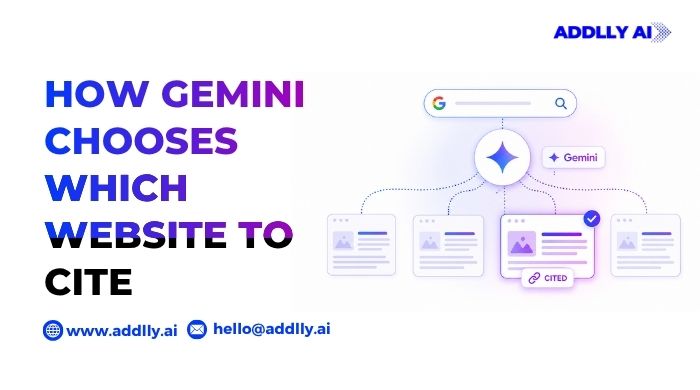
Most people assume that if a page ranks well on Google Search, Gemini will probably cite it too. In practice, that doesn’t always happen. Plenty of high-ranking pages never appear in Gemini responses, while others with lower visibility become the cited source.
How Gemini chooses which website to cite depends on a process that goes well beyond traditional SEO. It looks at the user’s query, searches across multiple sources, evaluates the quality of information, and decides which pages provide the most reliable answer for that specific prompt.
Once you understand how that process works, it becomes much easier to create content that earns AI citations instead of hoping they happen. If you’re already investing in Generative Engine Optimization (GEO), the 12-step breakdown below explains exactly how Gemini moves from a search query to a final citation.
Quick Summary – How Gemini Chooses Which Website to Cite
- Gemini citations are earned through relevance, credibility, and context—not Google rankings alone.
- Content that answers complete questions with evidence and clear structure is more likely to become an AI citation.
- AI search rewards websites that are regularly updated, well-organized, and easy for AI systems to interpret.
- Monitoring your AI visibility is just as important as optimizing it, because Gemini citations evolve over time.
How Gemini Chooses Which Website to Cite: A 12-Step Breakdown
Every Gemini response begins with a user’s query, but the path to a citation involves much more than finding the highest-ranking page in Google Search. Gemini combines information from Google Search results, evaluates multiple sources, extracts relevant information, and relies on its large language model to decide which website best supports a direct answer.
Although the exact process isn’t public, Google’s documentation and the current state of AI search reveal a consistent pattern. The 12 steps below explain how Gemini chooses which website to cite and why some pages appear in Gemini citations while others do not.
Step 1: Gemini Understands the User’s Intent Before Looking for Sources
Before Gemini looks at Google Search results or decides on a citation, it first tries to understand what the user is really asking. The large language model interprets the query, identifies its intent, and determines whether the user wants an explanation, a comparison, recommendations, or a direct answer. This helps Gemini avoid returning information that matches the words but misses the context.
That initial understanding influences every step that follows, from retrieving relevant pages to selecting cited sources. Websites that answer real user questions clearly and naturally tend to align better with Gemini’s interpretation of search intent. Building content around conversational search queries and keywords also makes it easier for AI systems to connect your page with the same queries users type into Gemini.
Key takeaways:
- Gemini identifies the user’s intent before retrieving information.
- The same keywords can produce different Gemini responses depending on the context.
- Search intent determines which Google Search results are evaluated.
- Pages that answer complete questions are more likely to earn AI citations.
Practical takeaway: Instead of writing for keywords alone, create content around the questions your audience is actually asking. Match the intent behind the query before trying to optimize for rankings.
Interesting Read: How to Get Your Brand Cited by Claude AI: 10 Proven Ways to Improve AI Visibility
Step 2: Query Fan-Out Expands the Search Beyond a Single Keyword
After understanding the user’s intent, Gemini doesn’t stop at a single Google Search. It expands the original query into several related searches, a process known as query fan-out. This allows the AI system to gather information from different perspectives, compare cited sources, and identify the pages that collectively provide the most complete and accurate answer.
For the same query, Gemini may retrieve pages discussing AI citations, Google AI Overviews, structured data, E-E-A-T, or content quality before generating its response. This broader evaluation explains why websites that cover topics from multiple angles often have a stronger chance of appearing in Gemini citations than pages focused on a single keyword.
Key takeaways:
- Query fan-out expands one search into multiple related queries.
- Gemini reviews multiple sources instead of relying on a single webpage.
- Different query variations help Gemini validate information before generating a response.
- Comprehensive pages are more likely to match a wider range of Gemini responses.
Practical takeaway: Build content around a complete topic rather than a single keyword. Cover related questions, supporting concepts, and different user intents to improve your chances of earning AI citations.
Step 3: Google Search Retrieves the Most Relevant Pages
Once the expanded queries are ready, Gemini turns to Google Search to retrieve relevant information. Instead of generating an answer entirely from its own training data, it looks at Google Search results to find pages that best match the user’s intent. These results become the pool of potential cited sources, although appearing in Google Search does not automatically guarantee a Gemini citation.
At this stage, traditional SEO still plays an important role. Factors such as content relevance, topical authority, crawlability, and overall page quality help determine whether a page is retrieved in the first place. This is one reason why traditional SEO still matters in AI search, even as AI models change how information is presented to users.
Key takeaways:
- Gemini uses Google Search to retrieve relevant pages for many queries.
- Retrieved pages become potential citation candidates, not guaranteed citations.
- Traditional SEO helps improve a page’s chances of entering the initial pool of sources.
- Strong relevance and content quality increase the likelihood of being considered.
Practical takeaway: Continue investing in SEO fundamentals such as topical relevance, technical health, and quality content. They remain essential for helping Gemini discover your website before it can evaluate it for citations.
Move to the next
Step 4: Gemini Checks Content Quality and E-E-A-T Signals
Finding a page through Google Search is only part of the process. Before using it as a cited source, Gemini evaluates whether the information is trustworthy, well-supported, and genuinely useful for the user’s query. While Google hasn’t confirmed every signal, content that demonstrates strong E-E-A-T, cites credible sources, and explains a topic with depth is consistently more likely to appear in Gemini responses.
This is also where weak or generic content begins to lose ground. Pages that repeat common information without evidence, examples, or original insights are less likely to become AI citations. On the other hand, content that reflects real expertise and supports its claims gives Gemini more confidence when generating a direct answer.
Key takeaways:
- Gemini evaluates content quality before selecting a citation.
- E-E-A-T helps establish credibility and trustworthiness.
- Credible sources and well-supported claims strengthen a page’s value.
- Original insights and accurate information improve the chances of being cited.
Practical takeaway: Go beyond surface-level writing. Support your claims with evidence, include specific examples where relevant, and build content that demonstrates genuine expertise rather than simply repeating information available elsewhere.
Further Reading: The Role of E-E-A-T in Generative Engine Optimization (GEO)
Step 5: Structured Data Helps Gemini Understand Your Content
After evaluating content quality, Gemini needs to understand what the page is actually about. This is where structured data and schema markup become valuable. They provide additional context about articles, FAQs, products, organizations, and other page elements, making it easier for AI systems to interpret the content correctly. While schema markup does not guarantee Gemini citations, it reduces ambiguity and supports more accurate AI extraction.
A well-structured page also helps Gemini identify important entities, relationships, and specific data points without relying only on the visible text. When paired with clear headings and logical content organization, clean schema markup for AI search visibility makes it easier for Gemini to process and reference the information when answering relevant queries.
Key takeaways:
- Structured data provides additional context about your content.
- Schema markup improves how AI systems interpret page elements.
- Clean implementation supports more accurate AI extraction.
- Structured pages are easier for Gemini to evaluate and reference.
Practical takeaway: Implement relevant schema markup such as Article, FAQ, Product, or Organization wherever appropriate. Combined with a well-structured page, it helps AI systems understand your content more accurately.
Step 6: Gemini Verifies Information Across Multiple Sources
Gemini rarely relies on a single webpage when generating a response. Before selecting a citation, it compares information across multiple sources to check whether important facts, claims, and specific data points are consistent. This verification helps improve the accuracy of Gemini responses and reduces the risk of surfacing unsupported information.
When several credible sources support the same answer, Gemini has greater confidence in citing them. Pages that include evidence, references, and verifiable information are therefore more valuable than content built around opinions or unsubstantiated claims. Publishing content backed by credible sourceshelps strengthen that trust.
Key takeaways:
- Gemini compares information across multiple sources.
- Consistent facts increase confidence in AI citations.
- Credible sources strengthen the reliability of a page.
- Unsupported claims are less likely to appear in Gemini responses.
Practical takeaway: Whenever possible, support important claims with reliable references, original research, or verifiable data instead of relying on generic statements.
Step 7: Gemini Prefers Fresh Content for Time-Sensitive Queries
For topics that change frequently, Gemini prefers information that reflects the current state rather than outdated content. Whether the query is about Google AI Overviews, AI models, product updates, or a day, month, or year event, Gemini looks for recent information that is still accurate and relevant. Older pages can still earn citations, but only if their information remains valid.
This doesn’t mean you need to publish new content every week. Updating existing pages with new examples, revised statistics, or the latest developments helps AI systems recognize that the information is still reliable. That’s one reason keeping content fresh for AI citations has become an important part of AI search optimization.
Key takeaways:
- Gemini considers freshness for time-sensitive queries.
- Recent updates help AI systems deliver more accurate answers.
- Evergreen content can still be cited if it remains relevant.
- Updated pages are more likely to match the current state of AI search.
Practical takeaway: Review your most important pages regularly. Refresh outdated examples, statistics, screenshots, and references so Gemini can confidently use them as cited sources.
Step 8: Specific Data Points Strengthen AI Citations
Gemini looks beyond general explanations. When multiple pages answer the same query, it often prefers the one that includes specific data points, examples, statistics, or original observations. These details give the large language model stronger evidence to support a direct answer and reduce the need to infer missing information.
This is especially important for AI search, where users expect accurate, evidence-based responses instead of broad summaries. Pages that include first-party research, case studies, product pages with detailed specifications, or clearly explained processes provide richer context. That’s why adding original data to improve AI visibility can increase the likelihood of earning Gemini citations.
Key takeaways:
- Gemini favors pages with specific data points over generic statements.
- Original research and examples strengthen AI extraction.
- Detailed product pages and case studies provide richer context.
- Evidence-backed content is more likely to become a cited source.
Practical takeaway: Whenever possible, support your content with original examples, research, statistics, screenshots, or real-world case studies instead of relying on broad claims.
Don’t Miss: How To Measure Brand Visibility in AI Search?
Step 9: Domain Authority Supports Visibility, But Doesn’t Decide Citations
A common misconception is that websites with the highest domain authority automatically receive Gemini citations. In reality, domain authority may help a page appear in Google Search results, but Gemini looks much deeper before choosing a cited source. Relevance, content quality, E-E-A-T, and how well a page answers the user’s query often carry more weight.
This is why smaller websites can still outperform larger competitors for the same queries. If a page provides a clearer explanation, stronger evidence, and a better user experience, Gemini may choose it over a more established domain. Therefore, domain authority in AI searchshould be viewed as a supporting signal rather than the deciding factor.
Key takeaways:
- Domain authority can improve visibility in Google Search.
- High authority alone does not guarantee Gemini citations.
- Gemini prioritizes relevance, quality, and trustworthy information.
- Well-written pages can outperform larger websites for specific queries.
Practical takeaway: Don’t focus only on building backlinks. Invest in creating authoritative, well-structured content that directly answers user questions and demonstrates genuine expertise.
Step 10: AI Extraction Works Better on Well-Structured Pages
Before Gemini includes information in its responses, it needs to extract it accurately from a webpage. AI extraction becomes much easier when an article is well structured, with clear headings, logical sections, concise paragraphs, tables where appropriate, and clean schema markup. This allows AI systems to understand the relationship between different pieces of information instead of treating the page as unorganized text.
Structure also supports Gemini’s multimodal support, helping it interpret text, images, product pages, and other page elements together. A well-organized website gives the large language model enough context to identify relevant information, preserve references, and generate more accurate Gemini responses from the available search results.
Key takeaways:
- AI extraction depends on a well-structured page.
- Clean schema markup helps AI systems understand content.
- Clear headings and logical sections improve content interpretation.
- Multimodal support allows Gemini to process text and other page elements together.
Practical takeaway: Structure every article so both people and AI models can follow it easily. Use descriptive headings, concise paragraphs, tables where relevant, and clean schema markup to improve AI extraction.
Step 11: Gemini Selects the Most Reliable Cited Sources
By this stage, Gemini has already understood the user’s query, evaluated Google Search results, compared multiple sources, and verified important claims. It now decides which website should appear as a citation based on relevance, credibility, and how well the page supports the answer. The goal isn’t simply to repeat the highest-ranking result but to provide users with the most reliable information.
The final Gemini response may include one or several cited sources, depending on the complexity of the query. Different AI models can also choose different references for the same search because each model evaluates content slightly differently. Consequently, AI search ranking factors extend beyond traditional SEO signals and focus on whether a page genuinely helps answer the user’s question.
Key takeaways:
- Gemini selects citations after evaluating multiple quality signals.
- One or several cited sources may appear in a response.
- Different AI models can cite different websites for the same query.
- Helpful, trustworthy pages are more likely to earn AI citations.
Practical takeaway: Instead of chasing a single ranking factor, focus on publishing complete, evidence-backed content that answers the user’s intent better than competing pages.
Step 12: Gemini Continually Refines Citations as the Web Changes
Gemini’s citation process is never fixed. As new content is published, existing pages are updated, and Google Search indexes fresh information, Gemini may change which website it chooses to cite for the same queries. Different results can also appear across the Gemini App, Google AI Overviews, and other AI models because each AI system evaluates the available data based on the current state of the web.
That’s why earning Gemini citations is an ongoing process rather than a one-time achievement. Monitor your performance in Google Search Console, run regular test queries, review how your pages appear in AI search, and keep improving your content with new data, accurate references, and updated information. Websites that continue to demonstrate quality, relevance, and credibility are more likely to remain the dominant citation source over time.
Key takeaways:
- Gemini citations evolve as new content becomes available.
- The same queries can produce different citations over time.
- Google Search Console and test queries help track visibility.
- AI search rewards websites that are regularly updated and remain accurate.
Practical takeaway: Treat AI visibility as an ongoing process. Review your important pages regularly, refresh outdated information, monitor changes in Gemini responses, and test how your website appears across AI search platforms.
Common Misconceptions About Gemini Citations
As more users rely on Gemini for answers, several misconceptions have emerged about how websites earn AI citations. Many of these assumptions come from traditional SEO, where higher rankings and backlinks often dominate the conversation. Gemini follows a different process. It combines Google Search, AI systems, and large language model reasoning to evaluate content before selecting cited sources, making relevance and quality just as important as visibility.
Myth 1: Ranking #1 on Google Guarantees a Gemini Citation
A strong position in Google Search results can improve your chances of being discovered, but it doesn’t guarantee that Gemini will cite your page. The model also considers E-E-A-T, structured data, content quality, and whether the page provides the best direct answer for the user’s query. Hence, optimizing content for AI answer engines has become just as important as improving Google rankings.
Myth 2: More Backlinks Automatically Lead to More AI Citations
Backlinks continue to support SEO, but they are only one of many signals Gemini evaluates. AI citation decisions also depend on credible sources, AI extraction, content structure, and how effectively a page answers the user’s question. A page with fewer backlinks can still become a cited source if it delivers a clearer and more trustworthy answer.
Myth 3: Schema Markup Guarantees Gemini Citations
Schema markup helps AI systems interpret a webpage, but it isn’t a shortcut to earning Gemini citations. Clean schema markup provides additional context, yet Gemini still evaluates the accuracy, completeness, and usefulness of the content before deciding whether to cite it.
Myth 4: Gemini Always Produces the Same Citation for the Same Query
The same queries can produce different Gemini responses over time. New content, updated information, changes in Google Search results, and improvements across AI models all influence which pages appear as cited sources. That’s why it’s valuable to compare your AI visibility against competitors, rather than relying on a single test query or one snapshot in time.
Myth 5: AI Search Only Matters for Blogs
Gemini can cite many types of content, including articles, documentation, research studies, FAQs, and product pages. Depending on the user’s query, information from a Google Business Profile or other structured web sources may also contribute to AI search responses. Building a website with diverse, high-quality content gives Gemini more opportunities to identify relevant citations.
How to Monitor and Improve Your Gemini Citation Visibility
By the time you’ve finished this guide, one thing should be clear: earning Gemini citations isn’t about optimizing for a single ranking factor. It’s about understanding how AI systems interpret your website, identifying what’s preventing your pages from being cited, and improving those gaps over time. The challenge is that none of this is visible in traditional SEO reports.
Start With a GEO Audit
If you don’t know why Gemini is overlooking your content, making random SEO changes is unlikely to help. A GEO Audit shows how your website performs across AI search, highlights citation opportunities, and identifies the content, structure, and authority signals that may be limiting your visibility.
Then Track Your Progress
Optimizing once isn’t enough because Gemini citations change as new content is published, AI models evolve, and search behavior shifts. Instead of manually running the same test queries every week, use an AI Search Visibility Checker to monitor how your website appears across Gemini, Google AI Overviews, and other AI search platforms, so you can measure progress and spot new opportunities as they emerge.
Conclusion
Gemini citations aren’t driven by a single ranking signal. They result from a combination of search intent, content quality, structured data, credible sources, and how effectively your website answers a user’s query. The better you understand this process, the easier it becomes to create content that AI systems trust and reference consistently. Rather than chasing algorithms, focus on publishing accurate, well-structured, and genuinely helpful content.
If you want to move beyond assumptions, Addlly AI helps you measure and improve your AI search visibility. From identifying citation gaps with a GEO Audit to tracking how your website appears across Gemini, Google AI Overviews, and other AI platforms, Addlly AI gives you the insights needed to strengthen your AI visibility strategy over time.
FAQs – How Gemini Chooses Which Website to Cite
1. How Does Gemini Choose Which Website to Cite?
Gemini evaluates the user’s query, retrieves relevant Google Search results, compares multiple sources, and considers factors like E-E-A-T, content quality, and structured data before selecting a cited source.
2. Does Ranking First on Google Guarantee a Gemini Citation?
No. High Google rankings improve visibility, but Gemini also evaluates relevance, credibility, and how well a page answers the user’s query before choosing a citation.
3. Does Schema Markup Improve Gemini Citations?
Schema markup helps AI systems understand your content more clearly. While it doesn’t guarantee citations, it supports better AI extraction and content interpretation.
4. How Can You Check Whether Gemini Is Citing Your Website?
Use Google Search Console, run test queries in the Gemini App, review Google AI Overviews, and monitor your AI search visibility over time with dedicated tracking tools.
5. How Can Addlly AI Help Improve Gemini Citation Visibility?
Addlly AI helps you identify citation gaps, monitor AI search visibility, and optimize your content with GEO insights to improve your chances of being cited by Gemini and other AI search platforms.

