
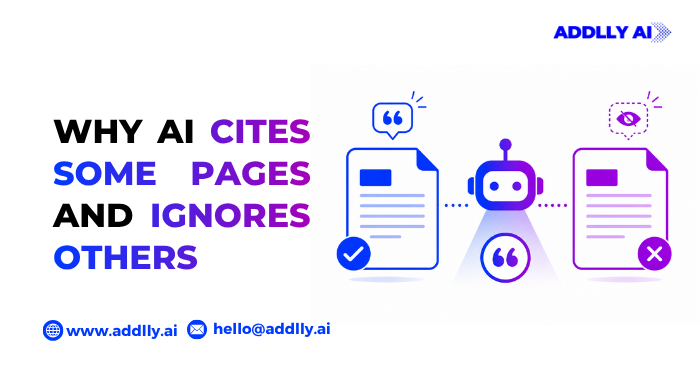
Why AI cites some pages and ignore others is the question every content team asks once their traffic from AI engines starts to slip. You rank on Google, your writing is solid, yet ChatGPT, Perplexity, and Gemini never name your brand. The cause is rarely your ideas. It is that an AI engine cannot extract a clean answer from your page, or trust it enough to cite it. For example, your sharpest line may sit where no model looks.
The good news: every reason has a fix. This article breaks down exactly why AI cites some pages and skips the rest, and how to earn citations fast.
Quick Summary: Why AI Engines Cites Some Pages and Ignore Others
- AI cites pages whose answers are self-contained and stand on their own.
- Ranking on Google no longer guarantees citations for your best pages.
- Schema and consistent entity naming make you easier to cite.
- AI systems read content in chunks, favoring the first screen.
- Trust signals and fresh, well written facts win more AI citations.
- Fixing structure, entities, and authority gets your brand cited across engines.
What Does It Mean When AI Cites a Page?
When AI cites a page, it names that page as a source inside an AI-generated answer. A user asks a question, the model writes a reply, and it credits the pages it pulled facts from. If your page is one of them, you earned an AI citation. This is different from a blue link in Google search. Here, the model reads your content, lifts the most useful part, and points users to your brand inside the answer itself. A human reader sees a clickable source on the internet; the model sees an extractable fact it can trust.
AI systems prefer content with clear, extractable answers. The cleaner your answer, the easier you are to cite.
Checkout our guide on: Why Your Website Gets Zero AI Citations
Does Ranking on Google Mean AI Will Cite You?
No. Ranking on Google no longer means AI will cite you. Recent 2026 studies show most pages cited by AI tools do not sit in Google’s top results at all, and the overlap between top rankings and citations is small.
Traditional SEO focuses on ranking, not AI citation. Old search rewarded backlinks and domain authority. AI search engines reward something different: a clear answer they can extract and verify quickly. So a page can rank first and still get zero citations, while a lesser-known page wins because its answer is cleaner. AI engines often skip well-ranked pages if the content is unclear. Watching rivals rank below you yet get cited is the clearest sign of a gap, and closing that gap is the goal here.
Why AI Cites Some Pages and Ignore Others: The 5 Real Reasons
AI does not skip your page out of malice. It skips pages it cannot read cleanly, resolve clearly, or trust fully. Here are the five reasons most sites fall short, and what each one signals to the model. Each gap below has a matching fix later in this article.
1. Your Content Isn’t Semantically Explicit or Self-Contained
The top reason is simple: your content is not built for extraction. Content must be semantically explicit and self-contained. AI systems evaluate content in chunks, not as whole pages, so each passage has to make sense on its own.
If your key point is buried after a long narrative buildup, the model cannot lift it. Content should avoid vague references and floating pronouns that only make sense with surrounding context. Each answer should be self contained, naming its subject plainly so it can be extracted independently. For example, a passage that opens with “this tool does X” fails because “this” has no context. Write the way AI systems extract fragments that appear immediately useful.
Read our guide on Signs Your Content Is Too Generic for AI Search for more information.
2. Weak Entity Clarity and Inconsistent Naming
AI builds an internal map of who is who, and weak entity clarity breaks it. If your brand is written one way on your site, another in press, and a third in forums, AI systems struggle to resolve you into a single entity.
AI citation likelihood increases with consistent entity naming across sources. So introduce your canonical name early, use it consistently, and stay entity grounded throughout the article. Use schema to declare relationships between entities explicitly. When your entities are clear, the model trusts the link between your brand and the topic, and that trust is what turns a retrieved page into a cited one.
3. Missing Structured Data and Schema Markup
Structured data is code that tells AI exactly what your content is about. Without it, the model has to guess. Schema improves an engine’s ability to cite content accurately, because pages with machine-readable formatting perform better in AI retrieval systems.
FAQ, How-To, and Article schema are the strongest picks. They label each part of your page, and internal links between related pages help too, so engines read relationships without parsing every word. Think of schema as a cheat-sheet that lowers the work an AI engine must do to trust you. Skip it, and you make the model work harder.
AI rewards the sites that make extraction easy.
4. Thin Trust and Authority Signals
AI engines cite sources they trust, and thin authority signals make you a risky pick. AI systems favor sources with high domain authority and cross-reference information across multiple trusted domains for verification.
If your brand shows up only on your own site, the model has nothing to confirm. Trust signals influence an AI’s decision to cite specific sources, and cross-validation weights confirmation frequency from multiple reliable sources. Earn mentions, name real authors, and publish concrete facts.
Sources providing concrete facts and statistics are more likely to be cited. Verifiable claims also reduce hallucination risk, which is why these signals matter so much to the model.
5. Stale Content or Blocked Crawler Access
Even great content falls short if AI cannot reach it or sees it as outdated. Technical barriers can prevent AI from indexing content, and many sites restrict content access for AI indexing bots, often by accident.
First, test that AI crawlers like GPTBot, ClaudeBot, and PerplexityBot are allowed, and fix broken links along the way. Then check freshness. AI evaluates the publication date of content for time-sensitive queries and prioritizes up-to-date information over outdated content.
A visible update date signals your facts are current. AI also overlooks pages lacking in-depth information for complex queries, so thin, stale pages get skipped while fresh, deep ones earn the citation.
Check our blog post on: What Happens After an AI Crawler Reads Your Page
How Do AI Systems Decide Which Pages to Cite?
AI systems decide what to cite through retrieval, then selection. First, when a user asks a question, the model gathers candidate pages from across the web. AI engines rely on live retrieval, not memory, so they do not rely on a single internet snapshot. Retrieval systems evaluate vector embeddings to ensure deep query answers, matching meaning instead of exact words, which is how they favor passages that resolve intent quickly.
Then the model judges the chunks it pulled. AI models select web pages based on relevance, authority, and content structure, and they evaluate semantic clarity and authoritative consensus when selecting pages. Engines prioritize the first screen of content for citation, so your best answer belongs near the top, not buried after preamble. The page with the clearest passage for that same question wins. Models prioritize balanced and neutral sources based on human feedback, the kind real humans rate highly.
Cited Pages vs Ignored Pages: What Actually Differs
The difference between a cited page and an ignored one is rarely the topic. It is clarity, structure, and trust. Cited pages give AI a clean, well written answer it can lift in one block; ignored pages bury the answer in vague prose. For example, that buried answer is the gap that decides citations.
Here is the core difference:
| Cited Pages | Ignored Pages |
|---|---|
| Self-contained, evidence backed answers | Floating pronouns and vague references |
| Consistent, entity grounded naming | Inconsistent names across the web |
| Schema and clear structure | Plain text with no markup |
| Fresh, topically coherent content | Stale or off-topic pages |
| Trusted across multiple domains | Mentioned only on its own site |
AI prefers passages that are standalone and verifiable. The web still works because humans read and trust content, so write for humans first, then close the structure gap for machines. These small choices matter at the document level.
AI Citation vs Traditional SEO: What Changed
Classic SEO and AI citation reward different things. SEO is built to win clicks on Google through backlinks and site authority. AI citation is built to win a mention inside an answer through clarity, structure, and trust. This difference matters, and what your audience wants should matter most.
Here is the core difference:
| Traditional SEO | AI Citation (GEO) |
|---|---|
| Goal: rank in search engines | Goal: get cited in AI answers |
| Relies on backlinks and links | Relies on clear, extractable answers |
| Measured by clicks and traffic | Measured by AI visibility and citations |
| One platform: Google search | Many: ChatGPT, Gemini, Perplexity, Claude |
So what does traditional SEO bring to AI search? A solid base. But generative engine optimization adds the structure and entity work that turns rankings into citations. AI visibility requires clear, structured content, and that is the real value of this newer focus. The intent you rank for still matters, but how you rank it changes.
How to Fix It and Get Cited by AI
Fixing zero citations is mostly about making your content easy to read, resolve, and trust. Here is the process content teams use to earn citations across every engine. Let me explain each step, and explain why each one works.
1. Write Self-Contained, Extractable Answers
Start each section with a direct answer, then explain the why. AI systems prioritize content that is easy to extract, so lead with the answer your audience asked for and skip the long narrative buildup. Make headings match real user intent and the questions users ask. Keep paragraphs short, two to four sentences, so they stay readable for humans. Add lists, tables, and clear links, since engines pull these almost word for word into snippets.
For example, a clean table gives the model context fast. Each block should work at the paragraph level and the document level. Test each section structure by reading it on its own, and you give AI a citable answer with zero extra work.
2. Add Structured Data and Clear Entity Signals
Give AI a map of your page. Add schema like FAQ, How-To, and Article markup so each part is labeled. Use schema to declare relationships between entities explicitly, link related pages with internal links, and keep your entity naming consistent everywhere your brand appears.
Content should avoid vague references to enhance AI citation. Name the subject in each sentence instead of relying on “it” or “this,” which strip out context. Stay entity grounded and topically tight so the model connects your brand to one clear topic. Then test your markup with free tools. Done right, this makes your content easier to read, trust, and cite.
3. Build Authority and Keep Content Fresh
AI engines trust some sources far more than others, so build authority on purpose. Publish original data and concrete statistics no one else has, for example a small study from your own customers. That unique value gives the model a citable hook. Earn brand mentions across the web, since AI cross-references information across many trusted domains.
Then keep content fresh. Add clear publish and update dates, refresh stats, and review top pages on a schedule. AI prioritizes up-to-date information over outdated content. It also prefers unique content over generic or duplicate information, so original, well written facts beat recycled takes. Strong authority signals plus freshness keep your pages ready for every AI engine, the way real users expect.
How Addlly AI Helps You Get Cited Across Every AI Search Engine?
Addlly AI is an AI Search Visibility Platform built to get your brand cited across AI answers and search engines. Instead of guessing why AI picks rivals and skips you, you get a clear picture and a clear fix in one place. It maps why your pages stay invisible, then hands you the tools to fix each one:
- GEO Audit Tool: Pinpoints why AI engines skip your pages and shows where rivals win citations.
- AI GEO Agent: Rewrites and structures your content into clean, self-contained answers AI can extract.
- AI Schema Markup Generator: Builds the structured data that labels your page so AI cites it.
- Product Detail Page AI Agent: Turns product pages into entity-clear, citation-ready content for AI search.
Together they audit, optimize, and create content AI tools cite across ChatGPT, Gemini, Perplexity, Claude, and Google AI Overviews. Trusted by Shiseido, MetLife, and Kenvue.
Want to see why your pages get skipped? Run Your GEO Audit with Addlly AI today. No signup or credit card needed.
Frequently Asked Questions About Why AI Only Cites Some Pages
Does a Page Need to Rank on Google to Get Cited by AI?
No. A page does not need to rank on Google to get cited by AI. Studies show most AI-cited pages do not sit in the top results. Clear formatting, extractable answers, and trust signals matter more to engines than your rank for that same question.
What Type of Content Do AI Engines Cite Most?
AI engines cite clear, self-contained content most: definitions, direct answers, comparisons, and educational content backed by data. Comparison tables and FAQ blocks get cited often because they declare facts in a machine-readable way. Well written, entity grounded passages with concrete stats also earn citations.
Can a Small Site or Local Business Get Cited by AI?
Yes. A small site or local businesses can absolutely earn citations from AI. The model rewards clear answers and trusted facts, not size. A focused page with schema, consistent entities, and a few quality mentions can beat much larger sites in AI search answers.
Does Structured Data Really Improve AI Citations?
Yes. Structured data improves an AI engine’s ability to cite content accurately. Schema markup labels your page so AI citation systems read relationships without parsing every word. It is a cheat-sheet that makes educational content and product pages easier to extract and cite.
How Long Does It Take to Start Getting AI Citations?
Most sites see early AI citations within a few weeks of fixing weak structure and crawler access. Trust-based wins from authority and original data take longer, often two to three months. A simple test is to ask AI tools your main questions and watch how often your pages appear.
Is GEO Just Hype, or Does It Actually Work?
GEO is not just hype. Beyond the GEO hype, the fundamentals make sense and are proven: clean structure, explicit entities, and solid foundations of trust have always made content easier to find. Generative engine optimization just keeps the human focus while making those qualities easier for AI to detect, the way smart humans would.

