
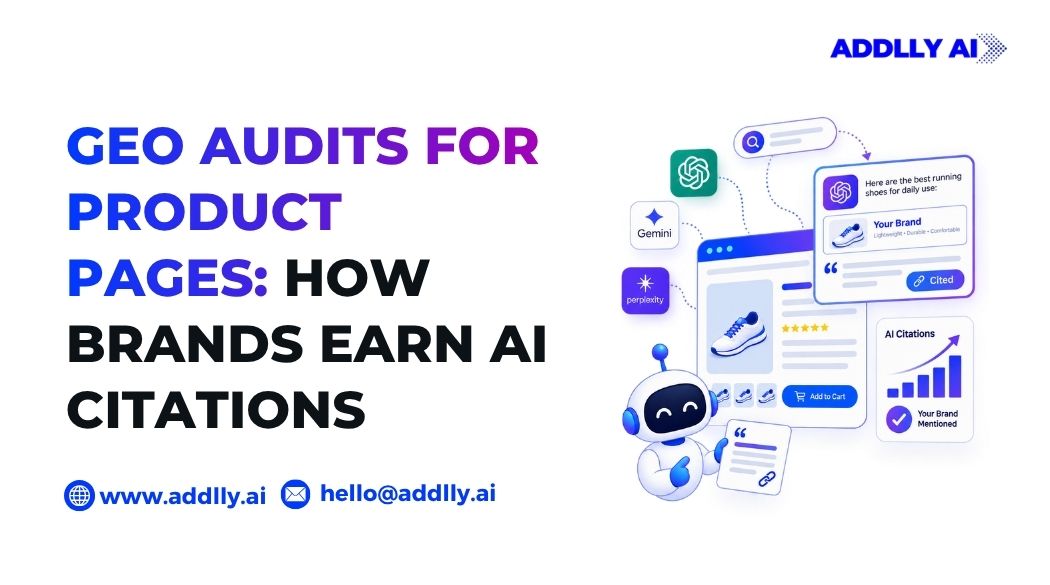
Your product ranks #1 on Google. Your competitors rank below it. Yet when a buyer asks ChatGPT which product to choose, your brand doesn’t even appear. That gap is becoming harder to ignore as AI-generated answers replace more traditional search journeys. This is exactly where GEO audits for product pages come in. They look beyond rankings to examine whether AI systems can find, understand, verify, and cite the information on your product pages. A page needs more than keywords and backlinks to become useful to AI engines; its product details must be clear, structured, current, and supported by credible signals across the web.
A website AI search visibility audit can reveal broader visibility issues, while a product-focused GEO audit shows where individual pages are losing opportunities.
Quick Summary – GEO Audits for Product Pages
- GEO audits for product pages help brands identify why their products may be missing from AI-generated answers and citations.
- Clear, structured, current product information makes pages easier for AI systems to understand and cite.
- AI visibility depends on more than rankings, with third-party mentions, reviews, authority, and citation patterns also playing a role.
- Comparing AI citations and competitor visibility can reveal content and visibility gaps that traditional SEO audits may miss.
- Regular GEO audits help brands track changes in AI search visibility and build stronger long-term visibility.
What Are GEO Audits for Product Pages?
A product page can contain everything a human shopper needs and still leave an AI engine with very little to work with. That is the problem GEO audits for product pages are designed to uncover.
A GEO audit examines how easily AI systems can find, understand, extract, verify, and cite the information on a product page. Instead of asking only whether the page ranks in traditional search engines, it asks a different set of questions: Can an AI model clearly identify the product? Can it find the specifications, pricing, use cases, and key differentiators? Are those claims supported by structured data and credible third-party sources? And when someone asks an AI platform for a recommendation, does the product have enough useful information to make it into the answer?
In simple terms, SEO helps a product page compete for visibility in traditional search results, while GEO helps make the product understandable and citable in AI-generated answers.
What Does a GEO Audit Actually Look At?
A product-page GEO audit looks at several layers of information rather than one ranking factor:
- Content clarity: Are the product’s features, specifications, benefits, and use cases stated clearly?
- Extractability: Can AI systems quickly pull specific facts and direct answers from the page?
- Structured data: Does the schema accurately describe the product, brand, SKU, price, availability, and reviews? Schema markup for AEO can give AI engines a clearer, machine-readable view of these details.
- Entity recognition: Is it clear which product and brand the page represents?
- Trust and authority: Do review sites, retailers, industry publications, and other third-party sources support the product’s claims?
- Freshness: Are pricing, availability, specifications, and other time-sensitive details current? Content freshness and AI citations become especially relevant when product information changes frequently.
- Citation visibility: When buyers ask relevant questions, is your product cited, or are competitors getting those mentions?
This is why a technical GEO audit alone isn’t enough. A page can be crawlable and have valid structured data but still fail to provide the kind of clear, useful evidence that AI models can confidently use in their responses.
The goal isn’t to make a product page sound like it was written for a machine. It’s almost the opposite. The best GEO improvements usually make the page clearer for humans and easier for AI systems to interpret at the same time.
Why Product Pages Need GEO Audits
A product page can be technically sound, rank well, and still get overlooked in an AI-generated answer. That’s because AI engines aren’t simply looking for the highest-ranking URL. They need to understand what the product is, why it fits a specific question, and whether the information is clear and trustworthy enough to use. A GEO audit helps uncover these visibility gaps before they become a bigger problem for brands competing in AI search.
There’s another reason product pages deserve closer attention. Buyers can now ask AI tools to compare products, suggest alternatives, explain features, or recommend the best option for a particular need. If your product page isn’t easy for AI systems to interpret and cite, those conversations can happen without your brand. This makes GEO for eCommerce increasingly relevant as product discovery moves beyond traditional search results.
How AI Search Engines Decide Which Product Pages to Cite
AI search engines do not simply pick the product page that ranks highest on Google. They look for pages that are relevant to the question, easy to understand, factually useful, and credible enough to support an AI-generated answer. For product pages, that usually comes down to a few key signals.
Relevance to the Question
AI systems first need to understand whether the page actually helps answer the user’s query. A product page that clearly matches the buyer’s intent has a better chance of being retrieved and cited.
Clear, Extractable Information
AI models need facts they can easily pull into an answer. Clear product specifications, use cases, comparisons, pricing, and direct answers are more useful than vague promotional copy.
Product and Brand Understanding
AI engines need to recognize what the product is, who makes it, and what category it belongs to. Consistent product names, brand information, and clearly defined entities help build that understanding.
Structured and Machine-Readable Content
Well-structured HTML and relevant schema make important product information easier to interpret. This is particularly useful for details such as SKU, price, availability, reviews, and product attributes.
Trust and Supporting Evidence
A product page does not exist in isolation. AI systems can cross-reference information from review sites, retailers, industry publications, and other third-party sources when evaluating whether a brand or product is worth mentioning.
Freshness and Accuracy
Product information can change quickly. Outdated pricing, specifications, availability, or product versions can make a page less useful for AI-generated responses, particularly for high-intent buying queries.
The Role of AI Retrieval
Behind the answer is a retrieval process in which AI systems find potentially useful sources, evaluate them, and use selected information to construct the response. This is why how AI search engines decide which sources to cite matters when auditing product-page visibility.
Interesting Read: How AI Search Engines Decide Which Brands Get Seen?
What to Check in a GEO Audit for a Product Page
A good GEO audit looks beyond traditional rankings and asks a more practical question: can AI systems understand, trust, and use this product page when generating an answer? The checks below help marketing teams identify gaps between traditional SEO performance and current AI visibility.
AI Crawler Accessibility
AI search platforms need to access the same useful product information that a human visitor sees. If important content is blocked or hidden, it can affect how the brand appears in AI responses.
- Check robots.txt and AI crawler access
- Make sure important content is available in the HTML
- Check JavaScript-rendered product information
- Review redirects, status codes, and indexing issues
- Check whether important content is hidden behind interactions
Product Information and Content Completeness
AI answers work better when product pages provide structured answers to the questions high-intent buyers actually ask.
- Product name, category, and description
- Key features and specifications
- Use cases and compatibility
- Pricing and availability
- Warranty, dimensions, materials, or other relevant attributes
- Direct answers to common buyer questions
- Information that supports AI-powered search results and product comparisons
Product Entity Signals
Large language models need to recognize the product as a distinct entity and connect it with the right brand, category, and attributes.
- Consistent product and brand names
- SKU, model number, GTIN, or other identifiers
- Clear relationship between product, brand, and category
- Consistent information across the website and third-party sites
- Signals that strengthen entity recognition and topical authority
Structured Data and Product Schema
Relevant structured data helps AI engines understand important product attributes without having to infer everything from surrounding copy.
- Valid Product schema
- Brand and SKU information
- Price, currency, and availability
- Reviews and ratings where applicable
- Consistency between visible content and schema
- Relevant schema for Answer Engine Optimization (AEO)
Content Citability
A page can contain useful information and still struggle to earn AI citations if the information is difficult to extract or doesn’t provide a clear answer.
- Put important answers near the beginning
- Use concise, fact-based statements
- Use question-shaped headings where relevant
- Include specific numbers, comparisons, and verifiable facts
- Create structured answers that can work within the AI answer layer
- Avoid hiding important information behind tabs or interactive elements
Reviews and Third-Party Mentions
AI systems don’t always rely on the brand’s own page. They can compare information across review sites, publications, retailers, and other sources before deciding whether a brand appears in an AI answer.
- Review sites and structured reviews
- Retailer listings
- Industry publications
- Expert reviews and comparisons
- Relevant communities and third-party sites
- Consistency of product claims across external sources
- Positive and relevant brand sentiment
Product Page Authority and Trust Signals
Strong product content needs supporting authority signals to compete for visibility across AI search platforms.
- Original product data or research
- Relevant industry publications
- Strong third-party brand mentions
- Digital PR and content marketing
- Consistent product information across platforms
- Evidence supporting important product claims
- Signs of brand authority and topical authority
Atraditional website audit focuses heavily on rankings, technical health, backlinks, and performance in Google’s blue links. A GEO audit adds another layer: whether the brand is being understood and cited across AI search results, AI Overviews, and AI-driven search experiences.
That difference is becoming increasingly important as ChatGPT, Gemini, and Perplexity become part of how people research products.
How to Run a GEO Audit for a Product Page
Once you know what AI systems look for, the next step is turning those signals into an actual audit. The process doesn’t have to be complicated. Start with the questions buyers are asking, compare your visibility with competitors, and then work backward to find what your product page needs to become easier for AI systems to understand and cite.
Start With the Queries Your Customers Ask
Begin with real, high-intent questions rather than generic keywords. Think about the questions a buyer might ask an AI assistant before choosing a product.
- Build a list of product-specific prompts
- Include comparison, recommendation, and problem-based queries
- Test questions across ChatGPT, Gemini, and Perplexity
- Record where your brand appears and where it doesn’t
See Which Pages AI Search Is Citing
Look beyond whether your brand is mentioned. Check which URLs AI systems actually use as sources and what information they pull from them.
- Record cited URLs across AI search platforms
- Look for repeated citation patterns
- Identify whether product pages, review sites, or other sources are being cited
- Note missing mentions and citation gaps
Look at What Your Competitors Are Doing
A competitor comparison can show you what your product pages lack. If competitors are consistently being cited for the same queries, examine the content and authority signals behind those citations.
- Compare cited competitor pages
- Look for differences in product information
- Check reviews and third-party mentions
- Identify competitor content gaps and strengths
Find the Information Your Page Is Missing
This is where a GEO content gap analysis becomes useful. The goal is to find the questions competitors answer that your product page leaves unanswered.
- Missing product specifications
- Unanswered buyer questions
- Missing comparisons or use cases
- Lack of original data or supporting evidence
- Weak or unclear product differentiators
Check Your Technical and Schema Signals
Now move from content to the technical side of the page. Make sure AI systems can access the content and correctly interpret the product information.
- Check crawler accessibility
- Review HTML and JavaScript rendering
- Validate Product and relevant schema
- Compare visible product data with structured data
- Check pricing, availability, SKU, and other key attributes
For brands managing large product catalogs, this is also where a Product Detail Page AI Agent can help create structured product content, features, benefits, FAQs, and schema-ready information at scale. https://addlly.ai/product-detail-page-pdp-ai-agent/
Track Changes in AI Citations
A GEO audit shouldn’t end when you fix the page. AI search visibility can change as competitors publish new content, product information changes, and AI models update their responses.
- Track citations across your target AI platforms
- Monitor brand mentions and recommendations
- Record changes in citation share
- Compare visibility before and after optimization
- Run the audit regularly to maintain long-term visibility
The important thing is to treat the audit as an ongoing process rather than a one-time SEO audit. Traditional rankings can be checked in a dashboard, but AI visibility often requires repeated prompt testing, citation analysis, and visibility data to understand how your brand stands across AI-driven search experiences.
GEO vs. SEO: What Changes When You Audit a Product Page?
A traditional SEO audit asks whether a product page can rank and attract clicks from search engines. A GEO audit asks a different question: can AI systems understand the product well enough to mention, recommend, or cite it in an answer?
The two approaches overlap in areas such as technical accessibility, content quality, structured data, and authority. But the signals you pay attention to and the outcome you measure are different. This distinction is becoming more important as AI-generated answers and AI-powered search results become part of the buyer journey.
| Area | Traditional SEO Audit | GEO Audit |
|---|---|---|
| Primary goal | Improve traditional search rankings | Improve visibility in AI-generated answers |
| Search experience | Blue links and traditional search results | AI answers, summaries, and AI-powered search results |
| Main outcome | Rankings, clicks, and organic traffic | Brand mentions, recommendations, and AI citations |
| Content focus | Keywords, search intent, and comprehensive content | Clear, extractable information and direct answers |
| Product information | Optimized around relevant search queries | Structured around questions AI systems and buyers ask |
| Technical checks | Crawling, indexing, Core Web Vitals, and internal links | Crawler accessibility, content extractability, rendering, and machine readability |
| Structured data | Helps search engines understand page content | Helps AI systems interpret product attributes and entities |
| Authority | Backlinks, domain authority, and topical relevance | Third-party mentions, reviews, publications, and broader authority signals |
| Measurement | Rankings, impressions, CTR, and organic traffic | Citation rate, brand visibility, AI mentions, and citation share |
| Competitor analysis | Compare rankings and backlinks | Compare which competitors’ AI engines cite and why |
| Optimization cycle | Optimize → rank → monitor | Test prompts → analyze citations → identify gaps → optimize → retest |
The biggest shift is the answer layer. SEO is largely about helping a page earn a place in traditional search results. GEO is about making the information on that page useful enough for an AI system to include in its response. That means a product page can perform well in traditional rankings while still having weak AI search visibility.
For marketing teams, the two audits should work together rather than replace one another. Traditional SEO helps people find the product page; GEO helps ensure that when buyers ask AI assistants about the product, the brand stands a chance of being part of the answer. Tracking AI search visibility can show where that difference is starting to appear across platforms such as ChatGPT, Gemini, and Google AI Overviews.
How Do You Know If Your Product Page Is Winning in AI Search?
Getting mentioned once in an AI answer is not enough to call a product page successful. The better question is whether your brand shows up consistently when relevant buyers use leading AI tools. Look at how often your brand is cited, which pages appear as sources, how competitors perform, and how AI describes your product across AI conversations. These visibility metrics give marketing teams a more useful picture of performance than traditional rankings alone.
This is where Generative Engine Optimization (GEO) differs from what a traditional SEO audit focuses on. SEO can tell you where a product page ranks and how much traffic it receives, while GEO looks at whether generative AI systems actually use that information in an AI summary, recommendation, or comparison. An AI Search Visibility Checker can help track brand mentions, citations, sentiment, and competitor visibility across AI platforms.
For a deeper diagnosis, a GEO audit can examine why your product pages are or aren’t appearing in AI-generated answers. It can uncover visibility gaps, citation patterns, and areas where your product content needs stronger signals.
You can start with manual tracking by recording prompts, AI responses, cited URLs, competitor mentions, and changes over time. Test relevant prompts across ChatGPT and Perplexity, and track whether your brand is cited or whether competitors are taking those citations. This is particularly useful because AI systems using retrieval-augmented generation (RAG) can draw information from sources beyond traditional search results. The goal isn’t to influence a model’s training data; it’s to make your product information accessible, clear, current, and authoritative enough to be retrieved and used.
A useful measurement framework should track:
- Brand mentions: How often your brand appears in relevant AI responses
- Citation rate: How often your product pages are used as sources
- Visibility metrics: How your presence changes across AI platforms and prompts
- Competitor visibility: Which competing brands appear when yours does not
- Source quality: Whether citations come from your site or authoritative third-party sources
- Brand sentiment: Whether AI-generated descriptions of your brand are positive, neutral, or negative
- Platform coverage: How your brand performs across ChatGPT, Perplexity, Gemini, and other AI search platforms
Over time, these measurements show whether your brand stands out in the AI answer layer and whether your GEO work is building long-term visibility, rather than simply improving traditional rankings.
Conclusion
Product pages now need to do more than rank in traditional search. They need to be clear enough for AI systems to understand, useful enough to answer buyer questions, and trustworthy enough to cite. That is what makes GEO audits for product pages increasingly important for brands competing in AI search.
Regular audits can reveal where product information, citations, authority, or visibility are falling short. As AI-driven discovery continues to grow, treating GEO as part of your broader search strategy can help your products stay visible when buyers move from blue links to AI-generated answers. Addlly AI can help brands navigate this shift and build stronger visibility across the changing search landscape.
FAQs – GEO Audits for Product Pages
1. What Is a GEO Audit for a Product Page?
A GEO audit evaluates how easily AI systems can access, understand, extract, verify, and cite information from a product page. It looks beyond traditional rankings to assess AI search visibility and citation opportunities.
2. How Is a GEO Audit Different From an SEO Audit?
A traditional SEO audit focuses on rankings, organic traffic, technical health, and search visibility. A GEO audit focuses on whether AI systems can understand the product and include the brand in AI-generated answers, recommendations, and citations.
3. What Should You Check During a Product Page GEO Audit?
Check AI crawler accessibility, product information, entity signals, structured data, content citability, reviews, third-party mentions, freshness, and product-page authority. These factors can influence how AI systems interpret and cite a product.
How Can Brands Track Their Product Page AI Visibility?
Brands can track relevant prompts across AI platforms such as ChatGPT, Gemini, and Perplexity. Monitor brand mentions, citations, cited sources, competitor visibility, sentiment, and changes in visibility over time.
Can Addlly AI Help With GEO Audits for Product Pages?
Yes. Addlly AI helps brands understand and improve their visibility across AI-driven search, making it easier to identify opportunities as product discovery increasingly moves toward AI-generated answers.

