
What Are Addlly AI’s AI GEO Agents?
Addlly AI’s AI GEO Agents are built for teams that want to stay visible inside AI answers while protecting and improving performance in Google and Bing. As AI platforms increasingly shape what people trust, content needs to be clearer, more structured, and easier for systems to interpret, summarise, and cite.
Generative Engine Optimization (GEO) at Addlly AI is treated as a practical workflow, not a single catch-all feature. Instead of one generic tool, we offer three connected Addlly AI GEO solutions that map to real content needs and real publishing workflows:
- AI GEO Audit Tool
- GEO AI Agent
- GEO AI Rewrite Agent
- 1. Audit what you already have
- 2. Create content where you have gaps
- 3. Rewrite content that should perform better
In this guide, you will learn what each of our AI GEO Agents do, when to use it, what outputs to expect, and how they work together as a complete GEO system for planning, creation, and continuous improvement across SEO and AI search.
Understanding Generative Engine Optimization (GEO)
Generative Engine Optimization (GEO) is emerging as the next evolution of search visibility, driven by the way people now discover information through AI assistants and answer engines. When someone asks a question, they often receive a curated response rather than a list of links. In 2026, the new priority is earning a place in these responses.
That shift changes what “optimization” means. GEO makes your expertise easy for AI systems to interpret, summarise, and reuse without distortion, so your brand shows up with the right context and the right framing. It bridges the gap between being present online and being confidently recommended when people ask the exact questions your business is built to answer.
GEO Basics: What You Are Optimising For
Without AI Search, You Are Losing Market Share
Google is already replacing search results with AI overviews. If you’re not preparing for AI-first discovery, your traffic is at risk.
84%
of marketers believe AI is essential for SEO to align content with user intent.
80%
of consumers rely on AI-generated answers for roughly 40% of their searches.
62%
of organizations use AI for data analysis, and 60% for creating personalized CX.
Generative Engine Optimization (GEO) is the practice of shaping your content so AI platforms can understand it clearly and confidently include your brand in answers. Instead of focusing only on rankings and clicks, GEO focuses on how your brand becomes part of the answer itself.
In practical terms, GEO aims to:
- Help AI systems recognise your brand as a relevant option.
- Make your pages easier to summarise accurately.
- Increase the chances of mentions and citations.
- Improve consistency in how your brand is described across AI platforms.
- Align your content with real question-based search behaviour.
The Three Layers Of Visibility: Indexed, Understood, Cited
A practical GEO mindset separates three layers of visibility:
- 1. Indexed in search systems
- Search engines can crawl and store your pages.
- 2. Understood by AI platforms
- AI models can correctly interpret what your brand does, who it serves, and where it fits.
- 3. Cited in AI answer engines
- Your pages and brand are actively referenced, quoted, or recommended inside answers.
Classic SEO concentrates on the first layer and part of the second. GEO focuses heavily on the second and third layers, where visibility inside AI answers is won or lost.
Why GEO Is Essential for Enterprises
Enterprises have more at stake in this shift because their visibility depends on trust at scale. When AI systems generate answers, they often compress complex markets into a short shortlist of “safe” recommendations. If your brand isn’t consistently understood as a clear, credible option, the engine can default to simpler competitors or the sources that are easiest to interpret, even if you lead the category.
GEO helps enterprises protect and extend the work they have already invested in content, reputation, and authority. It creates a framework for making large, distributed content ecosystems more legible to AI. This makes sure that product positioning stays accurate, messaging remains consistent across answers, and discovery doesn’t depend on whether a user happens to click through a traditional results page.
How Search Behaviour Has Changed
People are no longer only typing short keywords like “best CRM” or “running shoes”. They are asking full, contextual questions such as:
- “Best CRM for a remote B2B startup with under 20 people.”
- “Hair loss treatment that is safe for women in their 40s.”
- “Insurance options that cover freelancers who work across countries.”
This shift changes what content has to deliver:
- People want direct recommendations, not long lists of links.
- People bring context like company size, use case, budget, and constraints.
- People look for clear pros, cons, and trade-offs in plain language.
GEO exists to ensure your brand is ready for this style of search, not just old keyword patterns.
How AI Answer Engines Differ from Classic Results Pages
Classic search results show a ranked list of links. AI answer engines show a synthesised response, often with a shortlist of brands or products.
Key differences:
- AI engines summarise first and link second, so the answer becomes the main experience.
- AI engines blend multiple sources, so your brand often appears beside competitors.
- AI engines include only content that feels clear and complete, so confusing pages are easy to skip.
This means that even if you rank in classic search, your brand can still be left out of AI answers if your content is not easy to parse, structure, and summarise.
How GEO Differs From Classic SEO Tools?
Most SEO platforms are built around links and SERPs. Our AI GEO Agents are built around AI answers and citations.
In simple terms:
- SEO tools track keywords, rankings, links, and technical issues.
- Our AI GEO Agents track AI visibility, mentions, and how AI systems describe your brand.
With GEO, the key questions shift from:
- “Where do we rank?” to “Where do we appear in AI answers?”
- “Which keywords bring traffic?” to “Which topics and pages get cited?”
- “Is the page optimised?” to “Can AI clearly understand and reuse this page?”
Traditional SEO tends to leave gaps that matter for AI search, such as:
- Keyword focus without enough context or explanation.
- Thin or unstructured pages that are hard to summarise.
- Weak entity clarity around brand, product, audience, and category.
- Limited, scattered FAQs instead of clear Q and A sections.
- Schema that is basic, inconsistent, or missing altogether.
What Makes Content “AI Ready” in a GEO Sense
In most cases, AI systems perform best with content that has:
- Clear entities for your brand, products, audiences, and categories.
- Structured sections with logical, easy-to-scan headings.
- Credibility signals such as authorship, supportable claims, case studies, and proof of experience.
- Concise, FAQ style answers to important user questions.
- Schema tags for products, FAQs, organisations, and articles that help machines classify the page.
What Happens If Enterprises Ignore GEO
If enterprises ignore GEO and only continue with classic SEO, common patterns emerge:
- AI answers recommend competitors, while your brand rarely appears.
- Brand descriptions drift and feel inconsistent across AI platforms.
- Content work becomes reactive, with teams publishing but not knowing why AI ignores their pages.
- Measurement feels blurry, and it is hard to link AI visibility to traffic, leads, and revenue.
How GEO and SEO Work Together
SEO and GEO are strongest when they operate as one system rather than two separate initiatives. SEO builds the foundation by ensuring your content is discoverable, indexable, and competitive in traditional search. Meanwhile, GEO makes that same content easier for AI engines to interpret and confidently reuse when producing answers. Together, they turn visibility into both reach (being found) and influence (being included in the response).
For most teams, the opportunity is not to reinvent strategy, but to extend what already works. The same content planning that supports rankings can also be shaped to support citations, accurate summaries, and consistent brand positioning across AI platforms. Every page does double duty in classic search and generative results.
Sharing Inputs Across SEO and GEO
SEO and GEO do not need separate worlds of research and planning. In most teams, the same inputs can support both:
- Keyword and topic research, expanded into real questions and use cases.
- Competitor and category analysis, used to define how your brand should be positioned in AI answers.
- Existing content inventories, used to decide what to create and what to rewrite.
- Performance dashboards, with AI visibility layered onto rankings and traffic.
- Brand and product messaging guides, keeping AI-ready content consistent with everything else you publish.
Why SEO Still Matters For GEO?
SEO and GEO solve related but different problems.
- SEO keeps your site discoverable and technically healthy in traditional search.
- GEO focuses on how AI systems read, interpret, and reuse your content inside AI-generated answers.
Addlly AI’s AI GEO Agents sit on top of your existing SEO work and add the AI search layer that classic SEO tools do not touch.
Strong SEO makes GEO easier. AI platforms still depend on a site that is fast, crawlable, and well-structured.
SEO is still responsible for:
- Keeping pages crawlable and accessible.
- Making sure important pages are indexed.
- Improving speed and technical health.
- Building topic authority through consistent coverage.
- Supporting trust through organic visibility and links.
GEO works best when it can assume this base is in place rather than fixing fundamental technical issues.
GEO vs Traditional SEO
Goal
Focus
Measurement
Tools To Use
Audience Behavior
Future Relevance
Generative Engine Optimization (GEO)
Traditional SEO
Get mentioned in AI generated answers on ChatGPT, Perplexity and Google AI Overviews
Get your website ranked higher on Google SERPs
Gives topics which are hot and trending in AI searches
Keywords, backlinks, technical seo, etc.
AI mentions, visibility in AI generated responses
Organic traffic, keyword rankings
Addlly's GEO AI Agent
Google Search Console, Ahrefs, SEMrush, or other free tools
Question based (asking queries on AI platforms and tools)
Search based (searching for keywords or direct queries)
The digital visibility is changing with AI generated answers. The search world is changing
Still important but, but SEO is changing
Generative Engine Optimization (GEO)
Traditional SEO
Goal
Get mentioned in AI generated answers on ChatGPT, Perplexity and Google AI Overviews
Get your website ranked higher on Google SERPs
Focus
Gives topics which are hot and trending in AI searches
Keywords, backlinks, technical seo, etc.
Measurement
AI mentions, visibility in AI generated responses
Organic traffic, keyword rankings
Tools To Use
Addlly's SEO AI Agent
Google Search Console, Ahrefs, SEMrush, or other free tools
Audience Behavior
Question based (asking queries on AI platforms and tools)
Search based (searching for keywords or direct queries)
The digital visibility is changing with AI generated answers. The search world is changing
Still important but, but SEO is changing
How Addlly AI Approaches GEO for Enterprise
Enterprise GEO is an operating model for making sure your brand remains visible as discovery shifts toward AI-generated answers across large content libraries, multiple business units, and complex product lines. Addlly AI approaches GEO as a structured, repeatable process that helps teams diagnose what AI systems misunderstand, close the gaps with purposeful content, and continuously improve what already exists.
GEO as a Workflow, Not a Single Tool
GEO works best as an ongoing lifecycle, not a one-off optimisation pass. A single rewrite might help for a moment, but enterprise visibility depends on consistent clarity across many pages, products, regions, and teams, so AI systems can reliably understand and summarise your brand without drift.
That’s why Addlly AI treats GEO as a repeatable workflow with clear stages, rather than a standalone writing tool. In practice, the biggest enterprise challenge is knowing what to prioritise, making key pages easier to interpret, and continuously improving based on how AI engines actually respond.
How Addlly AI’s AI GEO Agents Fit Into the Enterprise Search Landscape
Discovery is now split across two habits:
- Traditional search for scanning results, comparing links, and researching in depth.
- AI search for fast, conversational recommendations and shortlists.
If your strategy only optimises for traditional search engines, you can still lose visibility where buyers are already asking AI tools like ChatGPT, Perplexity, Gemini, Claude, Grok and Google AI Overviews for direct recommendations.
Our AI GEO Agents are three connected tools that help your brand show up more often, more clearly, and more accurately in AI-generated answers while still supporting your SEO fundamentals.
Each agent owns a different stage of Generative Engine Optimization:
- The AI GEO Audit Tool is the diagnosis and strategy layer.
- The GEO AI Agent is the creation and expansion layer.
- The GEO AI Rewrite Agent is the improvement and modernisation layer.
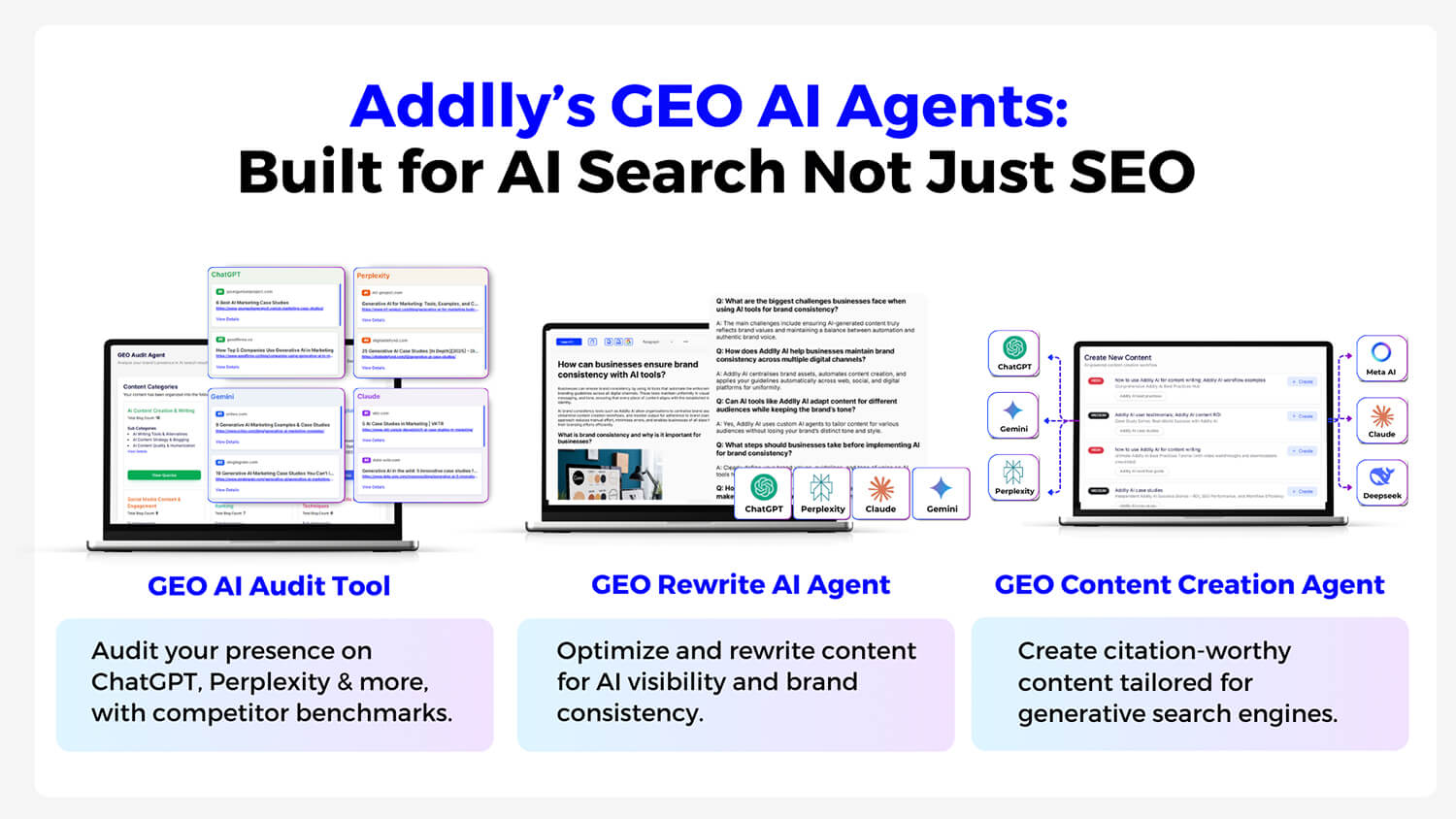
Addlly's Brand Visibility Agents: Built for AI Search not just SEO
GEO Audit AI Tool
Runs a full AI search visibility audit across platforms like ChatGPT, Gemini, and Perplexity, compares you with competitors, and identifies where you’re missing citations.
GEO Rewrite AI Agent
Optimizes and refreshes existing copy so it’s SEO-friendly and AI-search ready, making every update count for rankings and citations.
GEO AI Agent
Creates brand-focused, citation-ready content designed to appear in AI-powered search results and close visibility gaps.
At a high level, they support one simple loop:
- Audit what you already have.
- Create content where you have gaps.
- Rewrite content that should perform better.
This gives your team a repeatable workflow instead of scattered, one-off experiments.
Addlly AI’s AI GEO Agent Suite
Our AI GEO Agents are designed as three connected tools that help your brand show up more often, more clearly, and more accurately in AI-generated answers, while still supporting your SEO fundamentals. Rather than treating GEO as a one-off content task, the suite maps to the real stages teams already run: diagnose what is happening, create what is missing, and upgrade what should perform better.
The Three AI GEO Agents at a Glance
The suite is built around one simple workflow: Audit → Write → Rewrite.
Each agent owns a different stage of GEO, so teams can move from insight to action without guessing what to do next.
- 1. AI GEO Audit Tool: Diagnoses your current AI visibility, including mentions, citations, brand framing, competitor comparisons, and the highest-impact gaps to fix.
- 2. GEO AI Agent: Creates new, AI-ready content from those insights, including question-led outlines and structured drafts designed to earn inclusion in AI answers.
- 3. GEO AI Rewrite Agent: Upgrades existing pages for AI readability and reuse by improving structure, entity clarity, and citation-worthiness.
The Audit → Write → Rewrite System
The suite runs as a continuous workflow:
- 1. Audit to see where you appear in AI answers, how you are framed, and where competitors are being selected instead.
- 2. Write to fill the gaps the audit reveals with new, structured pages designed for AI-style questions and summaries.
- 3. Rewrite to upgrade the pages worth keeping, so they become clearer, more reusable, and more citation-ready.
Over time, this loop replaces scattered experiments with a repeatable GEO system: audit what you already have, create where you have gaps, and rewrite what should perform better.
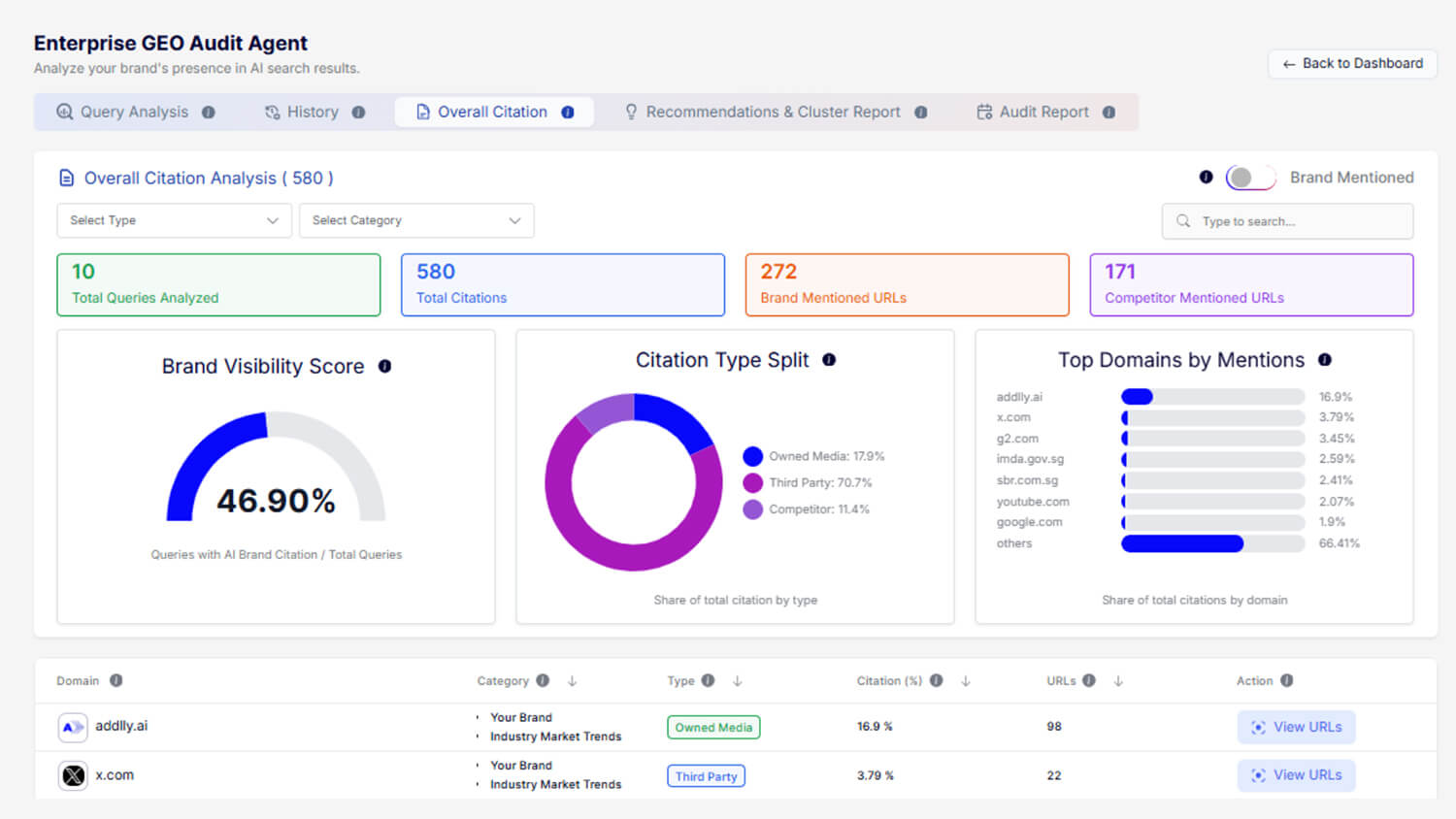
1. What is Addlly AI’s AI GEO Audit Tool?
The AI GEO Audit Tool by Addlly AI is the diagnosis layer of our AI GEO Agents. It is the best way to show your brand’s visibility in AI search, and is the starting point of the AI GEO workflow.
Rather than guessing how AI tools see your brand, our GEO Audit Tool:
- Checks whether your site is being cited or mentioned in AI-generated answers.
- Reveals how AI platforms describe, frame, and interpret your brand.
- Benchmarks your AI visibility against key competitors.
- Highlights the gaps that matter most for Generative Engine Optimization.
It is designed to boost AI search visibility across ChatGPT, Perplexity, Claude, Gemini, Grok, Google AI Overviews, and similar systems.
Once you know where you appear, how you are described, and where you are missing, the rest of our AI GEO Agents step in to help you close the gap.
What Addlly AI’s GEO Audit Tool Evaluates
Our GEO Audit Tool looks at your site and your brand through an AI search visibility lens. It focuses less on whether a page hits a keyword and more on whether AI systems can confidently use your content in real answers.
Typical checks include:
-
AI presence across engines
Where and how often your brand appears in answers on ChatGPT, Claude, Perplexity, Gemini, Grok, and Google AI Overviews. -
Citation patterns
Which pages are cited, how often, and in what context. -
Sentiment and positioning
How AI platforms talk about your brand, what strengths they emphasise, and where they are unsure or neutral. -
Entity and brand clarity
Whether your brand, products, audiences, and categories are clearly defined and consistently understood. -
Structure and GEO readiness
How well pages support summarising, follow-up questions, and extraction of clear answers. -
Schema and technical context
Where missing or incorrect markup is blocking understanding, such as product, FAQ, organisation, and article schema. -
Competitor benchmarking
How your AI visibility compares to competitors, including where they are preferred or more frequently recommended.
The goal is to give you a clear, data-backed view of where you stand in AI search, not just another generic SEO health check.
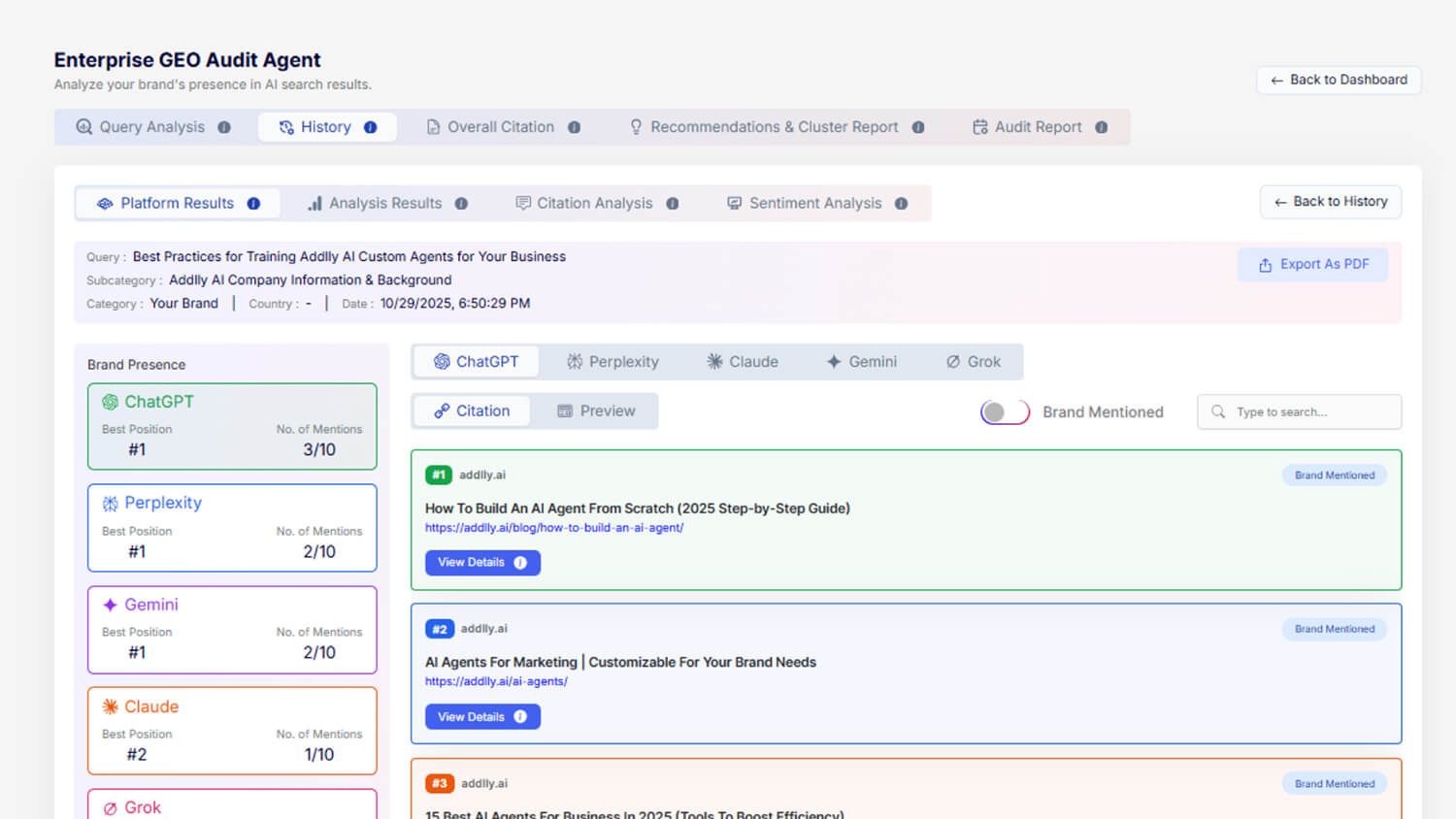
What Addlly AI’s GEO Audit Tool Delivers
Our GEO AI Audit Tool turns these findings into a practical GEO Strategy Report that your team can act on.
You can expect:
-
A prioritised AI visibility report
Showing where you appear, where you are missing, and how you compare to competitors. -
A breakdown of key issues
Including missing mentions, weak entities, unclear messaging, structural gaps, schema issues, and low trust signals. -
A GEO roadmap
Clear guidance on what to create, rewrite, and optimise for AI search visibility. -
Page-level recommendations
For rewrites, structure, FAQs, examples, and structured data that make each page easier for AI to reuse. -
Implementation guidance with other AI GEO Agents
Concrete next steps for using our GEO AI Agent and GEO AI Rewrite Agent to implement changes.
The idea is simple: once your GEO Audit is done, you should know exactly which pages to focus on, what to change, and which agent to use next.
2. Addlly AI’s GEO AI Agent (Write)
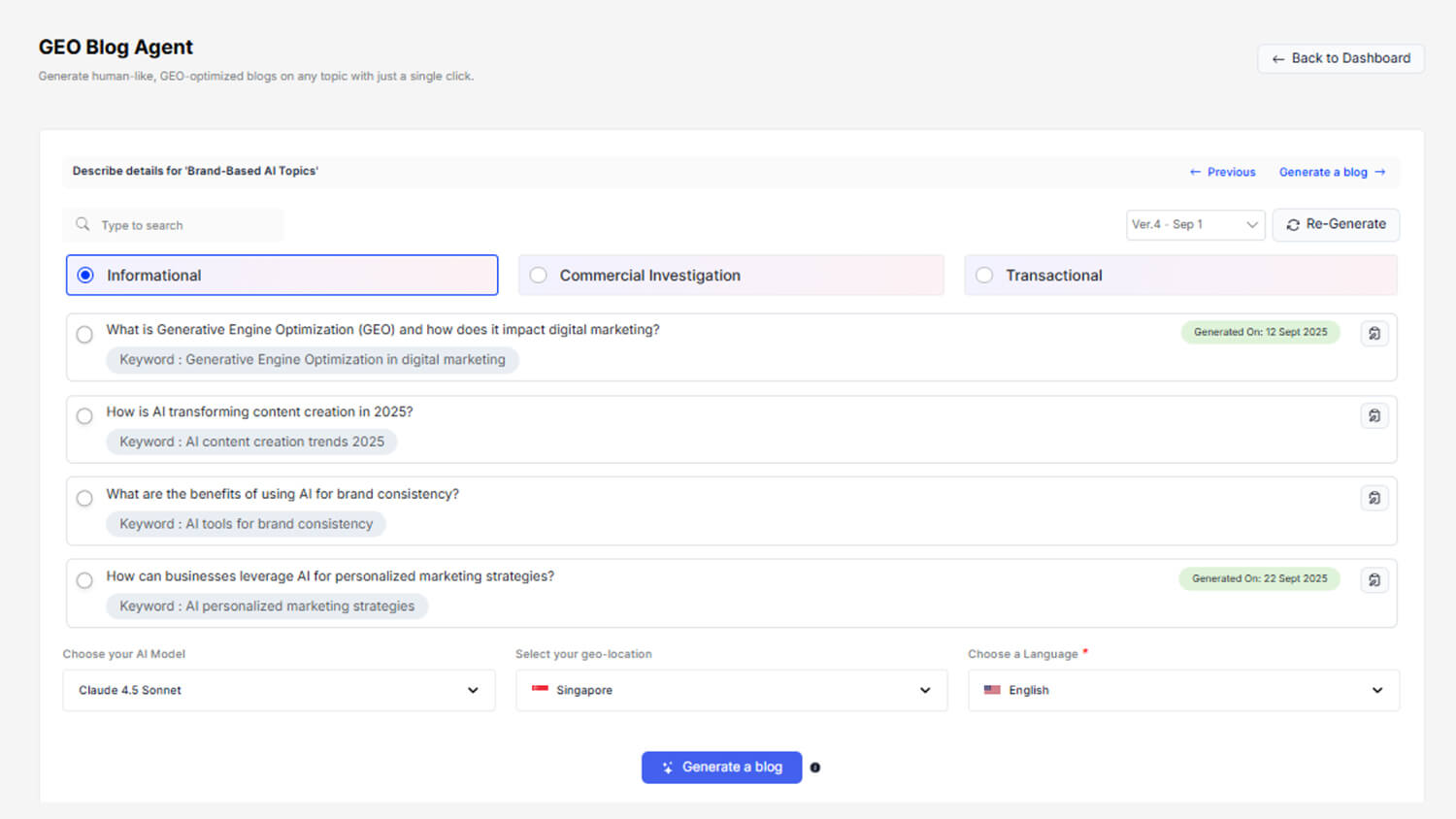
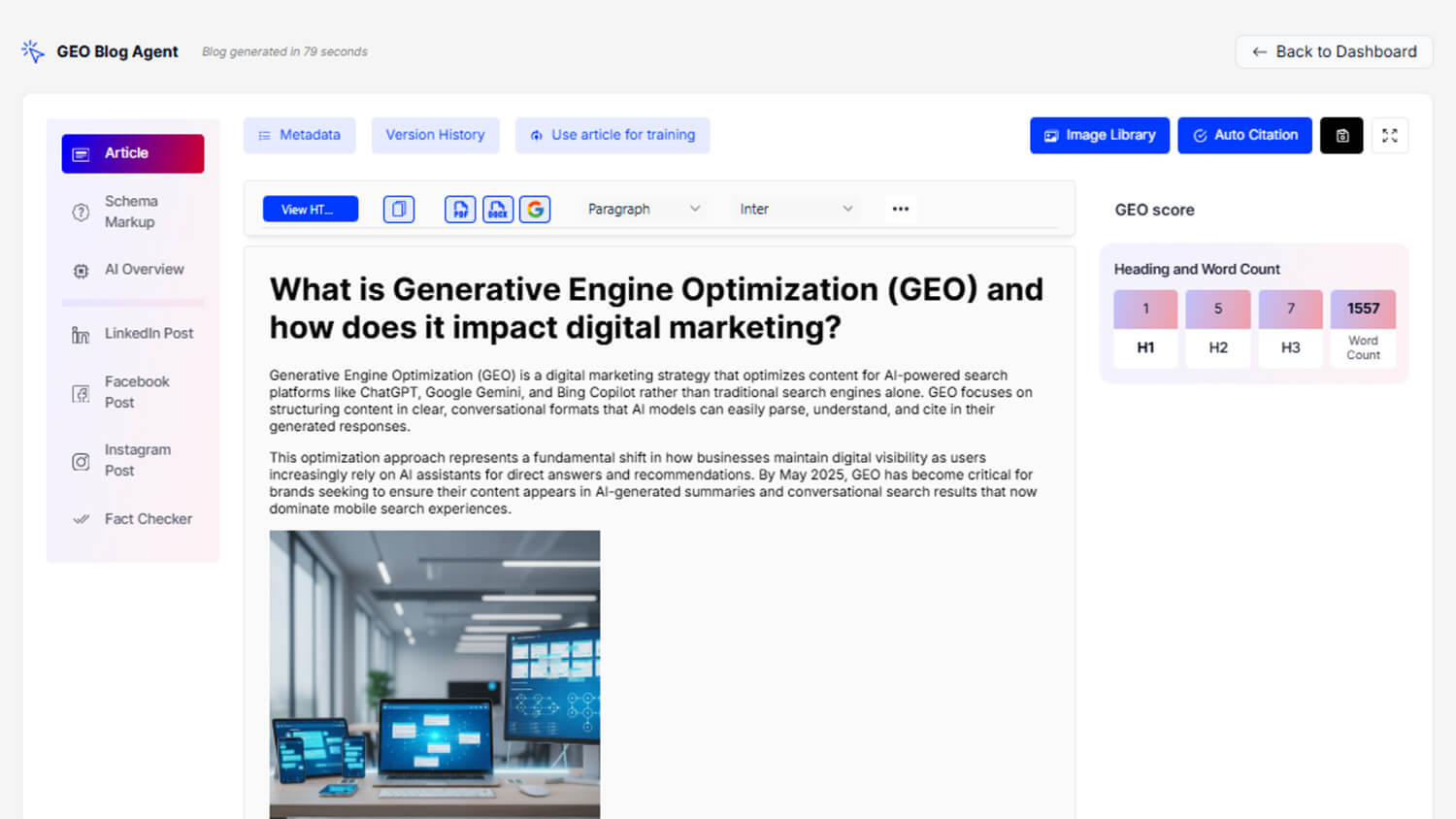
The second agent in the GEO suite is the GEO AI Agent. This is our content creation engine and AI writer agent, which creates fully optimised blogs for enhanced AI visibility. Where the GEO AI Audit Tool shows you what to fix or create, our GEO AI Agent is the tool you use to produce that content.
Instead of asking your team to guess what AI wants from scratch, our GEO AI Agent:
- Suggests GEO-ready topics that reflect real AI search behaviour.
- Builds AI-first structures that match how generative models read and reuse content.
- Generates drafts that work for both SEO and AI search visibility.
- Keep everything aligned with your brand tone, messaging, and positioning.
The result is content that feels like you wrote it, but arrives much faster and with stronger AI search foundations.
Core Capabilities of Addlly AI’s GEO AI Agent
Our GEO AI Agent focuses on creating content that is AI-ready and SEO friendly from the start.
Core capabilities include:
-
Topic suggestions for AI search
Based on real question patterns and intent signals from AI tools, not just keyword lists. -
AI search engine targeting
Structures that are tuned for ChatGPT, Perplexity, Gemini, Google AI Overviews and other answer engines. -
AI optimised content structures
Headings, subheadings, suggested metadata, schema hints, and FAQ blocks designed for summarisation. -
E-E-A-T aligned output
Content that supports experience, expertise, authority, and trust, which increases the likelihood of being trusted and cited by AI search engines. -
One-click article generation
Moving from outline to an AI-aware, SEO friendly draft in a single flow. -
Team-ready workflows
Outputs that plug into how marketers, agencies, and product teams already brief, review, and publish content.
How Addlly AI’s GEO AI Agent Supports Faster Content Creation for AI Visibility
GEO works best when AI platforms can reuse your content without distorting your brand. Our GEO AI Agent is designed to keep trust and accuracy front and centre, while also reducing the time it takes to turn an idea into publish-ready content that AI systems can interpret and cite.
It supports faster creation for AI visibility by:
- Turning a small set of inputs into a structured first draft quickly
- Producing scannable sections that map to common AI-style questions
- Building in clearer definitions and terminology to reduce rewrites
- Surfacing missing entities, comparisons, and FAQs early
- Standardising output structure so teams review faster and ship more consistently
Combined with your own product knowledge and editorial review, our GEO AI Agent produces content that matches your brand voice and standards, while being easier for AI systems to interpret, summarise, and cite.
Content Types Created with the GEO AI Agent
Our AI GEO AI Agent is flexible enough to work across the main formats that influence AI search visibility.
Typical content types include:
- Blog posts and long-form articles.
- SEO and campaign landing pages.
- Product and category content.
- Resource, help, and knowledge base content.
- Full funnel content for awareness, consideration, and decision stages.
In all of these formats, our GEO AI Agent focuses on structure, clarity, and answer quality so that your content is easier for AI models to reuse.
3. Addlly AI’s GEO AI Rewrite Agent
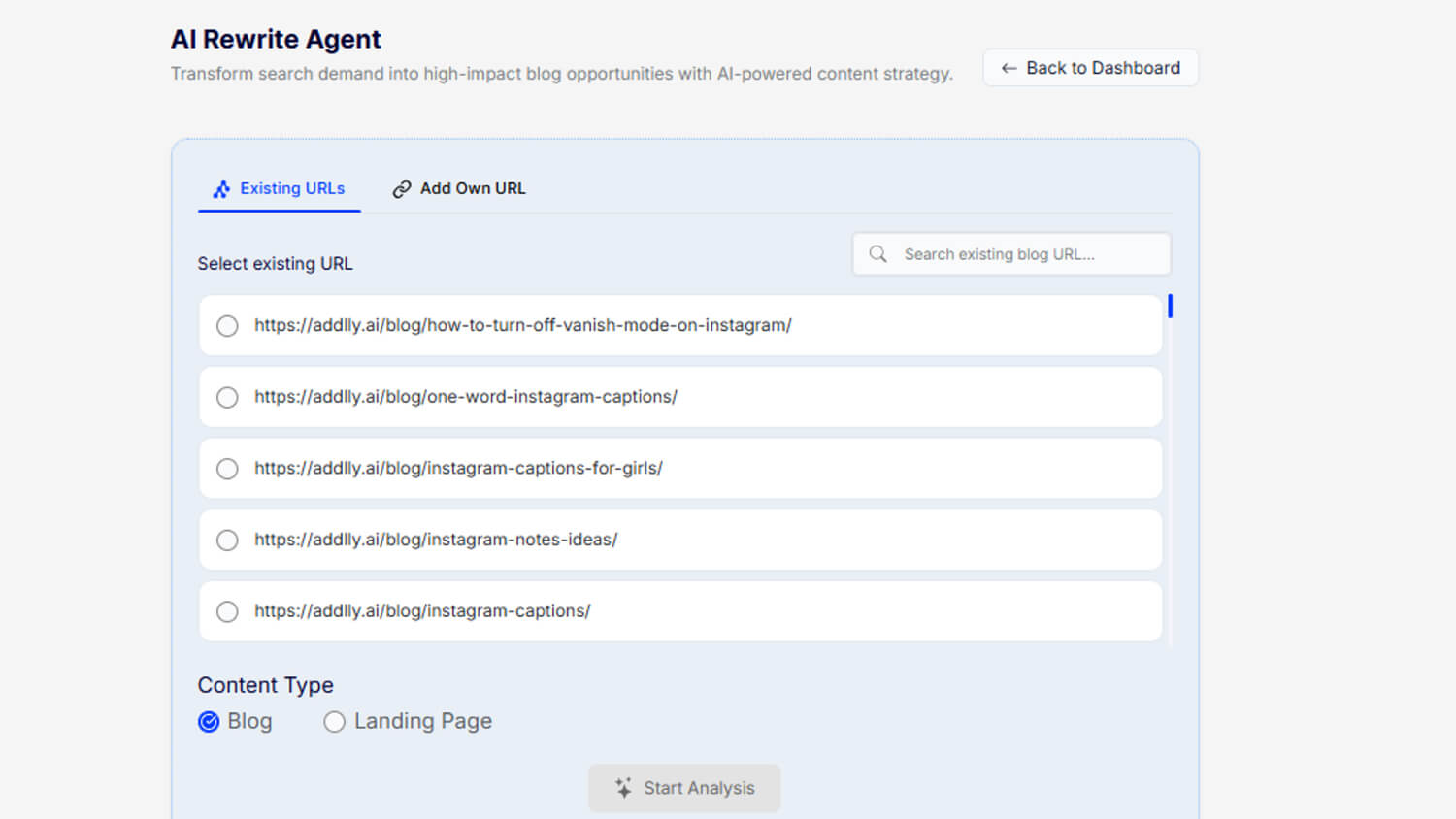
Where our GEO AI Agent focuses on net new content, our GEO AI Rewrite Agent takes pages you already have and rebuilds them for Generative Engine Optimization and AI search visibility.
Instead of starting from a blank page, it works with your existing content and:
- Cleans up the structure so AI tools can scan and summarise it more reliably.
- Strengthens entity clarity around your brand, products, and categories.
- Improves how well the page answers real questions users ask in AI platforms.
- Keeps what is working (for example: tone, examples, links) while fixing what blocks AI citations.
It is the best option when you know a page matters, but AI engines do not know what to do with it.
What Addlly AI’s GEO AI Rewrite Agent Optimizes
Our GEO AI Rewrite Agent focuses on the parts of a page that matter most for AI models and GEO.
It typically improves:
-
AI answer compatibility
So key sections can be easily quoted, summarised, and reused in answers. -
Entity clarity
So your brand, products, audiences, and categories are unambiguous and consistently described. -
Structure and flow
So headings, sections, and transitions make sense to both users and AI systems. -
Question coverage
So the page responds more clearly to high-intent, AI-style queries and follow-up questions. -
Readability and conciseness
So content is easier to process without losing nuance, context, or compliance considerations.
The goal is to keep the core idea and equity of the page while making it much easier for AI platforms to reuse.
How Addlly AI’s GEO AI Rewrite Agent Connects to the Audit Tool
Our GEO AI Rewrite Agent works best when it is fed by our GEO AI Audit Tool, rather than used in isolation.
The typical flow looks like this:
- 1. The GEO AI Audit Tool highlights which pages are weak for AI search visibility and explains why.
- 2. You select the highest impact pages where a rewrite is more efficient than starting again.
- 3. The GEO Rewrite AI Agent produces updated versions that address those specific gaps.
- 4. You publish, monitor changes in AI mentions and citations, and feed new results back into future audits.
Together with the GEO AI Agent, this gives you a clear split:
- Use Write with our GEO AI Agent for missing coverage and new topics.
- Use Rewrite with our GEO Rewrite AI Agent for underperforming assets.
This flow is guided by the results from the GEO AI Audit.
Choosing Between Write and Rewrite
Within Addlly AI’s GEO Agents ecosystem, you can either create something new with our GEO AI Agent or upgrade an existing page with the GEO AI Rewrite Agent. Picking the right one keeps your effort focused.
You should usually choose Write with our GEO AI Agent when:
- There is no strong existing page for a high-intent AI-style question.
- Our GEO AI Audit Tool shows clear topic gaps or missing themes.
- You are entering a new market, language, or product category.
- Existing content is off-brand, misaligned, or easier to replace than fix.
You should usually choose Rewrite with Addlly AI’s GEO Rewrite AI Agent when:
- A page ranks or converts, but is rarely cited in AI answers.
- The content has value and links, but weak structure or clarity.
- Parts of the page are outdated, but the core idea still works.
- You want improvements without losing established SEO equity.
In practice, most teams use both: audit first, write where you have nothing, rewrite where you have something worth keeping.
How the Three AI GEO Agents Work as a System
Individually, each of our AI GEO Agents solves a specific problem. Together, they form one continuous GEO workflow that fits into your existing marketing and SEO operations. The idea is simple: use data from the audit to decide what matters, use “write” to cover what is missing, and use “rewrite” to upgrade what already exists. This system ensures that every content action pushes AI search visibility in a deliberate direction.
The Addlly AI GEO Workflow
By this point, you have seen each Addlly AI GEO Agent on its own. This section explains how they work as a single system inside real planning and publishing cycles.
The three agents work in sequence:
- 1. Our GEO AI Audit Tool reveals where you stand in AI search and which pages or topics matter most.
- 2. Our GEO AI Agent creates AI-ready content for the gaps the audit exposes.
- 3. Our GEO Rewrite AI Agent modernises existing pages that are worth keeping but not yet GEO-ready.
You move from scattered one-off tasks to a recurring Addlly AI GEO workflow.
A standard Addlly AI GEO workflow looks like:
- Run our GEO AI Audit Tool to see where your brand appears in AI answers, how it is described, and where competitors are visible instead of you.
- Use our GEO AI Agent when there is no strong page for a topic or question.
- Use our GEO Rewrite AI Agent when a page has value but weak AI visibility or structure.
- Group changes into sensible batches, publish, and then watch how AI mentions and citations shift.
- Repeat the audit on a regular cadence so GEO stays aligned with your broader marketing and SEO programmes.
Audit insights flow naturally into your normal content or SEO backlog:
- New briefs can start inside Addlly AI’s GEO AI Agent.
- Refresh work can plug into existing content review cycles using the Addlly AI’s GEO Rewrite AI Agent.
- Reporting simply adds AI visibility alongside rankings, traffic, and conversions.
Supporting Long-Term GEO Strategy
Over time, the same three agents keep your GEO strategy moving:
- Recurring GEO audits with our GEO AI Audit Tool keep your view of AI search visibility up to date across engines and regions.
- Our GEO AI Agent gives you a repeatable way to launch new AI-ready content.
- Our GEO Rewrite AI Agent lets you retrofit and modernise older content without starting from zero.
The result is a content library that is SEO friendly and AI-ready by default, and a GEO process that runs like any other ongoing marketing programme rather than a one-time experiment.
The Addlly AI Agentic Platform
Underneath all three GEO Agents sits the Addlly AI agentic platform. This is the core differentiator that turns “three tools” into a coordinated GEO system. Instead of producing disconnected outputs, the platform is designed to keep strategy, brand context, and execution aligned. This is so audits, briefs, drafts, and rewrites reinforce each other rather than drifting over time.
What Makes Addlly AI’s Agentic Platform Different
Instead of isolated templates or prompts, Addlly AI runs specialised AI agents on a shared orchestration layer:
- A shared Brand Vault holds your products, tone of voice, positioning, and compliance rules so Addlly AI’s AI GEO Agent works from the same source of truth.
- A modular, multi-agent workflow lets different agents handle research, query design, outline generation, drafting, and rewriting without you having to micromanage prompts.
- A zero-prompt, workflow-first experience means teams work through guided steps (Audit → Plan → Write → Rewrite) rather than crafting manual prompts for every task.
- The platform is LLM agnostic and cloud native, designed to run on enterprise-grade infrastructure (Azure, AWS) while respecting security, governance, and data residency needs.
- The same agentic backbone powers Addlly AI’s other marketing agents (for SEO, GEO, schema, PDPs, newsletters, social content), so GEO can be plugged into your wider content system.
Practically, this agentic design means:
- You get consistent outputs across audits, briefs, drafts, and rewrites because they all sit on the same brand-trained platform.
- You avoid scattered “AI experiments” and instead run a repeatable, governed GEO process that can be handed to teams, agencies, and regions.
- You can expand from a GEO pilot into a broader AI marketing operating system without switching tools or rebuilding workflows.
This is where Addlly AI’s GEO suite differentiates itself from point solutions: it is an agentic platform first, a set of GEO tools second.
Outcomes and Business Value
Across our GEO AI Audit Tool, GEO AI Agent, and GEO AI Rewrite Agent, teams usually notice several shifts:
On the AI search visibility side:
- Better AI search visibility, with your brand appearing more often in AI-generated answers and summaries.
- More citations to your own pages instead of only to competitors or generic sources.
- Clearer and more consistent brand descriptions across AI platforms and markets.
On the day-to-day workflow side:
- Content planning becomes clearer because audits show which topics and pages matter most.
- Drafting goes faster because our GEO AI Agent replaces blank documents with AI-aware structures.
- Refresh cycles are more focused because our AI GEO Rewrite AI Agent targets pages that genuinely need work.
- Review rounds shrink because content arrives closer to your brand voice and AI search needs.
You are not just producing more content. You are spending time on work that AI is more likely to understand, trust, and reuse.
Visibility and Citation Impact
Most teams layer GEO metrics on top of what they already track for SEO and content.
Common signals include:
- Changes in AI mentions and citations for the brand and key pages.
- Performance of pages created or rewritten with Addlly AI compared to similar, untouched pages.
- Shifts in organic traffic, engagement, and conversions for content included in GEO work.
- Differences in how AI platforms describe the brand before and after a GEO rollout.
Where data is available, teams also connect these changes to pipeline, leads, or revenue for high-intent topics and segments.
The goal is simple:
- Move from “we hope AI sees us”
- To “we know where we stand, what changed, and how Addlly AI’s AI GEO Agents contributed.”
Workflow and Team Efficiency Gains
Beyond visibility, teams often see immediate operational wins once GEO becomes a repeatable process. Audits reduce guesswork, so planning is anchored on the pages and topics most likely to influence AI answers. This cuts low-impact work.
Common efficiency gains include:
- Faster planning and briefing: AI-ready outlines and target questions shorten kickoff cycles.
- Quicker draft-to-publish: Writers start from structured drafts that are easier to finish and refine.
- Fewer review rounds: Content lands closer to brand voice and compliance needs, so approvals focus on polishing, not rebuilding.
- More focused refresh cycles: Rewrites target the pages that truly need updates instead of broad refresh programs.
- Smoother coordination: Shared standards help regions, teams, and agencies work consistently.
The result is a more predictable content engine that scales without sacrificing quality or consistency.
How Teams Measure Business Impact
Enterprise teams usually measure GEO impact in layers, starting with visibility signals and then connecting them to the same business outcomes they already track for SEO and content.
Establish a Baseline Before Rollout
Start by capturing what “normal” looks like across priority topics and markets. Teams typically document current AI mentions and citations, which pages are being referenced, and how AI platforms describe the brand. This makes it easier to prove what changed after new pages and rewrites ship.
Track AI Visibility as a Leading Indicator
Because AI answers can shift quickly, teams monitor early signals that show whether GEO work is being picked up:
- Brand and page-level mentions across target engines
- Citation frequency and which URLs are cited
- Share of voice in shortlists for high-intent queries Changes in brand framing, accuracy, and consistency across markets
Prove Impact with Cohorts and Comparisons
The most common approach is simple: compare performance of pages created or rewritten with Addlly AI against similar untouched pages. Teams often group work into batches, publish, then review changes over a set window to spot clear deltas in mentions, citations, and downstream behaviour.
Connect GEO to Outcomes the Business Already Believes
Once visibility shifts show up, teams tie them to familiar metrics:
- Organic traffic, engagement, and conversions on GEO-touched pages
- Assisted pipeline or lead volume for high-intent topics
- Changes in branded demand or demo requests tied to priority segments
Report on a Repeatable Cadence
Many teams add GEO reporting into existing SEO dashboards, with a monthly view for trends and a quarterly view for business impact, so GEO stays measurable and operational.
Summary
Our AI GEO Agents give brands a structured way to compete in AI search, not just traditional SEO.
Instead of guessing how AI platforms see your content, you get a clear system:
- Our GEO AI Audit Tool shows where you stand and which pages and topics matter most.
- Our GEO AI Agent creates new, AI-ready, SEO friendly content that reflects real AI search behaviour.
- Our GEO AI Rewrite Agent upgrades what you already have, so valuable pages are understood, trusted, and cited.
Because all three of Addlly AI’s AI GEO Agents run on the same agentic platform, working from a shared Brand Vault and consistent workflows, your content engine starts to operate as one coordinated system.
- AI search visibility improves.
- Brand descriptions become more accurate and consistent.
- Planning shifts from hunches to data and from volume to impact.
GEO turns into a repeatable loop:
- 1. Audit what exists.
- 2. Create what is missing.
- 3. Rewrite what should perform better.
So your brand can show up, be understood, and be cited across AI-generated answers, while still performing strongly in traditional search.
FAQs
Addlly AI’s AI GEO Agents help brands appear more often and more accurately inside AI-generated answers by improving how AI systems interpret, summarise, and cite content, while still supporting strong performance in traditional search engines.
The AI GEO Audit Tool is the recommended starting point. It reveals current AI visibility, brand framing, citation patterns, and competitor positioning, making it clear which pages or topics should be prioritised next.
The GEO AI Agent is used to create new AI-ready content where gaps exist. The GEO AI Rewrite Agent is used to improve existing pages that already have value but are not being cited or understood by AI systems.
The workflow is designed to support visibility across major AI answer engines where users ask conversational questions and receive summarised responses, including ChatGPT, Perplexity, Gemini, Claude, Grok, and Google AI Overviews.
Clear brand and product context produces the best results. This typically includes positioning, target audiences, tone guidelines, constraints, and compliance requirements, which help ensure content remains accurate and consistent.
Teams usually track AI mentions, citations, and brand framing as leading indicators, then connect those signals to familiar business metrics such as organic traffic, engagement, conversions, and assisted pipeline performance.
Many teams run audits on a recurring cadence to monitor shifts in AI visibility and competitor positioning. Monthly tracking is common for trends, with deeper quarterly reviews to assess impact and prioritise updates.
In many cases, yes. Standardised structures, clearer entity definitions, and AI-ready drafts typically reduce heavy rewrites, leading to fewer review cycles and faster time from brief to publication.
Yes. The workflow is designed for enterprises with multiple teams, regions, or product lines, helping maintain consistent brand understanding and AI visibility across large and distributed content ecosystems.