
How Does Addlly AI’s GEO Suite Help Brands Rank in ChatGPT, Perplexity, and AI Overviews
The Addlly AI GEO Suite is designed to help brands understand how to rank inside modern AI search experiences such as ChatGPT, Perplexity, and Google AI Overviews, where answers are generated, summarized, and cited instead of simply listed as links. As discovery shifts from traditional search results to AI-powered responses, many brands that perform well in SEO still struggle to appear in these environments.
This guide explains how Generative Engine Optimization works, how answer engines choose which sources to trust, and how Addlly AI helps teams create structured, machine-readable, and citation-friendly content that improves AI search visibility across today’s most influential platforms.
Amplify AI Search Visibility (GEO)
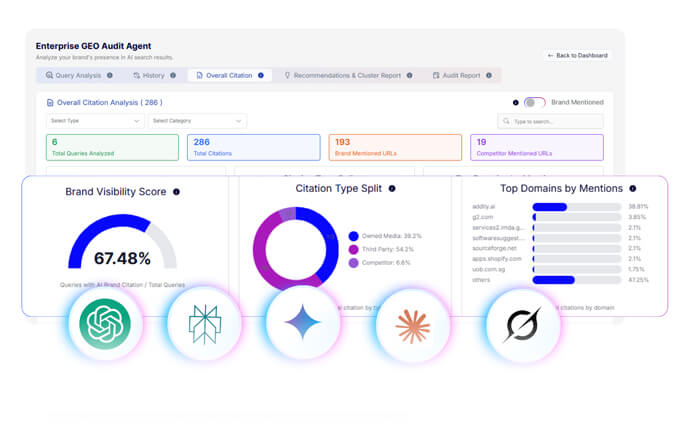
GEO Audit AI Tool
Runs a full AI search visibility audit across platforms like ChatGPT, Gemini, and Perplexity, compares you with competitors, and identifies where you’re missing citations.
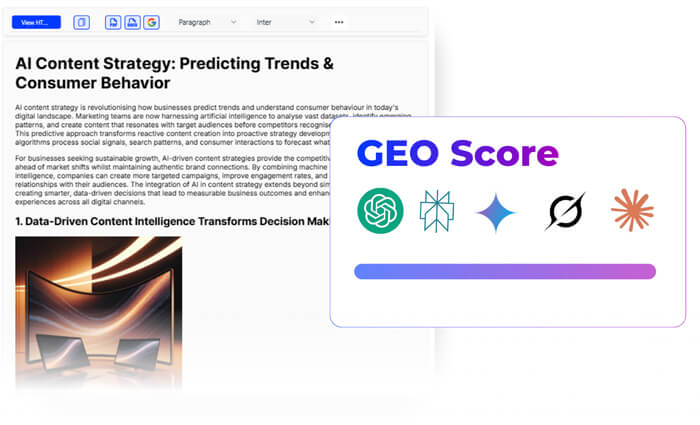
GEO Rewrite AI Agent
Optimizes and refreshes existing copy so it’s SEO-friendly and AI-search ready, making every update count for rankings and citations.
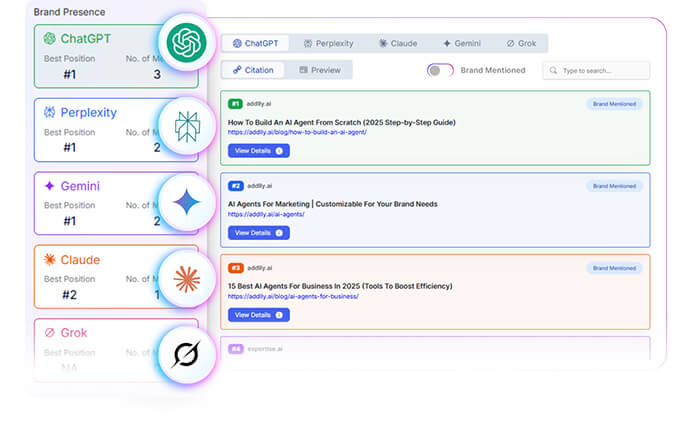
GEO AI Agent
Creates brand-focused, citation-ready content designed to appear in AI-powered search results and close visibility gaps.
What Is Generative Engine Optimization (GEO)?
Generative Engine Optimization, or GEO, is the practice of making your brand discoverable, understandable, and citable inside AI-generated answers.
Instead of optimizing pages to rank higher on a list of links, GEO focuses on helping AI systems extract your content, trust it, and reference it when they generate responses.
Think of it this way. SEO helps you get found. GEO helps you get quoted.
When someone asks ChatGPT for tools, strategies, or recommendations, the model does not rank websites the way Google does. It synthesizes information from sources it recognizes as clear, authoritative, and structured.
That shift is at the heart of Generative Engine Optimization, where visibility depends on citations, entity clarity, and machine-readable signals rather than keyword positions alone.
How GEO Differs From Traditional SEO
Traditional SEO was built for search engines that index pages and rank them using keywords, backlinks, and technical signals. GEO works differently because AI systems are not simply sorting links. They are composing answers.
Here’s a simple comparison:
| Traditional SEO | GEO |
|---|---|
| Ranks links | Generates answers |
| Optimizes keywords | Optimizes meaning and entities |
| Focuses on clicks | Focuses on citations and mentions |
| Measures traffic | Measures visibility inside AI responses |
The contrast between these two approaches is similar to what many teams notice when comparing GEO vs SEO, where rankings matter less and answer inclusion matters more.
With SEO, success means position one. With GEO, success means being referenced inside the answer itself.
Why Large Language Models Rank Answers Differently
Large language models do not crawl the web and return a ranked list of pages.
They interpret context, detect entities, summarize information, and select sources that appear credible and easy to extract. That is why dense, keyword-heavy pages often struggle while clean, structured content gets quoted more frequently.
In many ways, discovery has shifted from search engines to answer engines, where systems synthesize information instead of sending users to ten separate links.
Formats that consistently perform better include:
- Direct definitions
- Step-by-step instructions
- FAQs
- Tables
- Short, self-contained explanations
If a paragraph can stand alone and clearly answer a question, it becomes easier for an AI to reuse.
Why GEO Matters for Modern Brand Visibility
Here’s the part most teams underestimate.
Your buyers are already asking AI tools:
- Best tools for content marketing
- Top AI marketing platforms
- What software should I use?
If your brand is not mentioned inside those answers, you effectively disappear at the moment of decision.
Not ranking is one problem. Not being cited is a bigger one. This is where principles commonly associated with answer engine optimization come into play, focusing on structured, citation-friendly content that AI systems can confidently reference.
GEO helps you:
- Increase brand mentions in AI answers
- Improve citation probability
- Build topical authority across related content
- Make your expertise machine-readable
- Stay visible even in zero-click environments
For many brands, this becomes the difference between being compared and being forgotten.
How AI Search Engines Choose What to Cite and Recommend
Before optimizing anything, it helps to understand how AI systems actually pick sources. They are not random. They follow patterns.
Most answer engines evaluate three layers:
- 1. Clarity: Can this content be easily summarized or quoted?
- 2. Authority: Does this brand consistently publish high-quality, topic-focused content and earn mentions?
- 3. Structure: Is the page formatted in a way machines can parse and extract reliably?
In practice, this means AI engines favor well-structured articles, consistent topical clusters, factual language, and strong entity signals that reduce ambiguity.
Once you understand these mechanics, GEO stops feeling abstract and starts feeling systematic.
Why Are Brands Invisible in AI Search Results?
Many teams notice something confusing when they start checking AI tools. Their pages rank well on Google, traffic looks steady, yet their brand rarely appears inside ChatGPT, Perplexity, or Google AI Overviews. It feels like they did everything right, but still don’t show up.
The reason is simple. AI search systems do not treat visibility the same way traditional search engines do. Instead of presenting a list of websites for users to explore, they read multiple sources, combine the information, and surface only a few references inside a generated answer. That filtering step changes who gets seen.
If your content is difficult to interpret, loosely structured, or unclear about what your brand actually offers, the system often skips it even if the page ranks well. From the model’s perspective, it is safer to cite sources that are direct, well-organized, and easy to extract from.
As a result, strong SEO performance does not automatically translate into AI visibility. Ranking alone is no longer enough. Your content also has to be understandable and citable.
Here’s what they actually look for:
- Clear entities they can recognize and trust
- Structured, scannable content that is easy to quote
- Topical authority across multiple related articles
- Consistent brand mentions across the web
- Content that directly answers questions, not just targets keywords
Most brands still optimize only for traditional SEO. They chase rankings and backlinks, yet overlook machine readability and answer extraction. That is exactly why traditional SEO is no longer enough in an AI-first discovery environment.
So the content exists, yet AI cannot confidently use it.
In short, visibility today depends less on where you rank and more on whether an AI system can understand, trust, and cite you. This is where Generative Engine Optimization becomes essential.
That gap between ranking and recognition is precisely why brands feel invisible across AI search.
Why Traditional SEO Alone Is No Longer Enough
Traditional SEO still plays an important role in helping search engines crawl, index, and rank content. Strong keywords, backlinks, and technical hygiene continue to influence how pages perform on Google. However, these signals were designed for a system that presents users with a list of links to explore.
AI search tools operate differently.
Platforms such as ChatGPT, Perplexity, and Google AI Overviews do not primarily send users to websites. Instead, they generate summarized responses by combining information from multiple sources. The user often gets the answer directly on the screen, without needing to click through. As a result, a page can rank well and still receive little to no visibility within these AI-generated experiences.
This is one of the reasons many marketers have noticed that AI search is killing your organic traffic, even when rankings and impressions appear stable in traditional analytics.
The challenge is not only about where you rank anymore. It is about whether your content is selected, interpreted, and cited by AI systems.
Rankings Do Not Guarantee Inclusion in AI Answers
Search rankings measure position on a results page. AI systems do not work with positions in the same way.
When an AI tool generates an answer, it evaluates which sources are clear, trustworthy, and easy to extract information from. It may ignore several high-ranking pages if the content is difficult to parse or does not directly address the question.
In practice, this means that structured explanations, concise definitions, and well-organized sections often perform better than long, keyword-heavy articles. These patterns align closely with what teams learn when studying how to rank in AI search results, where formatting and answer clarity influence visibility more than traditional optimization tactics.
Simply put, ranking is no longer the same as being referenced.
Where Traditional SEO Methods Fall Short
Most SEO strategies focus on improving discoverability for crawlers and algorithms that score pages based on relevance and authority. That approach works well for link-based search engines, but it does not fully address how AI models interpret content.
Large language models evaluate meaning and relationships. They look for:
- Clear entities such as brands, products, and categories
- Direct answers to specific questions
- Consistent topical coverage across multiple pages
- Structured formatting that can be easily summarized
When these elements are missing, even strong content may be overlooked. This becomes especially visible during a GEO audit checklist, where gaps in structure, entity signals, and machine readability often surface despite solid SEO performance.
Visibility Now Depends on Citation, Not Just Traffic
The practical impact is subtle but significant.
If your brand is not cited inside AI-generated responses, potential customers may never encounter you during early research. Competitors who are mentioned become the default options, even if their websites are not ranking higher in traditional search results.
This broader transition from blue links to AI answers changes how discovery happens. Instead of choosing among ten links, users rely on synthesized recommendations. Brands that are optimized for citation gain disproportionate exposure, while others gradually lose mindshare.
For this reason, SEO remains necessary, but it is no longer sufficient on its own. A complementary GEO strategy is required to ensure your content is not only indexed, but also understood and referenced.
How to Rank in ChatGPT Search Results
ChatGPT does not rank websites the way Google does. It generates a direct answer by combining information from sources it considers clear, trustworthy, and easy to interpret. This means your goal is not to chase positions on a results page, but to make your content structured enough to be extracted and cited inside the response itself.
In practice, improving visibility often comes down to strengthening your brand’s presence and associations across the web. Content that consistently explains what you do, where you fit, and how you help makes it easier for the model to recognize and reference you. The same ideas show up when working on getting your brand mentioned in ChatGPT, where entity clarity and topical authority play a bigger role than classic on-page tricks.
To improve your chances of being included, focus on:
- Writing answer-first paragraphs that address one question at a time
- Using headings, lists, and tables to make information easy to extract
- Building multiple related articles around the same topic to establish authority
- Keeping claims specific and factual rather than promotional
When your content is easy for a human to skim and understand, it is usually easier for ChatGPT to reuse as well. Visibility follows clarity.
What Addlly AI Can Do for You to Rank in ChatGPT
Applying these practices manually can take time, especially when teams are juggling research, writing, and optimization across multiple articles. Addlly AI simplifies this process by turning ChatGPT visibility into a structured workflow rather than a series of one-off tasks.
It helps you:
-
Identify visibility gaps
Run a GEO Audit to uncover pages that are hard for AI systems to interpret or cite. -
Create AI-ready content faster
Use the AI GEO Agent to generate structured, answer-first content designed for extraction and summarization. -
Publish consistently with clarity
The AI Blog Writer produces well-formatted, citation-friendly posts that align with how answer engines process information. -
Align SEO with GEO
The SEO AI Agent ensures your content performs across both traditional rankings and AI-generated responses.
With the right structure in place, improving ChatGPT visibility becomes systematic instead of manual.
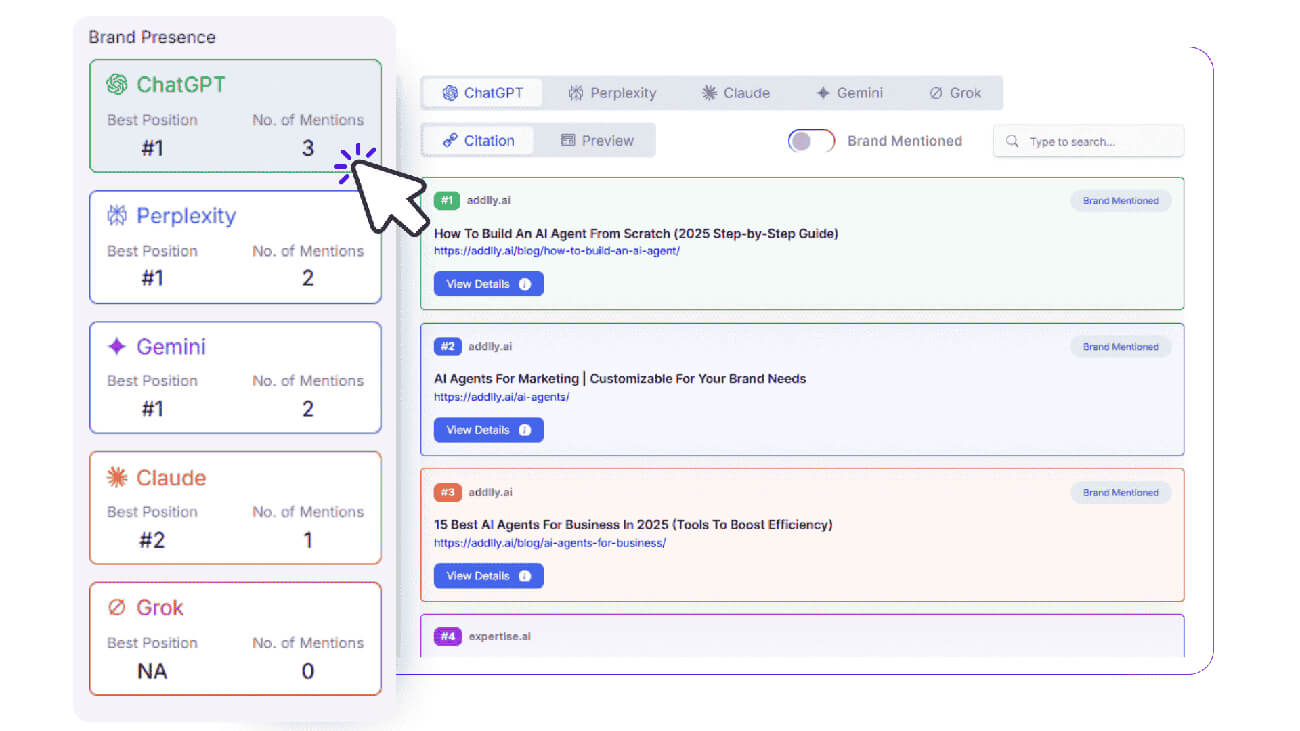
How to Show Up in Perplexity AI
Perplexity behaves differently from most AI tools because it shows its sources alongside every answer. Instead of generating a response without attribution, it cites the pages it pulls information from.
This makes visibility more transparent and, in many ways, more measurable.
If your page is clear and authoritative, it gets cited. If it is vague or generic, it is skipped.
Unlike traditional SEO, where ranking position drives clicks, Perplexity rewards credibility and structure. It tends to favor content that explains a topic thoroughly, presents facts cleanly, and comes from domains that consistently publish useful, focused material. These patterns are easy to notice when comparing tools in Perplexity AI vs ChatGPT, where Perplexity leans more heavily on explicit citations and sources.
Because every answer links back to references, your content must do two things well: communicate expertise and be easy to extract.
To improve your chances of appearing as a cited source:
- Write complete, self-contained explanations rather than surface-level summaries
- Support claims with specifics, examples, or data
- Organize content with descriptive headings so sections can stand alone
- Publish multiple articles within the same topic to build authority
- Maintain consistent terminology for your brand, products, and categories
It also helps to think beyond your own website. Perplexity often pulls from discussions, reviews, and third-party mentions. Strategies commonly used in monitoring and tracking brand mentions in AI answers can reveal where your brand is already being referenced and where visibility gaps exist.
In short, Perplexity rewards sources that look credible enough to cite publicly. The clearer and more trustworthy your content appears, the more likely it is to be included.
What Addlly AI Can Do for You to Show Up in Perplexity AI
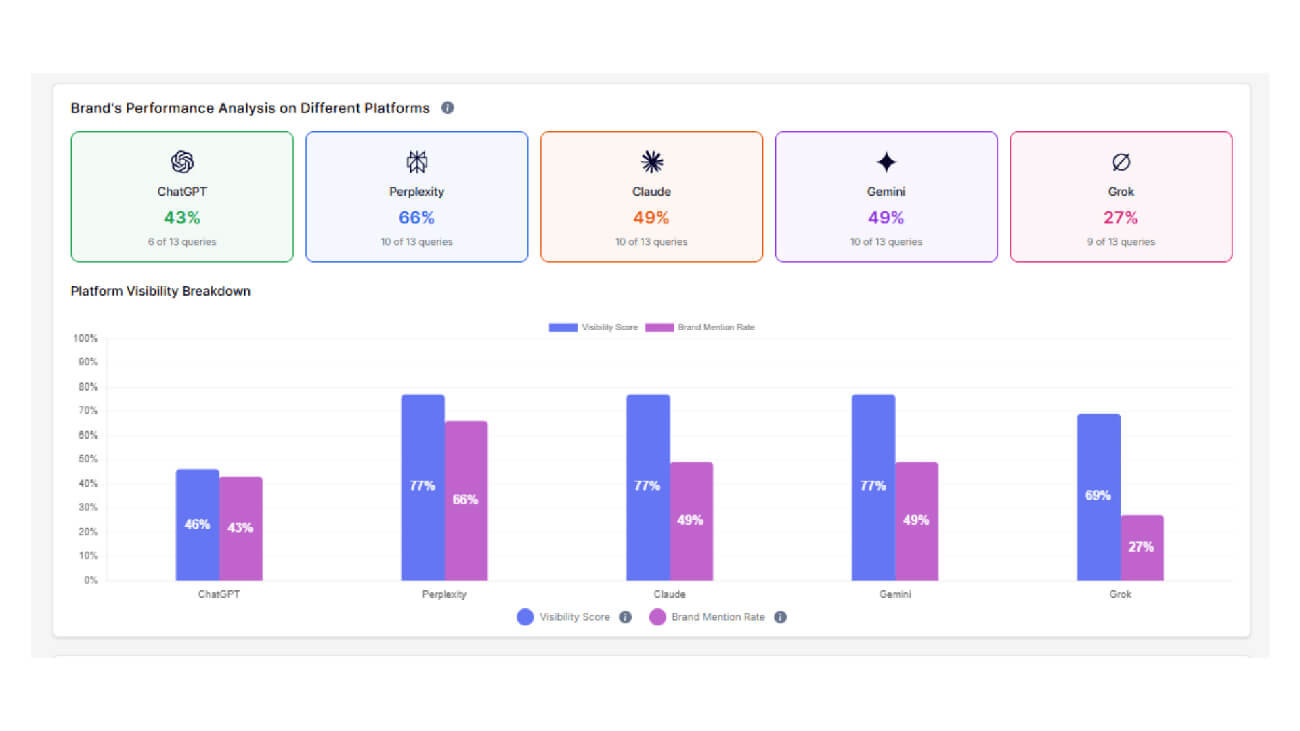
Managing citations across owned content and external mentions can be time-consuming. Addlly AI helps teams standardize and scale this process so authority signals are built consistently rather than manually.
It helps you:
-
Audit citation readiness
Identify pages that lack depth, structure, or clarity that prevent Perplexity from citing them. -
Create authoritative content faster
Generate well-researched, structured articles that are easier to reference and extract. -
Maintain topical coverage
Plan and publish related content clusters so your brand becomes a consistent source within a category. -
Track brand visibility
Monitor where your brand appears across AI answers and uncover missed opportunities.
How to Appear in Google AI Overviews
Google AI Overviews blend generative answers directly into the search results page. Instead of showing only blue links, Google summarizes information from multiple sources and presents a compiled response at the top, often before users scroll.
This means your content may influence the answer even when users never visit your page.
Unlike ChatGPT or Perplexity, Google still relies heavily on its traditional search infrastructure. Rankings, authority, and technical SEO continue to matter, but they are no longer enough on their own. Pages must also be structured in a way that Google can easily interpret, extract, and summarize.
In many ways, this is where classic SEO and GEO overlap.
Content that performs well in AI Overviews typically:
- Answers specific questions directly and early
- Uses clear headings that match search intent
- Includes structured data and schema markup
- Demonstrates topical depth across related articles
- Avoids filler and overly promotional language
Technical clarity plays a bigger role here than in most AI tools. Proper formatting and schema help Google understand what each section represents, which is why the role of schema markup in AI search visibility has become increasingly important for teams optimizing for AI-driven results.
It also helps to think in terms of complete topic coverage rather than isolated posts. Publishing clusters of related content strengthens authority and improves your chances of being selected as a source, similar to the practices outlined in how to rank in AI Overviews, where structure and comprehensiveness directly affect inclusion.
At a practical level, if Google can quickly identify what your page explains and trust the information, it is far more likely to feature it inside the generated summary.
What Addlly AI Can Do for You to Appear in Google AI Overviews
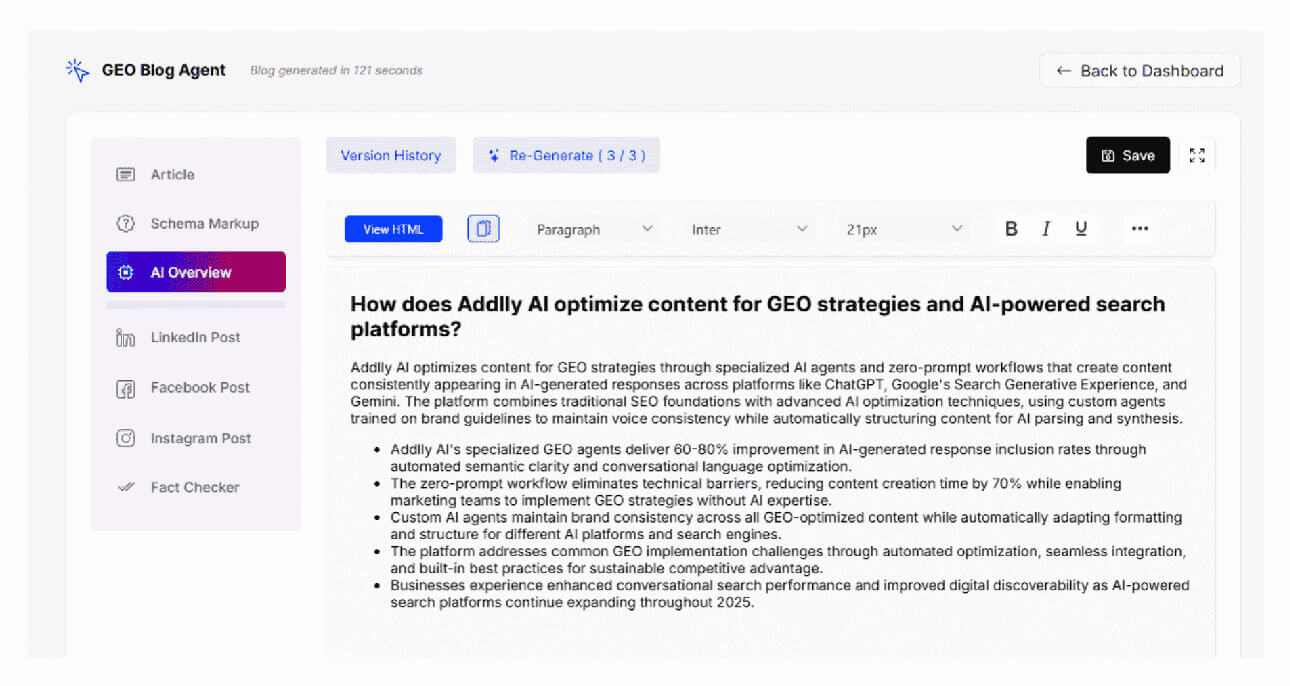
Balancing traditional SEO requirements with AI-ready structure can create extra work for marketing teams. Addlly AI helps combine both into a single workflow so content is optimized for rankings and AI summaries at the same time.
It helps you
-
Run structured audits
Detect technical and content gaps that limit eligibility for AI Overviews. -
Generate schema-friendly, well-formatted content
Produce pages that are easier for Google to parse and summarize. -
Align SEO and GEO together
Ensure content performs across search results and AI-generated answers without separate processes. -
Scale publishing consistently
Maintain topic depth and freshness across clusters that strengthen authority signals.
A Practical GEO Checklist for Marketing Teams
By this point, one thing should be clear. Ranking well on Google does not automatically translate into visibility inside AI-generated answers.
Generative Engine Optimization works best when treated as an ongoing content and structure discipline, not a one-time fix. Instead of chasing isolated tactics, teams need a repeatable system that makes their content easier for AI platforms to understand, trust, and cite.
The checklist below summarizes the core areas to focus on. Most of these improvements are incremental, but together they significantly increase your chances of being referenced across ChatGPT, Perplexity, and Google AI results.
| Area | What to Do | Why It Matters for AI Visibility |
|---|---|---|
| Content Structure | Use clear headings, short paragraphs, lists, and tables | Makes information easier for AI systems to extract and summarize |
| Answer Clarity | Lead with direct definitions and explanations | Improves citation probability inside generated answers |
| Entities | Clearly describe your brand, products, and categories consistently | Helps models recognize and associate your brand with topics |
| Topic Coverage | Publish multiple related articles instead of isolated posts | Builds topical authority and trust signals |
| Technical SEO | Add schema and maintain clean HTML structure | Improves machine readability and indexing |
| Authority Signals | Earn mentions, references, and backlinks from credible sites | Strengthens trust and likelihood of being cited |
| Brand Monitoring | Track where and how your brand appears inside AI tools | Identifies visibility gaps and opportunities |
| Audits | Regularly review your site using a structured GEO audit process | Surface structural and discoverability issues early |
Treat this checklist as part of your regular publishing workflow. Teams that review these factors consistently tend to see steadier improvements in AI visibility over time.
How Addlly AI GEO Suite Simplifies AI Search Visibility
Implementing GEO manually can quickly become fragmented. Teams often juggle audits, content rewrites, structural fixes, and tracking across multiple tools, without a clear way to measure whether their brand is actually being cited inside AI platforms.
The Addlly AI GEO Suite brings these efforts into one system. As part of Addlly AI’s Gen AI solutions for digital marketing, it translates GEO best practices into repeatable workflows so content is not only published, but consistently optimized for discoverability across ChatGPT, Perplexity, and Google AI results. Within Addlly AI, these workflows are supported by specialized AI agents that handle research, optimization, and content creation in a coordinated way rather than as disconnected tasks.
It supports teams through:
- GEO Audit: Evaluates your website for AI visibility gaps, entity strength, content structure, and machine readability so you can quickly identify what limits citations and mentions.
- AI GEO Agent: Optimizes and generates AI-ready content that is structured, answer-first, and designed to surface naturally inside generative search experiences.
- SEO AI Agent: Aligns traditional SEO fundamentals with GEO strategies, ensuring your pages perform across both search engines and AI answer platforms.
- AI Blog Writer: Produces well-structured, citation-friendly blog content engineered for AI discoverability, helping teams consistently publish articles that are easier for models to extract and reference.

Together, these capabilities turn GEO from a manual checklist into an operational process, allowing marketing teams to scale visibility across both traditional and AI-driven discovery channels with far less guesswork.
Summary
AI search has changed how discovery happens. Instead of scanning a list of links, users increasingly rely on generated answers that summarize, recommend, and cite sources directly. In this environment, visibility depends less on ranking positions and more on whether your content is clear enough for machines to understand and trustworthy enough to reference.
That shift is what Generative Engine Optimization addresses. Structured content, strong entities, topical depth, and consistent authority signals make it easier for platforms like ChatGPT, Perplexity, and Google AI Overviews to include your brand in their responses.
With the right system in place, AI visibility becomes predictable. When your content is built to be extracted and cited, inclusion follows naturally. The goal is no longer just to be indexed, but to be part of the answer itself.