
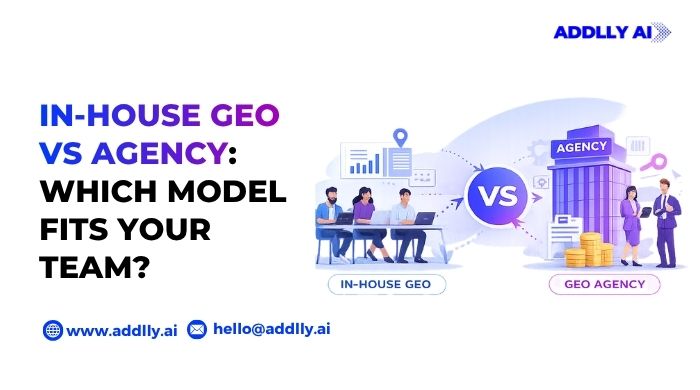
As consumer discovery shifts toward AI answer engines in 2026, enterprise marketing teams face a critical operational choice.
Deciding between in-house GEO vs hiring a GEO agency determines how effectively your brand adapts to this new search reality. Generative Engine Optimization (GEO) goes beyond traditional SEO by helping brands improve AI visibility across platforms such as ChatGPT, Perplexity, and Google AI Overviews.
As AI models increasingly generate direct answers instead of sending users to websites, businesses must decide whether to build GEO capability internally or rely on external GEO services. The right approach balances agency costs, internal resources, speed, governance, and long-term scalability.
This guide breaks down the key differences to help you choose the best generative engine optimization (GEO) strategy for the AI era.
Quick Summary – In-House GEO vs Agency
- Understand what Generative Engine Optimization requires beyond traditional search tactics.
- Compare internal teams and external agencies across cost, speed, and control.
- Discover how hybrid AI-assisted workflows reduce costs and accelerate delivery.
- Use a practical framework to choose the right model based on your operational reality.
What Does In-House GEO vs Agency Really Mean?
An in-house model means your internal team owns all optimization and content production to ensure maximum brand control. Conversely, an agency model outsources these tasks to external specialists for faster initial execution.
What GEO Adds Beyond Traditional SEO
To understand the generative engine optimization GEO execution model, we first need to look at how it differs from a standard GEO vs SEO strategy. Traditional search optimization focuses on ranking web pages through keywords and backlinks.
Today, AI answer engine optimization requires a completely different approach. You must ensure your brand is accurately understood and retrieved by Large Language Models. This involves deep entity optimization, GEO, and managing how your brand is perceived across the web.
A strong entity coverage strategy ensures that when a conversational engine generates an answer, your products are naturally included. This shift makes citation-building AI search a mandatory daily practice for marketing teams.
It is no longer just about getting clicks. It is about securing real estate in zero-click environments where users get their answers directly on the results page. As AI visibility becomes increasingly important, brands must optimize for AI-generated answers, brand mentions, and Google AI Overviews, not just traditional search rankings.
What Each Operating Model Includes
Evaluating an in-house GEO vs. an agency setup requires looking closely at daily responsibilities. A dedicated in-house marketing team at GEO handles everything from strategy to publishing. An external partner provides specialized GEO agency services but retains the core knowledge.
The choice often depends on available internal resources, required speed to market, and the level of generative engine optimization GEO capability already present within the organization. While in-house teams develop a deeper understanding of products and customers over time, a professional agency can provide immediate access to GEO experts, technical audits, and proven strategies.
| Feature | Internal Team Model | External Agency Model | Best For |
|---|---|---|---|
| Scope of Work | End-to-end internal management and content creation | Outsourced strategy, audits, and execution | Internal control |
| Knowledge Base | Stays within the company and compounds over time | Leaves the business when the contract ends | Internal Team Model |
| Speed to Launch | Slower initially due to hiring and workflow setup | Immediate access to established playbooks | External Agency Model |
Teams often find that blending internal ownership with specialized AI tools creates the most sustainable workflow for long-term growth. This hybrid model allows businesses to retain strategic control while benefiting from agency support when needed.
What Are the Key Differences That Matter Most?
The primary differences lie in upfront costs, deployment speed, and long-term governance. Internal teams win on control and asset ownership, while agencies win on immediate access to specialized expertise.
Cost, Ramp Time, and ROI Outlook
When looking at GEO budget planning, the financial structures differ wildly. A comprehensive GEO program cost in 2026 must account for either permanent headcount or recurring external fees.
Building GEO in-house typically requires investment in recruitment, training, AI tools, and workflow development before meaningful results appear. Many organizations underestimate the learning curve involved in developing GEO strategy internally. While long-term costs are often more predictable, time to value can take several months.
A GEO agency, by contrast, provides immediate access to specialized expertise, established processes, and execution resources. Professional GEO agency services can range from project-based pricing to a full-service retainer, making them attractive to brands that need faster deployment. The trade-off is that agency costs continue as long as the partnership remains active.
Control, Governance, and Brand Safety
For many enterprises, especially those needing GEO for B2B SaaS, strict data security is entirely non-negotiable.
- Approval workflows: Internal teams keep sensitive data secure during the review process.
- Brand voice consistency: Employees naturally understand the nuances of your messaging better than external writers.
- Compliance management: Regulated industries require tight control over what gets published and when.
Using an internal team also creates a deeper understanding of products, customers, and business objectives over time. A common mistake is handing over proprietary business data to external vendors without strict access controls in place.
Expertise, Speed, and Scalability
Comparing a GEO team vs agency often comes down to how fast you need to move right now. If you lack internal knowledge, navigating GEO specialist hiring can severely delay your launch. External partners bring immediate AI search content optimization skills to the table.
Many GEO agencies provide access to GEO experts with experience across AI search, structured data, technical audits, AI citation strategies, and visibility tracking. This can significantly reduce the time required to launch GEO campaigns and improve AI visibility.
However, in-house teams often gain an advantage over time. As internal knowledge grows and AI tools become integrated into daily workflows, organizations can scale GEO work more efficiently while retaining full ownership of their processes and data.
When Does In-House GEO Win?
In-house GEO wins when control, governance, and long-term capability matter more than immediate speed. This approach ensures your proprietary data remains secure while building lasting institutional knowledge.
Best for Control and Knowledge Retention
Building internal capabilities ensures your GEO content strategy aligns perfectly with broader company goals. When you own the process, your team naturally improves at AI citation tracking over time. This compounding knowledge means your GEO performance monitoring becomes more sophisticated and tailored to your specific products. You are not just renting expertise but building a permanent business asset.
This is especially true for managing Google AI Overviews optimization, where deep product knowledge is required to surface the right details. A strong GEO team structure allows you to pivot quickly when search algorithms evolve without waiting for an agency to update its strategy. Internal teams are often better positioned to maintain consistent brand messaging across AI-generated answers and rapidly adapt to changing user queries.
Best for Regulated or Complex Brands
Complex organizations often struggle with GEO outsourcing because of strict legal and compliance requirements. In highly regulated industries, maintaining GEO work internally often provides greater control over data governance, approval workflows, and AI visibility initiatives.
- Legal reviews: Internal teams can route documents through compliance much faster.
- Data privacy: Keeping operations inside the firewall prevents sensitive information leaks.
- Stakeholder alignment: Cross-functional teams collaborate more easily without an external middleman slowing things down.
For organizations operating in regulated industries, the ability to control content, approvals, and data access often outweighs the speed advantages offered by external agencies.
When Should You Hire a GEO Agency?
Agencies are best when speed and specialist support outweigh internal ownership. They provide immediate access to established playbooks when your internal team lacks the necessary skills or bandwidth.
Best for Fast Launches and Skill Gaps
If you need to quickly establish Perplexity brand visibility, external partners can deploy proven tactics immediately. Choosing to hire a GEO agency makes sense when you have an urgent product launch and cannot wait months to recruit talent. They bring a ready-made zero-click search strategy that can generate quick wins.
This is helpful when you need immediate AI-generated answers and visibility to outpace a nimble competitor. For companies evaluating a build vs buy GEO approach, agencies act as a vital bridge while internal resources catch up to speed. A professional agency can also provide immediate access to GEO experts, GEO specialists, technical audits, AI optimization workflows, and visibility tracking systems that may take months to build in-house.
Many GEO agencies bring a proven track record across multiple industries, allowing businesses to launch GEO campaigns faster and expand their AI search presence without the delays associated with hiring and training.
Where Agencies Often Fall Short
While fast, relying solely on an agency can introduce significant operational friction. There are several GEO agency red flags to watch out for as your program matures.
- Vendor dependency: Your company fails to develop its own institutional knowledge over time.
- Revision cycles: Communicating complex product nuances to external writers often requires multiple painful edits.
- Cost scaling: Increasing your output requires paying significantly more in external fees.
The biggest challenge is that long-term GEO capability often remains with the agency rather than the business itself. While agency support can accelerate execution, companies that rely entirely on outsourced GEO services may struggle to retain strategic knowledge, adapt their GEO strategy quickly, or scale AI visibility programs independently.
The most successful organizations treat an agency partnership as a way to accelerate execution while gradually strengthening internal capabilities. This approach combines external expertise with long-term ownership and creates a stronger foundation for sustainable AI search growth.
How Do Pricing and Long-Term Value Compare?
Internal costs center on payroll and software, offering predictable scaling. Agency costs focus on retainers and project fees, which can quickly become expensive as content volume increases. For many businesses evaluating in house GEO vs hiring a GEO agency, understanding long-term GEO costs is just as important as measuring short-term results.
What In-House Costs Usually Include
Understanding the true GEO internal team cost requires looking well beyond just employee salaries. Building GEO capability internally often requires investment in people, processes, software, and ongoing training.
- Headcount and benefits: The primary expense for strategists, content creators, and technical specialists.
- Tooling and platforms: Subscriptions for analytics, AI visibility tracking, and workflow management.
- Management overhead: The time spent training and directing the team daily.
Many businesses underestimate the costs associated with building GEO capability internally. Beyond salaries, organizations often invest in AI tools, structured data implementation, content governance, and reporting systems. Teams may also need additional resources to measure how their brand appears across AI responses, AI-generated answers, and traditional search engines.
For organizations producing large volumes of high-quality content, these investments can take months before meaningful results are achieved.
What Agency Costs Usually Include
A typical GEO agency monthly retainer covers strategy and a set amount of monthly deliverables.
- Project-based costs: Upfront fees for audits, strategy development, and implementation.
- Ongoing retainers: Monthly payments for continued execution and reporting.
- Communication overhead: The hidden cost of internal staff managing the vendor relationship.
Professional GEO agency services typically cost between $1,500 and $50,000 per month depending on strategy scope, content volume, and technical requirements. Some agencies operate on project-based costs, while others require a full agency retainer for ongoing support.
Hourly consulting for GEO typically ranges from $100 to $300, while AI visibility tracking software can cost between $50 and $1,000 monthly. GEO costs can range from as little as $10 per month for basic tools to enterprise-level investments exceeding $50,000 monthly.
For small businesses, agency support can provide immediate access to GEO expertise without the commitment of building an internal team. However, recurring agency retainers can become expensive as content production and GEO campaigns scale.
How Hybrid AI Models Change the Math
Comparing a GEO agency vs in-house team is no longer a simple binary choice. A GEO hybrid model offers the best of both worlds. By using brand-trained AI agents from platforms like Addlly AI, internal teams can scale execution while maintaining complete ownership of their GEO strategy.
This approach changes the economics of GEO significantly. Instead of choosing between building everything internally or paying for a full agency retainer, companies can combine internal expertise with AI-assisted execution.
Generative search prioritizes trusted sources over traditional rankings. As a result, AI visibility is increasingly about being recognized as a reliable source rather than simply ranking highly. AI systems rely on trusted, citable information, and citable knowledge is often prioritized over optimized content alone.
A hybrid approach allows organizations to create more high-quality content, improve AI visibility, and strengthen their presence in AI-generated answers without dramatically increasing headcount. It also helps teams maintain control over strategy in-house while reducing operational costs.
Many organizations are finding that GEO helps bridge the gap between traditional SEO and emerging AI search experiences. As AI systems continue evolving, businesses that combine human expertise with AI-powered workflows are often better positioned to scale efficiently and ensure their brand appears consistently across AI responses.
A mid-market retailer used a hybrid AI platform to refresh hundreds of product pages in weeks, avoiding a massive external project fee and accelerating its AI search growth.
How Should You Choose the Right GEO Model?
Choose your model by systematically auditing your current team capabilities, scoring your need for control versus speed, and running a small pilot program. This structured approach prevents costly operational mistakes and helps align your GEO strategy with your long-term business goals.
Step 1: Audit Team and Workflow Gaps
Before committing to a specific path, you must evaluate your current content operations GEO.
- Resource mapping: List your current writers, strategists, and technical optimization staff.
- Skill identification: Determine if your team understands AI search engine optimization concepts like entity retrieval, AI citations, and content structuring for generative search.
- Bottleneck analysis: Find exactly where your current publishing process slows down.
Many businesses discover that they have strong SEO foundations but lack the GEO capability required to improve AI visibility. Understanding these gaps early helps determine whether your organization should build in-house, work with a specific agency, or adopt a hybrid approach.
Step 2: Score Speed, Control, and Scale
Create a weighted scorecard to evaluate your options fairly. If you are managing GEO for mid-market brands, you might prioritize cost efficiency over absolute speed. Compare the expected GEO agency cost against the long-term benefits of internal ownership.
You must also weigh your SEO vs GEO investment to ensure balanced budget allocation. Consider the GEO scalability of each option. A rigid agency retainer might limit your growth, while internal GEO workflow automation can create greater flexibility over time.
When evaluating options, consider factors such as strategy scope, available internal resources, compliance requirements, and how quickly your team needs results. Many businesses initially choose agency support for execution before gradually bringing more GEO work in-house.
Step 3: Test a Hybrid Pilot First
Instead of immediately signing a contract for the GEO agency for enterprise services, test a smaller approach first. Run a pilot program focusing on a specific content refresh GEO campaign. Use Addlly AI to support your internal execution without full external dependence.
Measure the cycle time, monitor AI visibility improvements, and track early brand mentions and AI citationsto gauge success. This allows you to compare internal capabilities against expected GEO agency results before making a massive financial commitment.
A pilot approach is particularly useful because AI systems rely on evidence and performance data rather than assumptions. By testing a focused initiative first, you can better understand what drives AI responses, where your brand appears, and whether your current resources are sufficient to scale.
Sometimes, a focused GEO agency vs consultant engagement paired with strong internal AI tools is all you need.
Why Addlly AI Is Built for Modern GEO Teams
For many businesses, the choice is no longer simply in-house GEO vs hiring a GEO agency. The real challenge is building sustainable AI visibility without creating a large operational burden.
Building a GEO program internally requires investment in talent, workflows, governance, and ongoing optimization. At the same time, agency retainers and project-based costs can become expensive as content volume grows. This is why many organizations are adopting a hybrid approach that combines internal ownership with AI-powered execution.
Addlly AI helps teams scale Generative Engine Optimization without sacrificing control over their strategy, data, or brand voice. Instead of relying entirely on external agencies, businesses can use specialized AI agents to accelerate GEO work, improve AI visibility, and strengthen how their brand appears across AI-generated answers, Google AI Overviews, ChatGPT, and other generative engines.
- GEO Audit Agent: The GEO Audit Agent helps identify technical, content, and entity-level gaps that may prevent your brand from appearing in AI search results. It evaluates your website’s readiness for AI systems, uncovers citation opportunities, and provides actionable recommendations to improve AI visibility.
- AI Search Visibility Checker: The AI Search Visibility Checker helps brands understand where and how they appear across AI search platforms. Instead of relying solely on traditional search metrics, teams can monitor AI visibility, track brand mentions, and identify opportunities to improve their presence in AI responses.
- PDP AI Agent: For e-commerce brands, the PDP AI Agent helps optimize product detail pages so AI systems can better understand, retrieve, and recommend products. As AI-generated answers increasingly influence buying decisions, product content must be structured for both shoppers and AI models.
- AI Blog Writer: The AI Blog Writer helps marketing teams create high-quality content designed for both traditional search engines and AI search experiences. This allows brands to scale content production while maintaining consistency, quality, and alignment with their GEO strategy.
- AI GEO Agent: The AI GEO Agent helps teams execute GEO campaigns at scale by supporting content optimization, AI citation opportunities, entity development, and visibility growth. It enables organizations to build GEO capability faster without dramatically increasing headcount.
Choose the GEO Model That Matches Your Reality
The best approach depends entirely on your specific operating constraints, not fleeting industry trends. Internal teams offer unmatched control and knowledge retention, while external partners provide immediate specialist support.
However, for most modern organizations, a hybrid approach using AI-assisted execution delivers the perfect balance of ownership, efficiency, and scale. As AI answer engines continue to shape how consumers discover products, teams that combine smart strategy with scalable, brand-safe execution will dominate their markets.
Book a 20-minute workflow mapping session with Addlly AI to see how a brand-trained pilot could transform your domain.
FAQs – In-House GEO vs Agency
Is in-House GEO Better Than an Agency?
It depends. In-house GEO is usually better for control, governance, and long-term knowledge retention, particularly for regulated industries. Agencies are better for immediate speed and specialist support when internal resources are stretched.
Should You Hire a GEO Agency First?
Usually, yes, if your team completely lacks GEO expertise and needs to establish a baseline quickly. However, if you already have strong internal content owners, adopting a hybrid model with specialized AI tooling may be more efficient.
How Long Does an In-House GEO Take to Build?
Most enterprise teams require six to nine months for hiring, training, workflow design, and measurement setup. This time is necessary before an internal team becomes consistent and scalable without external help.
What Does a GEO Team Need to Succeed?
A successful team requires clear strategy, robust content operations, entity planning, technical support, and clear reporting metrics. Strong approval workflows and AI-assisted execution tools are also critical for maintaining high output.
Can Addlly AI Help an Internal GEO Team?
Yes. Addlly AI helps internal teams plan, audit, create, and publish faster using custom AI agents. Its zero-prompt workflows allow teams to scale AI search visibility without needing deep technical expertise.
How Does Addlly AI Compare to a GEO Agency?
Addlly AI supports internal ownership with custom-trained AI agents rather than requiring a full external retainer. It is an ideal fit for teams that want agency-level speed without giving up brand control or data security.

