
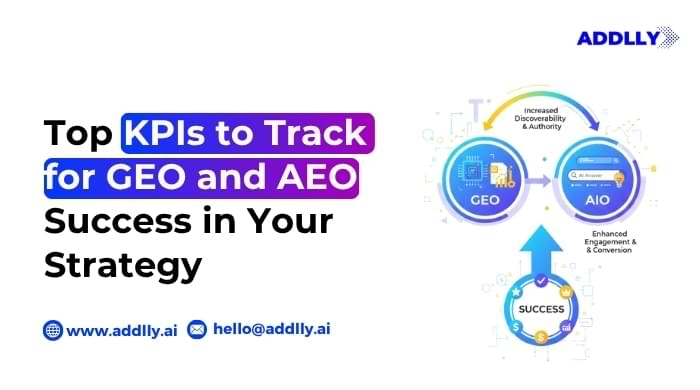
KPIs to track for GEO and AEO matter more today because the way people search has changed quietly but dramatically. Instead of scrolling through pages of results, users now ask a question and trust AI systems to deliver the answer in one clear summary. The journey feels effortless for them, but it creates a new challenge for brands trying to stay visible.
You could have strong traditional SEO metrics, solid keyword rankings, and consistent organic traffic, yet still be invisible inside AI-generated answers. Platforms like Google AI Overviews and Perplexity rely on entities, structure, and credibility to decide which sources deserve a place in their summaries. If your content isn’t being pulled into those responses, you’re missing a growing share of attention.
This guide breaks down the KPIs that help you understand how AI search engines interpret your brand, how often you appear in their answers, and what you can do to strengthen your visibility.
Quick Summary – What KPIs to Track for GEO and AEO Success
- AI search now shapes visibility more than traditional rankings, so brands must track how often they show up inside AI-generated summaries.
- GEO and AEO metrics reveal influence, not just position, helping you understand whether AI engines are actually using your content in their answers.
- A strong keyword ranking doesn’t guarantee AI visibility, which is why monitoring answer inclusion and entity coverage has become essential.
- AI platforms evaluate clarity and structure over backlinks, making citation quality a more meaningful measure of authority in AI search.
- Zero-click behaviour is rising, and the real win comes from appearing inside the summaries users read rather than the pages they never visit.
What Are GEO and AEO KPIs and Why They Matter Now?
Generative Engine Optimization and Answer Engine Optimization bring a new way to measure visibility in AI search. Instead of relying only on traditional SEO metrics, brands now need KPIs that show how often AI engines understand, use, or cite their content. This matters because users increasingly consume AI-generated responses instead of scrolling through traditional search engines.
GEO KPIs help you see how well your entities, topics, and content appear across AI search platforms. AEO KPIs focus on whether your brand is credited as a source inside AI answers. Together, they reveal your true online visibility at a time when zero-click searches, AI summaries, and AI overviews are shaping user decisions.
A brand might still rank well and maintain steady organic traffic, yet remain invisible in Google AI Overviews or Bing AI responses. That gap is exactly why these KPIs matter. They help you understand how AI systems interpret your content and whether you are part of the answers users actually read.
GEO KPIs vs AEO KPIs: What Each Measures
| KPI Type | What It Measures | Why It Matters |
|---|---|---|
| GEO KPIs | Entity coverage, answer inclusion, AI mentions, visibility across AI search platforms | Shows how often AI engines use your content in AI-generated answers |
| AEO KPIs | Citation quality, source attribution, brand appears data, and accuracy of AI responses | Proves whether AI engines trust your content enough to credit it |
| Traditional SEO KPIs | Keyword rankings, organic traffic, CTR | Useful, but no longer reflects visibility inside AI summaries |
Important KPIs To Track for Generative Engine Optimization Success
Generative Engine Optimization focuses on how clearly AI engines interpret your content and whether they reuse it while generating answers. GEO KPIs help you understand how visible your brand is inside AI summaries, how well your topics are represented, and where competitors may be outperforming you.
1. Entity Coverage Ratio: How Well AI Systems Understand Your Topics
The entity coverage ratio shows how consistently your core entities appear in AI-generated answers. When AI systems understand your entities, they can connect your content to the right queries and treat your brand as a relevant source.
What to Look For:
- How often do your key products, features, or topics appear in AI answers
- Whether competitors are mentioned more frequently for the same entities
- Gaps where AI engines misunderstand or skip your core concepts
- Opportunities to strengthen structured data and topical depth
2. Brand Mention Tracking Across AI Search Platforms
Brand mention tracking reveals how often your name, product, or domain appears in responses generated by platforms like Google AI Overviews, Bing AI, and Perplexity. It also highlights how visible you are in zero-click environments where users rely on summaries instead of clicking through.
What to Monitor:
- How many AI platforms mention your brand consistently
- Whether your mentions are positive, neutral, or missing context
- Competitor mentions inside the same query categories
- Shifts in visibility after publishing or updating content
3. Answer Inclusion Rate for Priority Topics
Answer inclusion rate measures how frequently AI platforms use your content while generating responses for your target queries. It’s one of the strongest KPIs for understanding whether your content influences AI answers or gets overlooked.
Why It Matters:
- Shows how often your insights shape AI summaries
- Helps identify topic clusters where you’re winning or losing visibility
- Highlights which AI platforms recognize your content and which don’t
- Guides content updates based on performance gaps rather than assumptions
Important Metrics To Track for AEO Performance
Answer Engine Optimization focuses on how often AI search platforms cite your content, reference your domain, and rely on your information to generate final responses. AEO KPIs help you understand whether AI engines consider your website trustworthy enough to use as a source. These metrics are essential because citation inside an AI-generated answer is the new equivalent of earning a top position in traditional search.
1. Citation Quality: How AI Engines Credit Your Content
Citation quality measures not just whether your brand appears in AI answers, but how it appears. Direct citations carry more value than plain mentions because they show AI engines have enough confidence in your content to attribute the information back to you.
What to Evaluate:
- Frequency of direct hyperlinks pointing to your pages
- Plain text mentions without links which signal awareness but lower authority
- Instances where your content is used, but another source receives credit
- Topics where competitors consistently receive citations, and you don’t
2. Source Attribution Rates Across AI Platforms
Source attribution rates track how often AI platforms assign credit to your domain when pulling information into their summaries. If AI engines repeatedly select your pages as trusted references, you gain visibility, credibility, and influence inside the answers users rely on.
Key Indicators:
- Percentage of answers where your domain is cited as the primary source
- Differences in attribution rates across Google AI Overviews, Bing AI, and Perplexity
- Topics where your site consistently earns citations versus topics that need improvement
- The relationship between structured data clarity and your attribution rate
3. Query Response Accuracy for Brand-Related Topics
Query response accuracy measures how correctly AI systems describe your products, features, services, and brand. When AI engines misunderstand or misrepresent your information, it signals missing content, unclear entities, or outdated pages that need optimization.
What to Check:
- Whether AI-generated answers describe your brand correctly
- Any factual errors or missing product details that lower credibility
- Queries where competitors receive more accurate descriptions than you
- Opportunities to strengthen entity clarity and add schema markup for precision
How to Build an Integrated KPI Measurement Framework?
A reliable KPI measurement framework connects your GEO efforts and AEO performance into one unified system. AI search works across multiple platforms, and each engine, whether it’s Google AI Overviews, Bing AI, or Perplexity, uses different AI models to generate results.
This is why you need a structure that tracks how often your brand appears in AI answers, how AI systems interpret your entities, and how your content performs across all search platforms.
Traditional search engines rely on organic traffic, keyword rankings, and Google Search Console data. AI search platforms, however, depend heavily on structured data, entity clarity, and model-driven interpretation. An integrated framework ensures you measure both worlds without getting blindsided by the rise of zero-click searches and AI-generated results.
Setting Up Cross-Platform Tracking Systems for AI Visibility
An effective system measures how your brand appears across AI search platforms, not just traditional search results. AI crawlers review your entities, schema markup, and topical relevance to decide whether your information deserves to be used in AI-generated answers.
What a Cross-Platform System Should Include
- Daily monitoring of target queries across multiple platforms like Google AI Overviews, Bing Chat, and Perplexity
- Tracking brand mentions and brand appearance data inside AI summaries
- Measuring answer inclusion rate and AI overview visibility for priority topics
- Monitoring AI responses for accuracy, sentiment, and attribution consistency
- Integrating seo tools and analytics platforms like Google Analytics for a holistic view
Establishing Baseline Metrics and Benchmarks
Before improving optimization efforts, you need to understand where you currently stand. A strong baseline helps you see how well your content creation and content production efforts support generative engine optimization GEO performance across multiple platforms.
Key Elements of a Strong Baseline
- Measure your current AI visibility, citation quality, and entity coverage ratio
- Track zero-click searches and click-through rates for relevant queries
- Identify where keyword rankings differ from AI results and summaries
- Benchmark domain authority against top competitors within generative engines
- Compare organic search performance with AI-generated responses to detect gaps
Why Enterprise Teams Need an Integrated Measurement Approach?
When AI engines interpret your content, they rely on entities, structured data, and topical authority, not just technical SEO or backlink profiles. Enterprise teams need a consistent measurement process so they can monitor AI comprehension, AI mentions, and AI-driven search performance without fragmentation.
Benefits of Integration:
- Helps local businesses and large organizations align traditional SEO with ai seo
- Makes it easier to detect issues with schema markup, structured data, or entity clarity
- Reveals content gaps where generative AI or AI platforms are misunderstanding your messaging
- Ensures every blog post, landing page, and featured snippet update supports user intent
- Connects your optimization efforts to measurable outcomes and long-term success
Manual Tracking vs Enterprise-Grade GEO Platforms
Manual tracking works only when you’re monitoring a handful of queries. AI search operates at scale, so enterprise teams need platforms built specifically for generative engine optimization and answer engine optimization. These tools make tracking brand mentions, AI-generated results, and AI mode summaries far more reliable.
What Enterprise Tools Offer:
- Automated scraping of AI answers across multiple platforms
- Real-time updates on answer inclusion, brand visibility, and citation accuracy
- Insights from large language models to identify content gaps
- Integration with search engine optimization workflows for seamless reporting
- Support for generative AI tools and AI comprehension analytics
Why Addlly AI Becomes the Saviour in GEO and AEO Measurement?
Most teams know how to measure traditional SEO performance, but AI search brings challenges you simply cannot track with old tools. You never truly know how often AI systems use your content, whether your entities are understood correctly, or why competitors appear in AI summaries when you don’t. This is the visibility gap that makes optimization unpredictable and where Addlly AI becomes genuinely valuable.
Addlly AI was designed for how generative engines evaluate content today. Instead of focusing only on rankings or traffic, it shows you how AI platforms actually interpret your topics, where your brand appears inside their answers, and which pages need clearer structure or improved entity signals.
See What AI Search Really Thinks About Your Content?
Addlly AI gives you a direct view into how often AI platforms include your insights in their summaries, which entities they pick up from your site, and what’s missing from your content clusters. The GEO Audit Tool plays a key role here, revealing patterns across AI Overviews, Bing AI, and Perplexity that you can’t see through traditional analytics.
This helps you understand:
- Where your brand appears and where it’s overlooked
- Which topics AI engines associate with your content
- Whether your structured data and schema are clear enough
- How your visibility shifts after updates or new publications
Fix the Issues That Stop You From Appearing in AI Answers
Sometimes AI engines skip your content because of unclear structure, missing entities, or outdated sections that weaken topical authority. Addlly AI highlights these issues instantly. The SEO Audithelps uncover technical gaps and schema markup problems that affect how AI crawlers read your pages.
This means:
- You know exactly which pages need improvements
- You understand why certain queries don’t trigger your appearance
- You can reinforce weak topics before competitors claim them
Strengthen Content for AI Answer Inclusion
Optimizing for GEO and AEO requires content that AI engines can easily interpret and reuse. Addlly AI simplifies this with the SEO AI Agent, which gives practical recommendations based on how AI models process information not just what ranks in search engines.
You get guidance on:
- Entity clarity
- Topic structure
- How to create content that aligns with AI summarization patterns
- Ways to turn existing pages into stronger sources for AI-generated answers
Track Your Performance Across AI Platforms Automatically
Manual GEO tracking is impossible at scale. Addlly AI automates the toughest part. The AI GEO Agentmonitors answer inclusion, brand mentions, and entity performance across multiple AI platforms so you always know where you stand.
You’ll be able to see:
- How your visibility differs across Google AI Overviews, Bing AI, and Perplexity
- Which topics drive the highest AI answer inclusion
- Where your brand is gaining traction
- Where immediate action is needed
Final Words
Understanding how your brand shows up in AI search isn’t optional anymore. Users are getting answers directly from AI platforms, and your visibility depends on whether those systems recognise your content and trust it enough to use it in their summaries. That’s why KPIs to track for GEO and AEO matter so much; they give you a real picture of how AI engines see you, not just how search engines rank you.
When you track metrics like answer inclusion, entity coverage, and citation quality, you start to see exactly where your content is doing the work and where it quietly disappears. These insights help you improve the pages that matter, close the gaps competitors are taking advantage of, and create content that AI systems actually understand.
And if you want to make this entire process easier and more accurate, Addlly AI is built for that world. It shows you what AI platforms pick up from your content, what they ignore, and what you can do to strengthen your presence across every major AI search platform.
Book a demo to see how Addlly AI can help you stay visible where users now discover answers.
FAQs – KPIs to Track for GEO and AEO
What’s the difference between GEO and AEO KPIs?
GEO KPIs measure your brand’s visibility within AI-generated results, while AEO KPIs focus on your performance as a cited source for direct answers. Both are vital for a full view of AI search optimization.
Which KPIs should enterprise teams track first?
Start with foundational metrics like entity coverage ratio, citation rates, and answer inclusion. These provide the clearest initial insights into your performance and biggest opportunities within AI search.
How often should we monitor GEO and AEO performance?
Monitor core metrics weekly, with daily tracking during active optimization campaigns. AI engines update constantly, so frequent measurement is key to staying competitive.
Can traditional SEO tools track GEO and AEO metrics?
No, traditional SEO tools are not built to measure performance within AI answers. You need specialized platforms designed for monitoring AI answer engines and tracking citations.
What’s a good entity coverage ratio benchmark?
Leading brands often achieve 40-60% entity coverage in AI answers for their core topics. A good first step is to measure your current ratio against your main competitors.
How do I track performance across multiple AI platforms?
Use an integrated measurement system that automates monitoring across ChatGPT, Perplexity, and Google AI Overviews. For enterprise teams, manual tracking simply isn’t scalable.

