
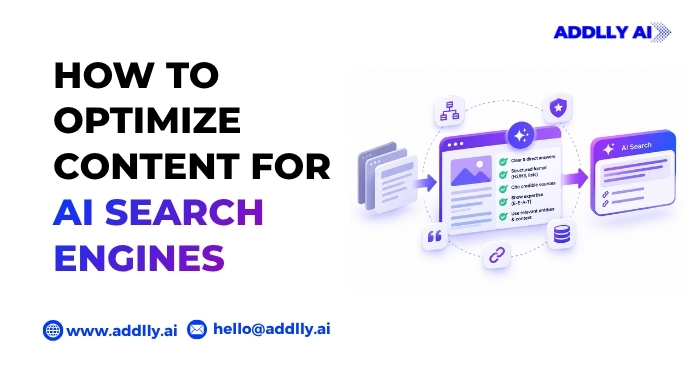
To learn how to optimize content for AI search engines, start with one rule: write for people, structure for extraction. AI search engines such as ChatGPT, Gemini, Perplexity, Microsoft Copilot, Google AI Overviews and Google AI Mode pull short passages from pages they trust and combine them into one answer. Your job is to make each passage easy to find, easy to lift and worth citing. Below: an 8-step process, a before-and-after example and a reusable checklist.
Key Takeaways
- Google says AI search engines need no special writing style, clear, useful content still wins.
- Put a direct answer in the first sentence of every section, then add the detail.
- Original data, named authors and sourced stats give AI systems a reason to cite you.
- Ranking helps, but only 37.9% of AI Overview citations came from top 10 search results.
- Check crawler access, keep key text in HTML and use schema markup that matches the page.
What Does It Mean to Optimize Content for AI Search Engines?
Optimizing content for AI search engines means shaping a page so AI-powered search engines can find it, understand it and quote it accurately in an AI-generated answer. The practice builds on search engine optimization (SEO) and is often called generative engine optimization (GEO) or answer engine optimization (AEO). Our guide to generative engine optimization covers the full definition.
Most AI-powered search engines combine generative AI with retrieval-augmented generation. The underlying AI models search a live index, pull the most relevant passages and write an answer grounded in them, instead of relying only on training data. Google adds query fan-out: Google’s AI Overviews and AI Mode run several related searches across subtopics before they answer (Google, Dec 2025). Google’s AI Overviews grew out of Google’s Search Generative Experience, a Search Labs test that started in 2023.
| Traditional search engines | AI-powered search engines | |
|---|---|---|
| What the user gets | A ranked list of links | One synthesized answer with a few cited sources |
| What competes | The whole page | A passage or section |
| How the query is read | Keywords plus intent | Context, intent and follow-up questions |
| What success looks like | Rankings and clicks | Citations, mentions and qualified clicks |
For Google, traditional search results and AI-generated answers draw on the same core ranking and quality systems, so SEO basics still apply.
How Do AI Search Engines Choose Which Content to Cite?
Unlike traditional search engines, AI search engines cite passages that directly answer the user’s query, come from a source they can crawl and trust, and add something other sources don’t. Search engine rankings still matter, but they no longer decide the whole outcome.
In a March 2026 study of 863,000 SERPs and 4 million cited URLs, it was found that 37.9% of URLs cited in Google AI Overviews also ranked in the top 10, and about 31% ranked outside the top 100. Other studies put the overlap anywhere from about 17% to over half, depending on method.
The queries that trigger AI Overviews are also changing. Semrush found the share of informational queries among them fell from 91.3% in January 2025 to 57.1% by October 2025, as commercial search queries grew.
AI Overviews correlate with a 58% lower click through rate for the top-ranking page. But the visitors AI-generated search results do send convert well. Another study found that the average AI search visitor is worth 4.4 times a visitor from traditional search, based on conversion rate. For Google-specific tactics, see how to rank in AI Overviews.
Do You Need to Write Content Differently for AI Search?
No. Google’s own guide says, “You don’t need to write in a specific way just for generative AI search,” and adds that unique, useful content will shape your presence in AI search more than any other tactic.
What does change is structure. AI systems lift sections, not whole pages, so each section has to hold up on its own.
| Popular tactic | What the evidence says |
|---|---|
| Add an llms.txt file to show up in Google’s AI features | Google Search doesn’t use it. Other platforms may see what llms.txt is |
| Split content into tiny “chunks” | Google says there’s no need to break content into tiny pieces. Clear sections are enough |
| Rewrite every page “for AI” | Not needed. Rewrite only where answers are buried, vague or outdated |
| Add special schema for AI | No special schema is required. Use structured data that matches the visible text |
| Seed fake mentions | Google lists inauthentic mentions as something to ignore. Earn mentions with real data |
| Search engines reward longer pages | Google says there is no ideal page length. Depth and specificity matter more |
Traditional SEO still does most of the work. The crawlable pages, clear structure and high-quality content that power search engine optimization also feed AI search optimization. In practice, AI SEO is traditional SEO with stricter rules on structure and proof, so most existing SEO strategies carry over. Our SEO vs AEO vs GEO guide explains where the three differ.
What You Need Before You Start
You need five things before you start editing:
- A target query and 10-20 related prompts that people ask AI tools about the topic.
- The page indexed by search engines, confirmed with URL Inspection in Google Search Console.
- Baseline screenshots of today’s AI answers in ChatGPT, Perplexity, Gemini and Google AI Overviews for the same query.
- A named author with real experience in the topic.
- Edit access to the page template, so you can fix headings, HTML and schema markup.
How to Optimize Content for AI Search Engines in 8 Steps?
These 8 steps cover the core of AI SEO. They follow one example page throughout: a fintech guide on how to choose a business credit card. Use them when creating content for a new blog post or refreshing an older page.
1. Map the Questions and Search Intent Behind Your Topic
Start by listing the questions your reader asks search engines and chatbots, not just the keywords they type. Pull People Also Ask questions, your keyword research data and the prompts your SEO and AI tools report. Then account for query fan-out: Google’s AI splits one question into several related search queries, so cover the likely follow-ups too.
An example question set for “how to choose a business credit card”:
- What credit score do I need for a business credit card?
- Does a business credit card affect my personal credit?
- Which is better for a small business, cash back or travel rewards?
- Which fees should I compare?
Group the questions by search intent. Informational questions become sections, comparison questions become tables and step-by-step questions become numbered lists. Then link related pages into a topic cluster so the site shows depth on the subject.
2. Write Question-Led Headings That Match How People Ask
Phrase most H2s and H3s as the questions people actually ask. A heading like “Fees” tells AI systems very little. “Which Fees Should You Compare on a Business Credit Card?” maps straight to the user’s query.
Keep headings literal and use your reader’s words: if customers say “annual fee,” don’t write “yearly charge.” Question headings also help you win featured snippets, because Google often pulls the paragraph directly under a heading that matches the query.
3. Put a Direct Answer in the First Sentence of Every Section
Open every section with a direct answer, then explain. This is the inverted pyramid, or “bottom line up front.”
Before: “Business credit cards come in many shapes, and choosing one depends on a range of factors that every owner should weigh carefully.”
After: “Choose a business credit card by matching its rewards to your largest expense category, then comparing the annual fee with what you would earn.”
The second version answers the question in one sentence that makes sense if AI search engines quote it alone. Aim for concise answers of about 40-60 words on definitions and key questions. This format helps with featured snippets, which feed other surfaces too. It was found that 40.7% of voice search answers came from featured snippets. Featured snippets also earn clicks, with one study putting their click-through rate at 42.9%. Content optimized for featured snippets is also easy for AI-generated summaries to quote.
4. Make Each Section Make Sense on Its Own
Write every section so it still makes sense if an AI system lifts it alone. Repeat the subject noun at the start, such as “A business credit card’s annual fee…”, instead of opening with “it” or “this.”
This is not the same as “chunking.” Google says there’s no need to break content into tiny pieces, and one page can cover several subtopics. The goal is clear sections that don’t depend on the paragraph above them. When your content appears in AI summaries, it usually appears as one block, so each block needs its own key information.
5. Format Lists, Steps and Comparisons So AI Can Extract Them
Use bullet points, numbered steps and tables only where the content really is a list, a process or a comparison. Microsoft recommends concise, self-contained phrasing in lists, Q&As and tables because AI systems can lift them cleanly.
An example comparison table for the business credit card guide:
| Card type | Best for | Watch out for |
|---|---|---|
| Flat-rate cash back | Mixed, everyday spending | Lower rates in your top category |
| Category rewards | One large expense, such as ads or fuel | Spending caps on bonus categories |
| Travel rewards | Owners who fly often | Annual fees and point transfer rules |
Label every column and row, and build the table in HTML, not as an image, so AI crawlers can read it. Lists and tables can also win list and table featured snippets, one widely shared figure says 36.6% of keywords trigger featured snippets. Relevant images and video help too, since Google’s AI features can show them alongside text.
6. Add First-Party Data, Examples and Sourced Stats
First-party data is the strongest reason for AI search engines to cite you instead of a competitor. Google calls this non-commodity content: pages that give unique expert or experienced takes instead of repeating common knowledge.
Practical ways to add it:
- Share a number only you have, such as results from your own test or survey.
- Cite every stat with its source and date, and link to the primary study.
- Quote a named expert from your team.
Proof also builds off your site. In a study of 75,000 brands, branded web mentions correlated with AI Overview visibility at 0.664, compared with 0.218 for backlinks. Creating content that others want to reference earns brand mentions. Generic rewrites made with generative AI tools don’t.
7. Prove Experience and Expertise With E-E-A-T Signals
E-E-A-T stands for Experience, Expertise, Authoritativeness and Trustworthiness. Many practitioners describe E-E-A-T as a misinformation filter: it helps AI systems decide which sources are safe to repeat in AI-generated responses.
Show each part of E-E-A-T on the page:
- Experience: first-hand detail, such as notes and screenshots from actually applying for the card.
- Expertise: a named author with a relevant role and a short bio.
- Authoritativeness: citations from, and mentions on, sites your industry trusts.
- Trustworthiness: a source for every claim, a visible “Updated” date and facts that are up to date.
Building E-E-A-T takes time, because authority depends on other people mentioning you.
8. Check Crawler Access, Semantic HTML and Schema Markup
Technical access decides whether AI crawlers can read your page at all. If a page isn’t in the search index, no AI feature can cite it. Check four things:
- robots.txt. AI companies run separate bots. OpenAI’s OAI-SearchBot surfaces pages in ChatGPT search results, while GPTBot collects training data for OpenAI’s AI models, and each is controlled separately in robots.txt.
- Raw HTML. Keep key text out of tabs, PDFs and images. Use semantic HTML, meaning real headings, lists and tables, so the structure survives.
- Page experience. Google lists good page experience among its AI basics, and fast loading with sensible browser caching is basic technical SEO.
- Structured data. Article schema, part of the shared Schema.org vocabulary, helps machines read the author, date and topic. But Google says no special schema is needed for its AI features, and schema markup is not a shortcut to citations. Rich results once had a 58% click-through rate versus 41% for plain results, yet Google stopped showing FAQ rich results on May 7, 2026.
For implementation details, see our guide to schema markup for AI search.
What Does an Optimized Passage Look Like? Before and After
This is AI SEO at the passage level: an optimized passage answers first, stays specific, names its source and stands alone. Here is one passage before and after the 8 steps.
| Element | Before | After |
|---|---|---|
| Heading | “Things to Consider” | “What Credit Score Do You Need for a Business Credit Card?” |
| First sentence | “Lenders look at many factors when you apply.” | “Most issuers look for a personal credit score of [VERIFY: score range and issuer source] or higher.” |
| Evidence | None | Issuer criteria linked and dated |
| Stands alone | Opens with “it” and “this” | Repeats “business credit card” |
| Format | One 140-word paragraph | A 45-word answer plus a 3-row table |
To test your own pages, ask the same question in ChatGPT, Perplexity and Google AI Mode before and after you optimize content for AI, and note where your content appears in each.
How Do You Measure and Maintain AI Search Visibility?
Measure AI visibility by tracking where your pages are cited in AI-powered search results, not only where they rank.
- Google Search Console: use the Generative AI performance report to see how pages perform in AI features on Google Search.
- Prompt checks: AI-generated answers change often, so re-run your baseline prompts across AI platforms every month and log whether you are cited, mentioned or missing in AI-generated responses.
- Analytics: track referral traffic and conversions from AI platforms such as ChatGPT and Perplexity.
- Refresh schedule: search optimization never stops, so keep stats, dates and examples up to date. Generative AI tools repeat stale facts as search evolves.
For the full metric set, see KPIs to track for GEO and AEO. Off-site work is covered in how to appear in AI search results.
AI Search Optimization Checklist for New and Existing Pages
Use this AI search optimization checklist before you publish a new page or refresh existing content.
| # | Check | New page | Existing page | Done when |
|---|---|---|---|---|
| 1 | Questions mapped | Before the outline | Compare with current H2s | Every core question has a section |
| 2 | Question-led headings | Write them first | Rewrite vague labels | Headings read like real questions |
| 3 | Answer-first sections | Draft answers first | Move buried answers up | The first sentence answers the heading |
| 4 | Self-contained sections | Write each to stand alone | Replace “it” and “this” openers | Each section reads alone |
| 5 | Bullet points and tables | Plan them in the outline | Convert dense comparisons | Tables labeled and in HTML |
| 6 | Original data or example | Plan one per page | Add at least one | One thing only you can say |
| 7 | Sourced, dated stats | Source as you write | Replace stale stats | Every number links to a primary source |
| 8 | Author and date | Assign an expert | Update bio and date | Named author, visible Updated date |
| 9 | Crawler access and HTML | Check the template | Recheck robots.txt | Key text visible in raw HTML |
| 10 | Schema markup | Add Article schema | Remove mismatched markup | Markup matches visible content |
| 11 | Baseline and re-test | Save prompts at launch | Save answers before edits | AI answers compared before and after |
For a deeper 25-point audit of live pages, use our AEO checklist.
What Mistakes Stop AI Systems From Citing Your Content?
The most common AI search optimization mistakes hide the answer, weaken trust or repeat what already exists.
- Obsolete SEO strategies: Keyword stuffing and mass-produced pages break content policies. Google’s scaled content abuse policy covers pages made in bulk to manipulate rankings.
- Hidden answers: Text in tabs, accordions, PDFs or images is harder for AI crawlers to parse. Microsoft lists each of these as a mistake that hurts AI search visibility.
- Vague claims: Words like “next-gen” or “industry-leading” with no proof give AI-generated responses nothing to quote.
- Stale or unsourced stats: Many web pages still repeat figures about AI Overviews from early 2025 that have since changed.
- Thin rewrites: Copying the top Google search results adds nothing new, so AI-powered results have no reason to pick your page.
- AI SEO tricks: Adding llms.txt for Google or rewriting everything “for AI” won’t fix unclear writing.
How Addlly AI Helps You Optimize Content for AI Search?
Addlly AI is an AI search visibility platform for enterprise and multi-market brands. Two parts of the platform support each step of AI search optimization:
- GEO Audit: shows how ChatGPT, Gemini, Perplexity, Google AI Overviews and other engines answer your buyers’ questions, which sources they cite and which pages to fix first.
- AI GEO Agent: creates and optimizes AI-ready content in your brand’s voice and recommends structure, including meta data, schema and headings.
Your team can run the audit and the fixes in-house, or hand them to Addlly’s generative engine optimization (GEO) specialists. Book a demo to see it on your own pages.
Frequently Asked Questions About Optimizing Content for AI Search Engines
What Content Works Best in AI Search?
Content that answers a specific question directly, backs it with original data or sourced facts and uses clear structure works best in AI search results. How-to guides, comparison tables and focused FAQ blocks are easy for AI tools to extract, and they use the same answer-first format that wins featured snippets.
How Do You Optimize Content for AI Search in 2026?
In 2026, follow Google’s May 2026 guide: focus on useful, non-commodity content and basic search optimization instead of AI SEO tricks. Two things changed this year. Google published official guidance for its generative AI features, and FAQ rich results disappeared on May 7, 2026. Answer-first writing, E-E-A-T and crawler access still matter most.
How Do You Optimize Blog Posts for AEO?
To optimize blog posts for AEO, use the same 8 steps in this guide: question-led headings, a direct answer under each one, self-contained sections, sourced data and clean HTML. AEO and generative engine optimization (GEO) build on search engine optimization and share one goal: getting your content cited by AI search engines.
Does Content Length Matter for AI Search?
Length matters less than depth, in AI search and traditional SEO alike. A 2019 Semrush study found that articles over 3,000 words earned three times more traffic than average-length posts. Google, however, says there is no ideal page length for its AI features. Cover every question your reader has, then stop.
Is Schema Markup Required for Google AI Overviews?
No. Google says there is no special schema markup you need to add for Google’s AI Overviews or Google’s AI Mode. Structured data still helps machines understand a page, and Article schema is a sensible default for a blog post. Keep every value consistent with the visible content. Backlinko’s 2018 voice search study put average Schema.org adoption at just 31.3%.
Start Optimizing Your Content for AI Search
Good AI search optimization is mostly traditional SEO done with more discipline: answer first, prove what you say and make every section easy to lift. Start with one high-value page and run the 8 steps.
To see which pages AI engines cite today and rework them in your brand voice at scale, use Addlly AI’s GEO Audit and AI GEO Agent.

