
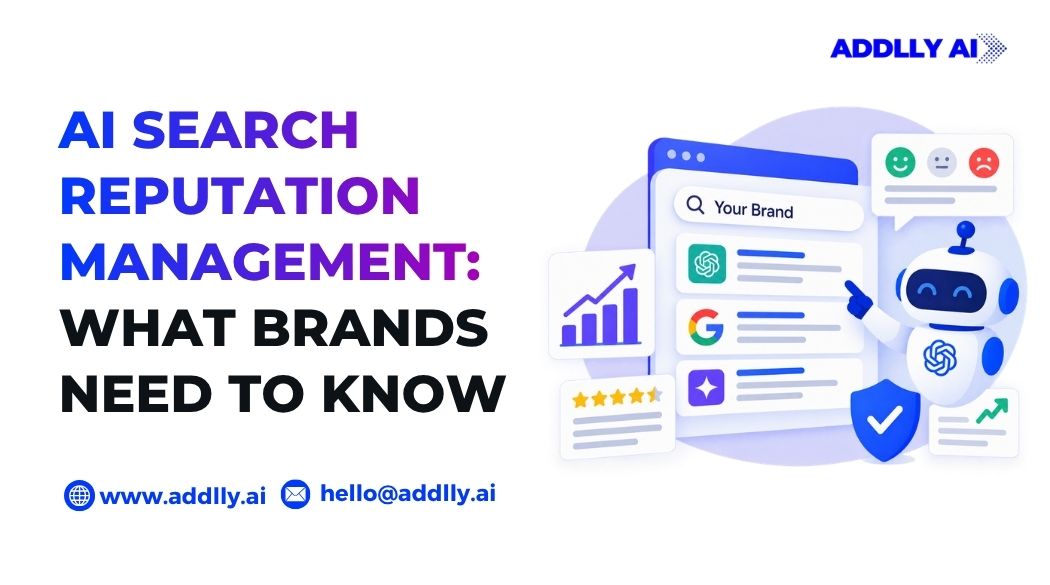
AI search reputation management is becoming increasingly important as people turn to ChatGPT, Google AI Overviews, Perplexity, and other AI tools to research brands, compare products, and decide who to trust. The answer they see can shape brand perception before they ever visit a website.
The challenge is that AI search engines look beyond a brand’s own website. They pull from review sites, news coverage, social media, forums, business listings, and other third-party sources to build an answer. That means outdated information, negative reviews, or inconsistent business information can influence how a brand appears.
This is where reputation management needs to expand beyond traditional search engines. Brands now need to understand their AI visibility, monitor brand mentions, track customer sentiment, and strengthen the sources AI systems rely on. A GEO audit can help uncover these gaps and show where your brand needs to improve.
Quick Summary – AI Search Reputation Management
- AI search reputation management focuses on how AI systems describe, cite, and recommend your brand.
- AI answers can shape brand perception before potential customers ever visit your website.
- Third-party sources, reviews, forums, social media, and news coverage all influence your reputation in AI search.
- AI-powered sentiment analysis helps identify positive perceptions, recurring complaints, and emerging reputation risks.
- GEO helps brands improve the accuracy, consistency, credibility, and visibility of information AI uses in its answers.
- Managing your AI reputation requires continuous monitoring as sources, customer sentiment, and AI-generated answers change.
What Is AI Search Reputation Management?
AI search reputation management is the practice of monitoring and improving how AI search engines describe, cite, and recommend a brand. Unlike traditional online reputation management, it looks beyond conventional search results to understand what AI models say, which sources they rely on, and how brand perception is being shaped through AI-generated answers.
AI systems pull information from websites, review sites, forums, social media, news coverage, and other third-party sources. They then synthesize these signals into a response rather than simply displaying a list of pages. This means brand reputation can be influenced by information a company does not directly control, including negative reviews, outdated facts, or inconsistent business information.
For that reason, reputation management in AI search requires ongoing monitoring of brand mentions, customer sentiment, citations, and AI answers. Brands also need to make sure the information available across the web is accurate and consistent. This is where AI search visibility becomes an important part of the wider reputation strategy.
Why AI Search Reputation Matters for Brands
AI search is changing how people discover and evaluate brands. Instead of scanning several search results, potential customers can ask an AI tool for a recommendation, comparison, or opinion and get a direct answer. That makes brand reputation part of the discovery experience, not something customers consider only after visiting a website. AI-generated answers can shape perception before the first interaction with a brand.
AI answers can influence customer decisions
When someone asks an AI system which company to trust or which product to choose, the answer can influence what they consider next. Negative content, outdated information, or inaccurate claims can therefore become reputation risks. This is particularly important because AI systems synthesize information rather than simply showing users individual pages.
Third-party sources matter more than ever
AI models can draw from review platforms, forums, news coverage, social media, business listings, and other third-party sources. Research published in 2026 found that third-party sources make up a substantial share of the citations used in AI-generated brand answers. This makes consistent business information, positive customer feedback, and accurate brand details across the web increasingly important.
Reputation affects AI visibility
A brand can have strong online visibility and still be represented poorly in AI answers. Monitoring brand mentions, customer sentiment, citations, and competitor positioning helps reveal what AI systems are actually saying about the business. Brands can also use AI search monitoring tools to track these changes across different AI platforms.
How to Audit Your Brand’s Reputation Across AI Search
A proper AI reputation audit should answer a simple question: What does AI actually say about your brand when nobody is controlling the question? Instead of looking at one search query, examine a range of prompts that potential customers might use when researching your company, products, competitors, and reputation.
1. Test how often your brand appears
Start by checking whether your brand appears in relevant AI answers across ChatGPT, Gemini, Perplexity, and Google AI Overviews. Look at how frequently the brand is mentioned, whether competitors appear instead, and whether the brand is recommended when users ask for specific products or services.
2. Check what AI says about your brand
The next step is to examine the actual language used in AI-generated answers. Are your strengths being recognized? Are outdated facts appearing? Does AI associate your brand with particular complaints, customer experiences, or negative reviews?
This is where sentiment analysis becomes important. Positive sentiment can reveal the themes that strengthen your brand image, while negative sentiment can highlight recurring reputation risks that need attention.
3. Identify the sources behind the sentiment
AI models rarely form their view from a single source. They can combine information from review sites, social media, news coverage, forums, business listings, and other third-party sources. If several AI platforms repeatedly mention the same positive or negative theme, trace that theme back to the sources supporting it.
4. Run a GEO audit
A GEO audit brings these checks together in a structured assessment. Addlly AI’s GEO Audit Tool tests your brand across 100+ AI prompts and evaluates areas such as AI visibility, brand mentions, citations, competitor presence, and sentiment. This makes it easier to spot where your brand is being represented accurately, where negative perceptions are appearing, and which areas need stronger signals.
Further Reading: How to Run a GEO Audit: Why Every Website Needs One
5. Compare the results across AI platforms
Finally, look for differences between platforms. Your brand may receive positive AI answers on one platform while another relies on outdated information or highlights negative customer feedback. These differences matter because AI search reputation management is not about optimizing for one AI system. It is about building a consistent and accurate brand presence across the wider AI search ecosystem.
How AI Sentiment Analysis Reveals Brand Perception
A brand can have strong search visibility and still leave the wrong impression. That is why AI-powered sentiment analysis matters. It looks beyond the number of brand mentions and examines the language AI systems use when describing a company, the themes that keep appearing, and whether the overall reputation in AI is positive, neutral, or negative. Sentiment can also be compared across AI platforms and competitors, giving brands a clearer picture of where their perception stands.
What positive sentiment can tell you
Positive sentiment can reveal what customers feel good about and which themes AI repeatedly connects with a brand. This could include customer satisfaction, product quality, helpful service, competitive pricing, positive reviews, or good customer experiences. When these themes appear consistently across online reviews, third-party reviews, social media posts, and AI answers, they can strengthen brand consistency and reinforce a clear brand voice.
Where negative sentiment becomes useful
Negative sentiment is not automatically a crisis. Sometimes it points to a specific issue customers keep mentioning, such as poor support, product concerns, misleading information, or unresolved negative feedback. Looking at these patterns alongside review volume, customer feedback, and brand interactions can show whether an issue is isolated or becoming part of the wider reputation data that AI systems use.
This is especially useful for brand reputation management because AI-generated answers can bring together information from many different sources. A recurring complaint on review sites, for example, may eventually become part of the narrative surrounding a brand even if the company’s own website never mentions it.
Look at the source behind the sentiment
The sentiment score itself is only the starting point. The more useful question is why AI is forming that perception. If several platforms repeatedly associate a brand with the same negative theme, teams can investigate the third-party reviews, social media conversations, or other sources behind it. That insight can then feed into review management, content strategy, consistent messaging, and the wider reputation strategy.
For multi location brands, this can also reveal local reputation issues. A pattern of negative feedback across a Google Business Profile, review platform, or local listing may affect local visibility, while a broader issue across markets may require a different response. Accurate listings and consistent business information become particularly important when brands are managing reputation at scale.
Ultimately, sentiment analysis helps answer a question that visibility metrics alone cannot: when AI mentions your brand, what do customers and potential customers actually seem to associate with it? Brands can then use those insights to improve the sources and messaging shaping their AI search reputation.
A useful next step is to track these perceptions over time through brand mentions in AI answers, rather than relying on a one-time snapshot.
What Shapes Your Brand’s Reputation in AI Search?
Your reputation in AI search is built from much more than your website. AI models pull together information from review platforms, social media, forums, news sites, business listings, and other third-party sources before producing an answer. That means a brand’s reputation is really shaped by the wider online ecosystem around it. Research into AI citations also shows that different platforms rely on different mixes of sources, so there is no single reputation signal that works everywhere.
Your own website is only one piece of the picture
Your website controls the information you publish, but AI systems can compare it with what other people and organizations are saying about you. A strong content strategy, clear brand voice, accurate business information, and consistent messaging give AI systems reliable information to work with.
But that is only the starting point. Other signals include:
- Online reviews and third-party reviews: Review volume, recurring complaints, positive feedback, and customer satisfaction can all contribute to how AI understands your brand.
- Business listings: Inaccurate listings, outdated addresses, inconsistent names, or incomplete profiles can create conflicting reputation data, particularly for businesses with strong local visibility.
- Social media: Social media posts and brand interactions can add context around how customers actually experience and discuss a company.
- News and industry coverage: Independent coverage can provide additional evidence about a company’s expertise, products, leadership, or reputation.
- Community discussions: Forums and communities can reveal customer experiences that may not appear on the brand’s own channels.
Reddit can influence the wider brand narrative
Reddit deserves particular attention because AI search systems frequently use community discussions when answering questions about products, companies, and customer experiences. A 2025 analysis of 248,000 Reddit posts found Reddit among the leading cited sources across Perplexity, SearchGPT, and Google AI Mode.
That makes genuine discussions around your brand worth monitoring. You cannot manufacture community sentiment, but you can pay attention to recurring questions, complaints, recommendations, and comparisons. This is also why Reddit’s role in AI search has become an important part of GEO and reputation strategy.
Review platforms provide another layer of evidence
For software and B2B brands, platforms such as G2 and Capterra can be particularly important because they contain structured information about products, categories, competitors, and customer experiences. G2 research citing Profound data found that G2 accounted for a substantial share of review-site citations across ChatGPT, Google AI Overviews, and Perplexity.
This makes review management more than a customer service task. Keeping profiles accurate, encouraging genuine customer feedback, and responding appropriately to reviews can contribute to the information AI systems have available when someone asks about your brand.
Brands can also look at how G2 and Capterra can improve AI search visibility, particularly when their category relies heavily on comparison and review queries.
Consistency matters across every channel
AI systems can encounter the same brand in dozens of places. If your website describes your company one way, your Google Business Profile uses outdated information, review platforms show an old product description, and social media presents a completely different brand voice, AI has more conflicting signals to reconcile.
This is especially important for multi-location brands. Accurate listings, consistent business information, local SEO, and consistent messaging across locations can help reduce confusion around what the brand offers and where it operates.
The goal is not to make every channel sound identical. It is to make sure the important facts remain consistent while allowing each platform to communicate naturally.
Third-party consensus can strengthen or weaken reputation
AI-generated answers are increasingly built from multiple sources rather than a single brand statement. When independent sources repeatedly describe a brand in similar terms, those signals can reinforce a particular perception. On the other hand, repeated negative feedback across review sites, forums, and social platforms can become a reputation risk.
How to Improve Your AI Search Reputation With GEO
Improving your AI search reputation is not about trying to control what AI says about your brand. It is about making the information available to AI systems clearer, more consistent, credible, and easier to cite. This is where Generative Engine Optimization (GEO) becomes part of reputation management.
A strong GEO strategy should address both your owned content and the wider signals that shape brand perception across AI search.
1. Strengthen the facts AI can rely on
Start with the basics. Make sure your website clearly explains who you are, what you offer, who you serve, where you operate, and what makes your products or services different.
Use consistent names, descriptions, product information, locations, pricing details, and other important facts across your website and major business profiles. Accurate business information gives AI systems fewer conflicting signals to reconcile.
Clear headings, concise explanations, structured content, and well-defined entities can also make information easier for AI systems to interpret and reuse.
2. Build content around the questions customers actually ask
GEO works better when content answers real questions instead of simply targeting keywords. Look at the questions customers ask about your brand, products, competitors, pricing, use cases, and common problems.
Then create content that provides direct, specific answers.
This could include:
- Product and service comparisons
- Detailed FAQs
- How-to content
- Use-case pages
- Industry explainers
- Customer questions and objections
- Comparison and alternative pages
The goal is to create high-signal content that AI systems can understand, summarize, and potentially cite when answering relevant queries.
3. Strengthen your presence beyond your own website
Your website is only one part of your online reputation. AI systems can also encounter your brand through review platforms, news coverage, forums, social media, business listings, and other third-party sources.
That means GEO and reputation management need to work together. If your website presents one version of the brand but third-party sources consistently present another, AI may have conflicting information to work with.
Building credible third-party mentions and maintaining accurate profiles can therefore support both brand authority and AI visibility.
4. Keep your reputation signals fresh
Outdated information can become a reputation problem when AI systems use it in generated answers. Regularly review important pages, business listings, product information, reviews, and other sources that influence how your brand is represented.
This is particularly important when products change, locations move, services are updated, or company messaging evolves.
A consistent process for monitoring and updating these sources helps maintain brand consistency across the web.
5. Connect GEO with your brand voice
Optimizing for AI does not mean making every piece of content sound robotic or identical. Your brand voice should remain recognizable across your website, social media, review responses, and other channels.
What matters is consistent messaging around the facts that define your business.
For teams managing content across multiple channels, a social media AI agentcan help maintain a consistent brand presence while scaling social content and engagement. This can be particularly useful when social media is one of the channels contributing to wider brand discovery.
6. Treat GEO as an ongoing process
AI search reputation can change as new reviews appear, new articles are published, competitors gain visibility, and AI platforms update the information they use.
That makes GEO an ongoing cycle:
Audit → identify reputation gaps → improve content and sources → monitor AI answers → refine again
The same approach is reflected in current GEO workflows, where brands audit AI visibility, identify citation and content gaps, make improvements, and continue monitoring the results.
The Future of Brand Reputation in AI Search
Brand reputation is no longer shaped only by Google rankings, reviews, or social media. As AI-powered search becomes part of how people discover brands, AI-generated answers can influence what customers believe about a company before they ever visit its website.
That makes AI search reputation management an ongoing priority. Brands need to monitor AI answers, track sentiment, maintain accurate information, strengthen third-party signals, and ensure consistent messaging across channels.
This is where GEO becomes increasingly important. Improving AI visibility is not just about getting mentioned. It is about being represented accurately, supported by credible sources, and associated with the right information.
Addlly AI helps brands do this with tools for GEO audits, AI visibility tracking, citation analysis, competitor benchmarking, and sentiment monitoring, giving teams a clearer view of how AI perceives their brand.
FAQs – AI Search Reputation Management
1. Can AI Search Reputation Management Replace Traditional Reputation Management?
No. AI search reputation management complements traditional reputation management. Brands still need to manage reviews, customer feedback, social media, business listings, and other channels while also monitoring how AI systems interpret those signals.
2. How Quickly Can a Brand’s AI Reputation Change?
It can change as new reviews, articles, discussions, and other information appear online. AI platforms also update their underlying systems and source selection, so a brand’s representation can shift without any changes to its own website.
3. Can Brands Remove Negative Information From AI Search Results?
Usually, brands cannot directly remove legitimate third-party information from AI-generated answers. The more practical approach is to address the underlying issue, correct inaccurate information at its source where possible, and build a stronger body of accurate, credible information.
4. Does Brand Size Affect AI Search Reputation?
Brand size can influence the amount of information available for AI systems to evaluate, but it does not guarantee positive representation. Smaller brands can still build strong AI visibility by developing authoritative content, earning credible mentions, and maintaining consistent information.
5. How Do AI Search Engines Handle Conflicting Information About a Brand?
AI systems may compare information from multiple sources before generating an answer. When sources conflict, factors such as source credibility, consistency, relevance, and recency can influence which information is reflected in the response.
6. Is AI Search Reputation Management Important for Local Businesses?
Yes. Local businesses can be affected by how AI systems interpret information from local listings, review platforms, business profiles, and other sources. Inaccurate or inconsistent information can create confusion when customers use AI to find or evaluate local businesses.