
Resources > Case Studies > 3X Organic Growth
Addlly AI Case Study: 3X Organic Growth and 22.2M Impressions in Five Months
Scaled organic clicks from 21.2K to 63.5K per month and reached 201K total clicks and 22.2M impressions by systemizing structured, AI-ready content using Addlly AI’s GEO and SEO Agents.
For most marketing teams, organic growth feels unpredictable. Traffic spikes one month, drops the next, and momentum is difficult to sustain.
Addlly AI approached growth differently.
Instead of treating content as isolated blog posts, the team built a structured, knowledge-first system powered by AI Agents. Every page was designed to be crawlable, internally connected, and readable by both search engines and generative AI systems.
Over five months, this system transformed the website from steady traction into compounding visibility.
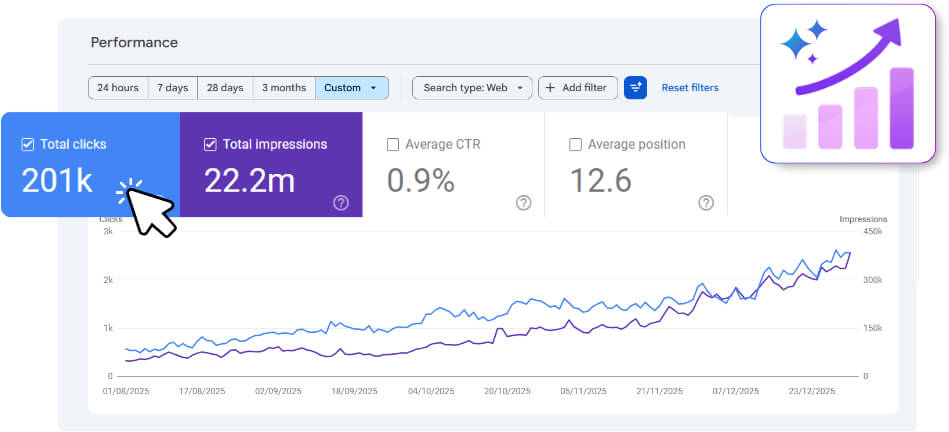
Performance data from Google Search Console shows consistent daily growth rather than short-term spikes, indicating stronger domain trust, faster indexing, and accelerating authority.
Date as of 3 February 2026.
Key Results At a Glance
- Increased monthly clicks from 21.2K to 63.5K in five months
- Generated 201K total clicks across the period
- Reached 22.2M total impressions
- Scaled publishing output more than 3X
- Improved indexing speed for new pages
- Established steady daily growth without volatility
- Achieved growth without increasing headcount
Tool Used
| Tool | Purpose |
|---|---|
| AI Search Visibility Checker | Track where Addlly appears across AI answers and generative engines; identify citation and discovery gaps |
| GEO Audit Tool | Analyze generative engine readiness and uncover AI visibility opportunities |
| AI GEO Agent | Optimize content specifically for AI search, answer extraction, and citations |
| SEO AI Agent | Apply keyword structure, metadata, headings, and on-page optimization automatically |
| AI Schema Markup Generator | Add structured data and schema for improved crawlability and rich results |
| AI Blog Writer | Generate high-quality first drafts grounded in brand knowledge |
| Knowledge Base (RAG) | Centralize product, messaging, and positioning context for consistent, accurate outputs |
| Internal Linking Automation | Build topic clusters and strengthen relationships between pages |
About Addlly AI
Addlly AI is a generative AI marketing platform built for Generative Engine Optimization and SEO. Its brand-trained AI Agents autonomously plan, create, and optimize blogs, landing pages, newsletters, and social content to help brands rank in search engines and get cited inside AI answers.
To validate its methodology, the company applies the same workflows internally, using its own website as a live demonstration of how structured, agent-led execution compounds organic growth.
How Did Addlly AI Build its Content System?
Rather than scaling headcount or outsourcing production, the team built a repeatable system that embedded structure and optimization into every step.
Step 1 – Centralize Knowledge
All product, feature, and brand information was organized into a unified knowledge base.
- Standardized terminology
- Consistent messaging
- Reusable context for every article
This ensured accuracy and eliminated rework.
Step 2 – Map Search and GEO Intent
Topics were selected based on real user queries instead of assumptions.
- Clustered keywords by theme
- Prioritized informational and high-intent searches
- Built content roadmaps, not ad hoc posts
- This created depth and authority around each subject area.
Step 3 – Generate With AI Agents
AI Agents handled drafting and structuring.
- Faster content production
- Consistent formatting
- SEO structure embedded automatically
Manual editing time decreased significantly.
Step 4 – Structure and Interlink
Every page was designed to guide both users and crawlers.
- Schema-ready formatting
- Topic hubs and supporting pages
- Contextual internal links
- Clear content hierarchies
This improved crawl paths and strengthened relationships between assets.
Step 5 – Establish a Publishing Rhythm
Consistency became the priority.
- Weekly releases
- Continuous updates
- Regular performance reviews
Authority compounded month over month.
What Results Did Addlly AI Achieve?
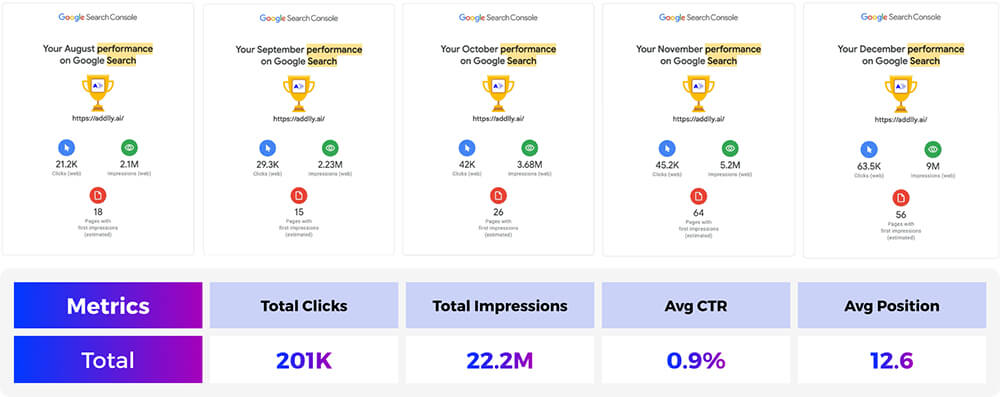
Month-by-Month Performance
| Metric | Aug | Sep | Oct | Nov | Dec |
|---|---|---|---|---|---|
| Clicks | 21.2K | 29.3K | 42K | 45.2K | 63.5K |
| Impressions | 2.1M | 2.23M | 3.68M | 5.2M | 9M |
| New Pages | 18 | 15 | 26 | 64 | 56 |
Growth accelerated each month as authority increased. New pages began ranking faster than earlier ones, indicating improved crawl trust.
Overall Period Totals (Aug 2025 → Dec 2025 Combined)
| Metric | Metric |
|---|---|
| Total Clicks | 201K |
| Total Impressions | 22.2M |
| Avg CTR | 0.9% |
| Avg Position | 12.6 |
The performance curve showed steady daily increases rather than isolated spikes, confirming that growth came from structural improvements rather than temporary boosts.
How Did This Impact Marketing Operations?
Beyond traffic, the system improved efficiency.
- Reduced manual writing and optimization
- Faster publish cycles
- Less dependence on external resources
- Consistent structure across all pages
- Predictable month-over-month growth
Content shifted from reactive production to a repeatable growth engine.
What Does This Prove?
This case study demonstrates that sustainable organic growth does not come from publishing more content at random. It comes from building a structured system that compounds authority over time.
Over five months, traffic increased steadily without spikes or volatility. This pattern indicates that growth was driven by stronger crawl trust, better indexing, and improved topical depth rather than short-term tactics.
The results reveal four clear patterns.
1. Growth Compounds When Content Is Connected, Not Isolated
Publishing individual articles creates temporary lifts. Publishing structured clusters builds authority.
As topics deepened and internal links strengthened, new pages began ranking faster than earlier ones. Each additional asset reinforced the rest of the site, turning content into a flywheel rather than a checklist.
Evidence: rising clicks each month despite similar publishing efforts.
2. Consistency Increases Search Engine Trust
Regular publishing improved crawl frequency and indexing speed.
Search engines returned more often, discovered pages sooner, and distributed rankings more quickly. This shortened the time between publishing and performance, which accelerated month-over-month gains.
Evidence: impressions scaled from 2.1M to 9M without volatility.
3. Automation Improves Scale Without Increasing Cost
AI Agents absorbed repetitive work such as drafting, structuring, and optimization.
Output increased significantly while team size remained constant. Growth came from process efficiency, not additional headcount or external agencies.
Evidence: 3X content velocity with stable operational overhead.
4. GEO Expands Visibility Beyond Traditional Rankings
Optimizing for both SEO and generative engines increased the number of surfaces where Addlly AI could appear.
Content was not only ranked but also structured to be extracted, summarized, and cited by AI systems, broadening discoverability across the entire search ecosystem.
Evidence: sustained impression growth alongside stronger average positions.
Summary Insight
When structure, cadence, and automation work together, organic growth becomes predictable. Traffic stops behaving like a campaign and starts behaving like a system.
How Can Teams Replicate This With Addlly AI?
Teams that want similar results should move away from ad hoc content creation and adopt a structured, system-led workflow. The objective is not to publish more pieces randomly, but to design a repeatable engine where every asset strengthens the next.
The following six-stage framework mirrors the exact process used internally.
Stage 1 → Establish the Foundation (Knowledge First)
Begin by centralizing all product, positioning, and brand information into a single knowledge base. This includes FAQs, feature details, use cases, compliance notes, and tone guidelines.
When every article pulls from the same verified source of truth, accuracy improves, and messaging stays consistent. Teams spend less time correcting errors or rewriting content, which reduces friction before production even begins.
Outcome: Higher quality content with minimal rework.
Stage 2 → Identify Real Opportunity (Intent Mapping)
Instead of brainstorming topics internally, analyze what customers are already searching for across both traditional search engines and generative AI systems. Group related queries into themes and clusters, then map each cluster directly to a business goal or solution page.
This ensures content addresses real demand, not assumptions, and creates clear pathways from education to conversion.
Outcome: Relevant topics that attract qualified traffic.
Stage 3 → Produce at Scale (Agent-Led Creation)
With intent defined, use AI Agents to handle drafting, structuring, and first-pass optimization automatically. Articles are generated using the knowledge base, which maintains brand voice and factual accuracy while dramatically reducing manual writing time.
By embedding SEO best practices at the creation stage, teams avoid time-consuming fixes later.
Outcome: Faster publishing cycles without increasing headcount.
Stage 4 → Engineer Discoverability (SEO + GEO Structure)
Content must be easy for machines to interpret. Apply clear headings, internal links, schema markup, and topic hubs so both search engines and AI answer systems understand how pages relate to one another.
This structured formatting improves crawl paths, strengthens topical authority, and increases the chances of being surfaced or cited in AI-generated responses.
Outcome: Higher rankings and broader visibility across search and AI platforms.
Stage 5 → Maintain a Consistent Publishing Rhythm (Cadence)
Consistency builds trust. Publishing on a predictable weekly or bi-weekly schedule encourages search engines to crawl the site more frequently and index new pages faster.
Over time, this shortens the gap between publishing and performance, allowing content to generate traffic sooner and compounding gains month after month.
Outcome: Stable, predictable growth instead of traffic spikes.
Stage 6 → Measure, Refine, and Compound (Optimization Loop)
Track performance metrics such as clicks, impressions, indexing speed, and AI visibility. Identify which clusters perform best, refresh high-impact pages, and expand successful topics further.
This continuous feedback loop turns content into a living asset rather than a one-time publish, allowing small improvements to accumulate into sustained growth.
Outcome: Long-term momentum and improving ROI over time.
Replication Framework at a Glance
| Phase | Focus | Primary Benefit |
|---|---|---|
| Foundation | Knowledge base | Accuracy and consistency |
| Opportunity | Intent research | Relevance and demand capture |
| Production | AI Agents | Speed and scalability |
| Structure | SEO + GEO optimization | Discoverability |
| Cadence | Regular publishing | Crawl trust and faster indexing |
| Optimization | Continuous refinement | Compounding growth |
Within three months on Addlly AI’s PSG plan, we went from almost no search presence to #1 in Google AI Overviews for our core topics, and a much larger keyword footprint. The setup was quick, the training was practical, and the gains were visible.
ATT Systems
Want Similar Results for Your Company?
We Can Help!
Contact us or schedule a free demo to learn more.
Answers to
Frequently
Asked Questions
How Did Addlly AI Grow Organic Clicks From 21K to 63K Per Month?
By publishing consistently, organizing content into clusters, and optimizing every page for both SEO and AI visibility. The structure helped each new page rank faster than the last.
What Changed in the Content Strategy To Drive This Growth?
We moved from ad hoc blog posts to a knowledge-first system. Topics were mapped to real search intent, then produced and optimized through AI Agents on a fixed cadence.
How Many Total Clicks and Impressions Did the Site Generate During the Period?
Across five months, the site recorded 201K clicks and 22.2M impressions, with steady month-over-month growth instead of spikes.
Why Did Traffic Increase Every Month Without Big Spikes?
Because growth came from authority and crawl trust, not one-time campaigns. Structured content and consistent publishing created compounding momentum.
How Fast Did New Pages Start Ranking After Publishing?
Faster over time. As domain trust improved, search engines crawled more frequently, which reduced indexing time and helped new pages rank sooner.
Did the Team Need To Increase Headcount To Scale Content Output?
No. AI Agents handled drafting, formatting, and optimization. Output increased while the team size stayed the same.
What Role Did AI Agents Play in the Workflow?
They automated research, first drafts, SEO structure, and updates. This removed manual bottlenecks and made weekly publishing predictable.
How Did Internal Linking Impact Performance?
Topic clusters and contextual links strengthened relationships between pages. This improved crawl paths and helped distribute authority across the site.
How Long Did It Take To See Compounding Results?
Early gains showed in the first month. Clear compounding effects became visible around month three and accelerated by month five.
Can Other Teams Replicate the Same Results With Addlly AI?
Yes. The same system, knowledge base, AI Agents, and structured publishing workflow can be applied to any brand that relies on organic discovery.
What Proves That This Growth Was Sustainable and Not Temporary?
The performance curve rose steadily day by day with no sharp spikes or drops. That pattern shows structural authority growth, not short-term tactics.