What Does Addlly AI GEO Audit Agent Assess?
What does Addlly AI GEO Audit Agent include in its visibility assessment? It evaluates how your brand appears, gets cited, and performs across AI-driven platforms like ChatGPT, Perplexity AI, Claude, and Google AI Overviews. You can rank well on search engines and still not show up when someone asks a question in AI tools. That’s because these systems don’t just list pages; they pull specific answers from content they can easily interpret and trust. If your content isn’t structured or cited in the right way, it simply gets skipped. This is where a focused AI visibility audit becomes essential.
What Addlly AI GEO Audit Agent Actually Assesses
Addlly AI GEO Audit Agent evaluates your visibility the way AI systems actually interpret content, not how search engines rank it. Instead of focusing on positions or keywords, it analyzes whether your content is being selected, understood, and cited in AI-generated responses.
This becomes critical because AI systems don’t “browse” your site the way users do. They extract fragments, compare sources, and construct answers dynamically. If your content is not structured for this process, it gets ignored. This is why many brands struggle even after following what looks like a solid AI search optimization audit checklist.
1. AI Search Visibility Across Platforms
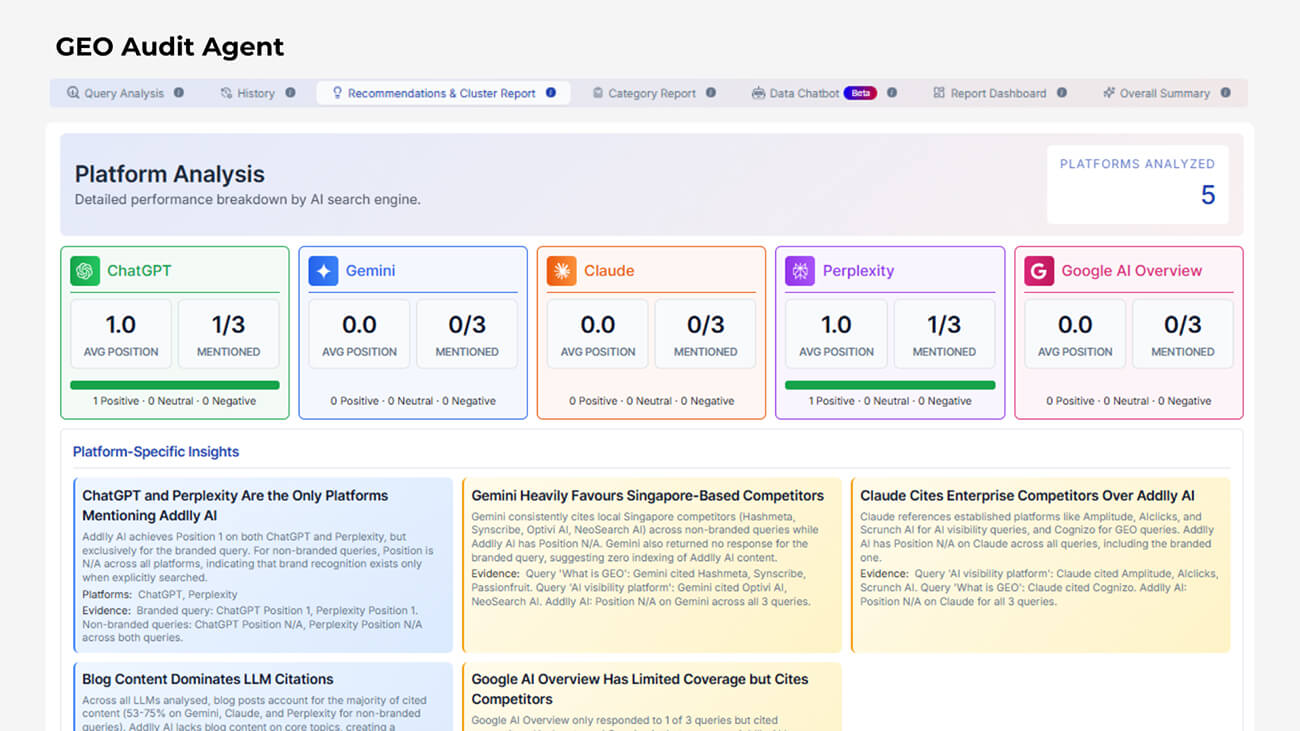
The first layer of assessment focuses on where your brand actually appears. Addlly AI tracks visibility across platforms like ChatGPT, Perplexity AI, Claude, and Google AI Overviews.
Each of these platforms retrieves and presents information differently. Some prioritize authoritative domains, others emphasize structured answers or real-time sources. This creates fragmented visibility, where your brand might appear in one platform but not in another.
The audit maps:
- Which prompts your brand appears in
- Where it is completely missing
- How visibility changes across platforms
This aligns closely with how AI search engines decide which brands get seen, especially when multiple sources compete for inclusion.
2. Prompt Coverage & Query Mapping
Ranking for keywords does not guarantee visibility in prompts. AI systems respond to natural language queries, not just search terms.
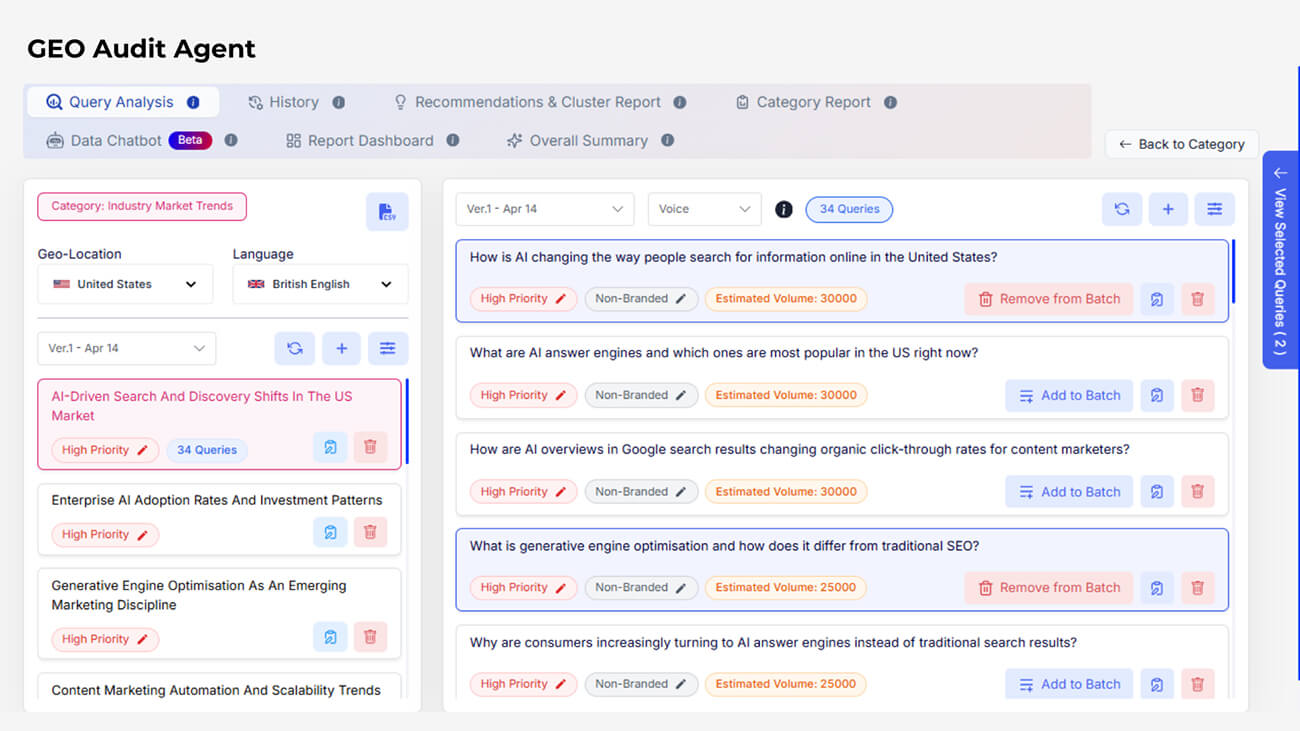
Addlly AI analyzes:
- Which real-world prompts trigger your content
- Where your brand fails to appear
- How coverage varies across the funnel
For example, a brand may appear for awareness-stage queries but disappear in decision-stage prompts. This gap is often missed unless you actively map conversational queries, something deeply connected to how conversational search queries and keywords for GEO content are structured.
This layer helps you understand not just visibility, but coverage completeness.
3. Citation & Source Attribution
Visibility in AI search is heavily influenced by whether your content is cited as a source.
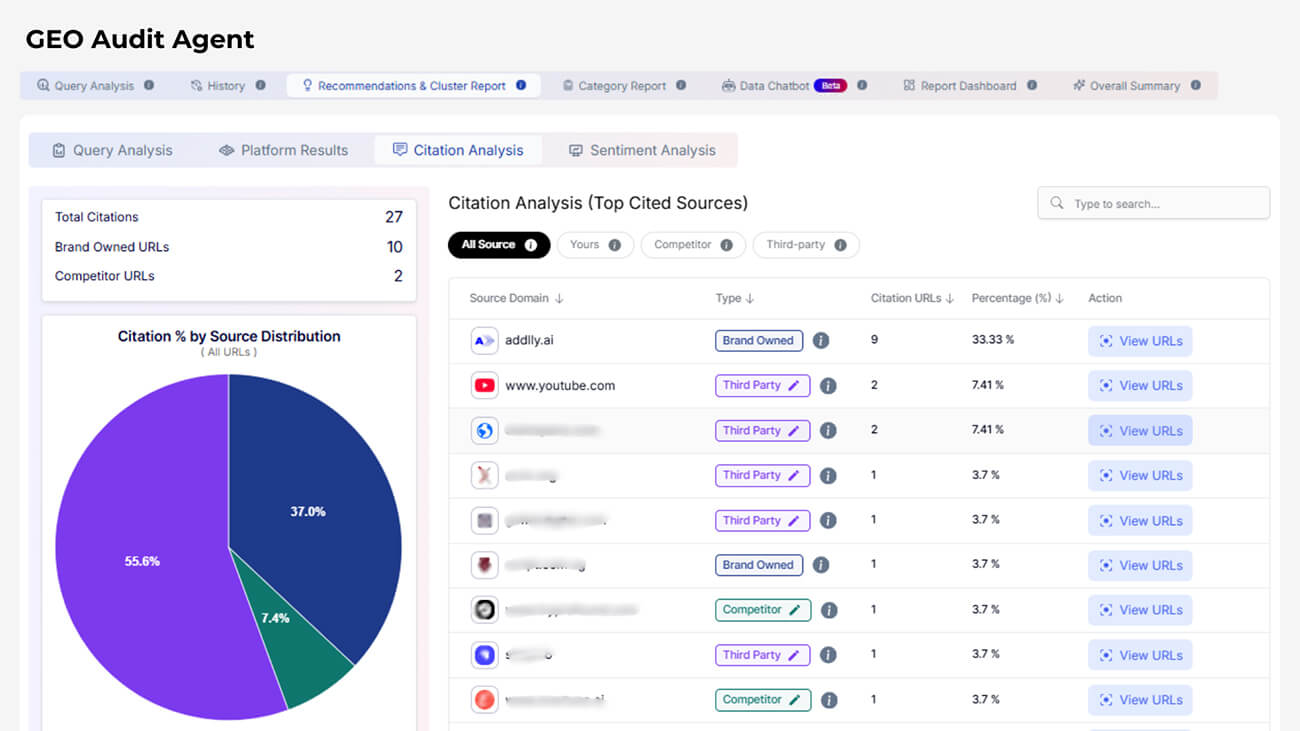
The audit evaluates:
- Frequency of citations across platforms
- Type of sources AI systems prefer over yours
- Patterns in how your content is referenced
In many cases, brands assume visibility because they rank well, but AI systems often rely on entirely different signals. Understanding this requires tracking how brand mentions are monitored across AI-generated answers and identifying where your content is being overlooked.
This section reveals whether your content is trusted enough to be referenced, not just indexed.
4. Content Extractability & AI Readability
This is one of the most critical and overlooked areas.
AI systems don’t read content the way humans do. They scan for structured, clear, and directly extractable information. If your content is buried in long paragraphs or lacks clear hierarchy, it becomes difficult to use.
Addlly AI evaluates:
- Whether answers are clearly defined within sections
- How easily key information can be extracted
- Structural clarity across headings and subheadings
This is closely tied to how you structure your blog content for AI answers and whether your content aligns with answer-first formats.
Even high-quality content can fail here if it is not formatted for machine interpretation.
5. Topical Authority & Share of Voice
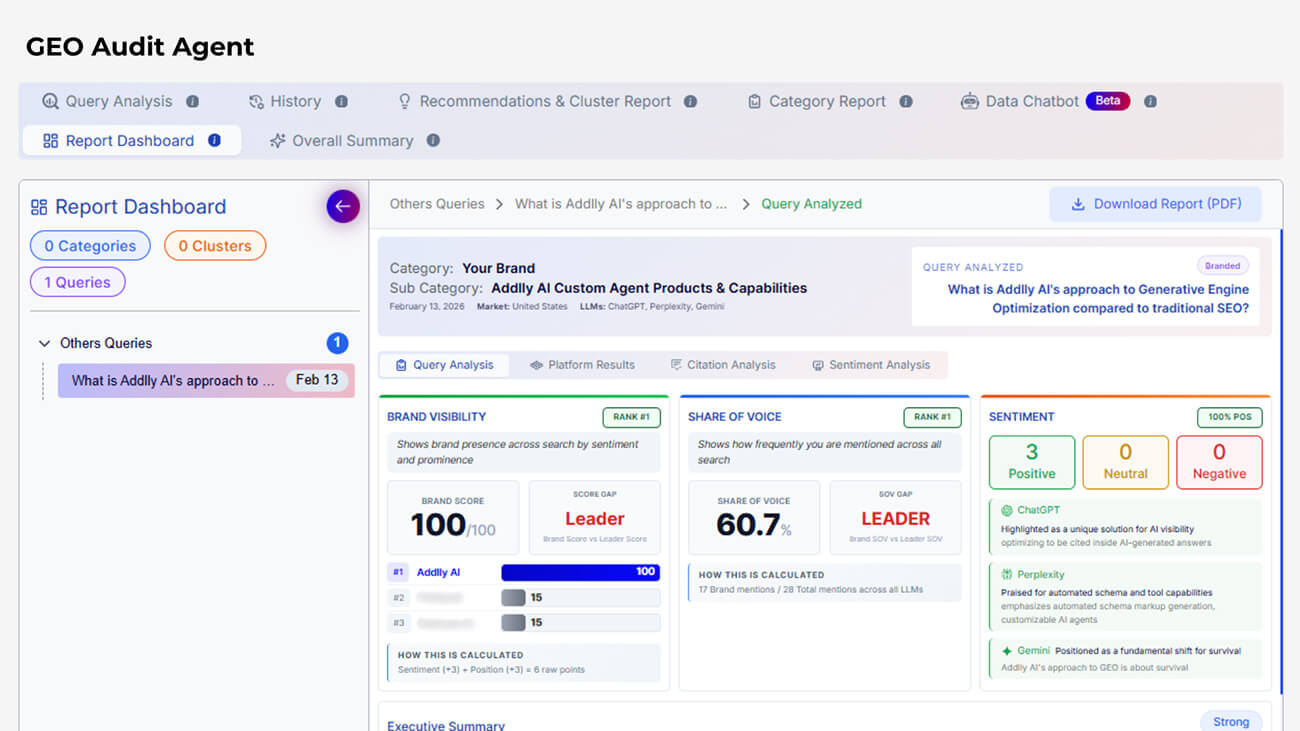
AI systems build an understanding of your brand through repeated signals across content, not isolated pages.
The audit looks at:
- Whether your brand is consistently recognized as an entity
- Depth of coverage across related topics
- Internal consistency across your content ecosystem
This connects directly with how brands build authority to increase AI visibility, especially when competing against larger or more established sources.
Without strong topical depth, your content may appear occasionally but won’t sustain visibility.
6. Competitor Visibility Benchmarking
AI visibility is relative. You’re always being evaluated against other sources.
Addlly AI compares:
- Which competitors appear more frequently
- Their share of citations across prompts
- Topics where they dominate visibility
Often, competitors win not because they have better content overall, but because their content aligns better with how AI systems extract and rank information. This becomes clearer when analyzing why some brands dominate in AI search results.
This section helps you identify exactly where you are losing visibility.
7. Technical AI Readiness
Technical foundations still matter, but in a slightly different way.
The audit checks:
- Whether your content is accessible and crawlable
- Use of structured data and schema
- Signals that help AI systems interpret your pages
For example, implementing structured data correctly can significantly improve how your content is understood, which is why the role of schema markup in AI search visibility becomes important.
Without this layer, even well-written content may not be properly processed.
8. Content Freshness Signals
AI systems tend to prioritize content that appears current and actively maintained.
The audit evaluates:
- Recency of updates
- Signs of outdated information
- Content sections that require refreshing
This is particularly important in fast-evolving topics, where stale content gets replaced quickly by newer sources.
9. AI Visibility Score & Key Metrics
Finally, all these signals are translated into measurable performance indicators.
Addlly AI tracks:
- Inclusion rate across prompts
- Prompt success rate
- Citation frequency
- Overall AI visibility score
These metrics align with what is typically tracked when measuring GEO performance, including KPIs used to track GEO and AEO success.
Instead of relying on assumptions, this gives you a clear, data-backed view of where your brand stands.
Also Read: How Does Addlly AI’s GEO Suite Help Brands Rank in ChatGPT, Perplexity, and AI Overviews
How Addlly AI Measures Visibility Across Different AI Engines
AI platforms don’t behave the same way. The same content can appear in one and disappear in another. Addlly AI accounts for these differences by evaluating visibility at a platform level and then bringing everything into a unified view.
Here’s how it breaks it down:
Platform Differences
Each engine retrieves and presents answers differently. ChatGPT and Claude rely more on structured understanding, while Perplexity AI and Google AI Overviews lean heavily on retrieval and citations. This is why visibility is often inconsistent across platforms.
What Gets Measured Across Each Engine
- Inclusion → Does your brand appear in the response?
- Citation → Are you referenced as a source?
- Prominence → How visible is your contribution in the answer?
Cross-Platform Gaps
Addlly AI highlights where visibility breaks:
- Appearing on one platform but missing on others
- Strong citation in some queries, but none in similar ones
- Inconsistent performance across prompt types
These gaps often reflect deeper issues in content structure or authority, similar to patterns seen in AI search ranking factors.
Unified Visibility View
Since every platform behaves differently, Addlly AI standardizes results into a single view so you can:
- Compare performance across engines
- Identify trends quickly
- Track improvements without fragmented data
Key Metrics That Define AI Visibility Performance
Addlly AI translates visibility into measurable signals so you’re not guessing what’s working. These metrics reflect how often and how effectively your content is used in AI-generated answers.
Core Metrics at a Glance
| Metric | What It Measures | Why It Matters |
|---|---|---|
| Inclusion Rate | How often your brand appears across prompts | Shows actual visibility, not assumed presence |
| Sentiment Score | Tone of brand mentions in AI responses | Indicates how your brand is perceived, not just whether it appears |
| Citation Frequency | How often your content is referenced as a source | Indicates trust and authority in AI systems |
| Prompt Success Rate | Percentage of prompts where your content is included | Reveals coverage across real user queries |
| Visibility Score | Combined score across platforms and prompts | Gives a unified view of performance |
| Consistency Score | Stability of visibility across platforms | Highlights fragmentation issues |
What These Metrics Actually Tell You
These aren’t just numbers. Together, they answer critical questions:
- Are you visible across enough prompts, or only a few isolated ones?
- Are AI systems trusting your content enough to cite it?
- Is your visibility stable, or dependent on specific platforms or queries?
This approach aligns with how AI visibility performance is measured in practice, but focuses specifically on AI-driven discovery.
How to Interpret Performance
- High inclusion, low citation → Your content is used but not trusted enough to be credited
- High citation, low coverage → Strong authority, but limited prompt reach
- Low consistency → Visibility depends too much on specific platforms
Understanding these patterns helps you move from visibility guesswork to clear, actionable insights.
How to Act on Insights from Addlly AI GEO Audit Agent
Once visibility gaps are identified, the focus shifts to fixing what actually impacts inclusion and citation.
What to Focus On First
-
Pages with partial visibility
Content that already appears in some prompts can be improved faster than starting fresh -
Structure over volume
Many issues come from formatting, not a lack of content, especially when the content isn’t structured for AI answers -
Prompt gaps, not keyword gaps
Expand coverage based on how users actually ask questions, which is why conversational queries matter in GEO
Summary
AI visibility comes down to one simple question: Is your content being used when answers are generated? Addlly AI GEO Audit Agent helps you answer that with clarity. It shows where your brand appears, where it gets ignored, and what needs to change. Instead of relying on assumptions, you get a structured view of visibility across platforms, prompts, and citations. Once these insights are clear, improving performance becomes less about creating more content and more about making existing content easier to extract, trust, and surface.