
Types of Addlly AI Agents
Addlly AI offers a range of AI agents designed to support different parts of the marketing workflow, from strategy and campaign planning to blog creation, ecommerce content, social publishing, and email production. Rather than relying on a single general-purpose writing tool for everything, teams can use specialized agents trained on brand inputs, business goals, and workflow needs.
This guide explains the main types of AI agents available in Addlly AI, what each one is designed to do, and how they fit into modern content operations. It also covers how these agents differ from generic AI writing tools, how they support enterprise workflows, and how teams can start small before scaling across more use cases.
The Main Types of AI Agents in Addlly AI
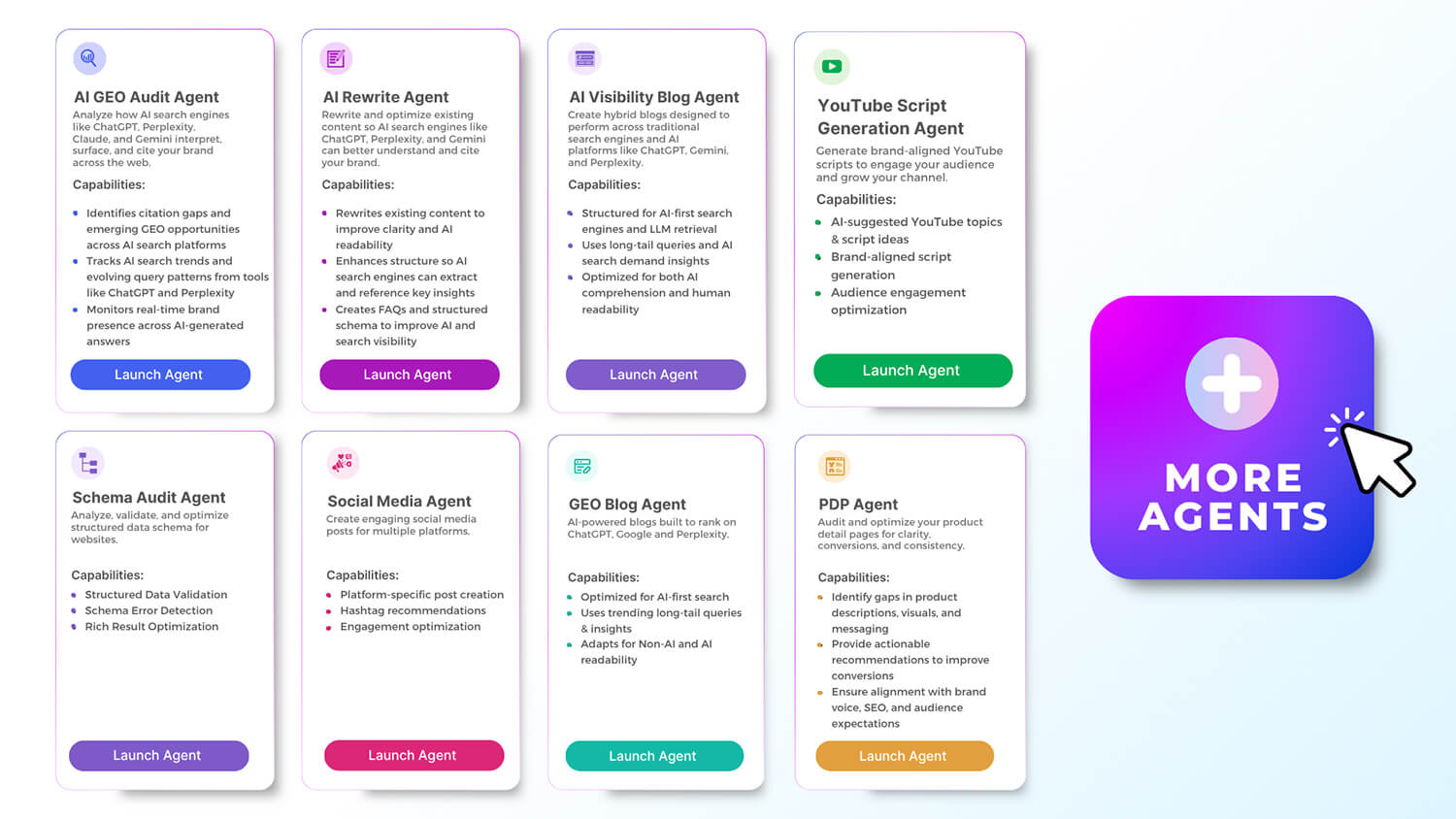
Addlly AI offers several core agent categories, each designed for a different stage of the marketing workflow. Together, they support strategy, visibility, content production, commerce, social media, and email operations.
1. Strategy Agents
Strategy agents help turn business goals into structured campaign direction. Instead of starting with disconnected ideas, teams can use agents such as the Media Strategy Agent to build a campaign plan based on goals, channels, audience, and messaging priorities.
Key capabilities
- Build multi-channel campaign plans
- Define audience focus and campaign objectives
- Recommend formats, themes, and content direction
- Support channel planning and publishing cadence
Strategy agents are useful when teams need to align campaigns before content production begins. They help provide a clearer starting point for blogs, social posts, newsletters, and other downstream assets.
Why it matters: A stronger strategy layer improves consistency later. When campaign direction is clear from the start, content teams can move faster and produce assets that feel more connected across channels and markets.
2. SEO Agents
- Cluster keywords and search intent
- Analyze search opportunities and content gaps
- Generate SEO-focused drafts with metadata and structure
- Support updates to existing content
- Improve technical and content readiness for search
SEO agents are best for brands focused on ranking in traditional search, scaling blog production, improving evergreen content, and managing large content backlogs.
Why it matters: They help maintain search visibility where keywords, site structure, and SERP performance still matter most.
3. GEO Agents
- Audit how AI systems interpret your brand and content
- Improve entity coverage and topic clarity
- Generate citation-ready, answer-friendly content
- Identify gaps that may limit visibility in AI answers
- Recommend rewrites or new pages to support AI discoverability
GEO agents are best for brands that want to strengthen AI visibility, improve brand inclusion in AI-generated answers, and create content built for modern answer-engine discovery.
Why it matters: As more users discover brands through AI-generated summaries and answers, GEO agents help ensure your content is easier for those systems to understand, trust, and surface.
4. Content Creation Agents
Content creation agents help teams produce high-volume, brand-aligned content across multiple formats. These agents are designed to speed up production while keeping output structured, useful, and closer to final quality from the start.
Key capabilities
- Generate SEO and GEO blog drafts
- Create product descriptions and web copy
- Produce social copy variations
- Support multiple formats from the same platform
- Maintain brand consistency across outputs
These agents are useful for teams that publish often, manage multiple content formats, or need to maintain quality across markets and channels.
Best for: These agents are useful for teams that publish often, manage multiple content formats, or need to maintain quality across markets and channels.
5. Ecommerce Agents
Ecommerce agents help automate product content creation, optimization, and localization. They are designed for brands managing large product catalogs or frequent product launches that require consistent, structured content at scale.
Key capabilities
- Generate product titles and descriptions
- Create meta tags and alt text
- Support localization by language and region
- Flag thin content or structural issues
- Maintain naming and tone consistency across products
Ecommerce agents are best for product-heavy businesses, online stores, and teams that need to publish optimized product content quickly across multiple items or markets.
Why it matters: They help reduce time spent manually writing and updating product copy while improving consistency, SEO readiness, and localization support.
6. Social Agents
Social agents support social media planning, listening, and post creation. In Addlly AI, this category includes tools for generating brand-aligned captions, selecting hashtags, working from campaign themes, and creating platform-specific social content more efficiently.
Key capabilities
- Generate platform-specific captions
- Support trend-aware content creation
- Create social posts from segments, campaigns, or themes
- Help maintain tone consistency across platforms
- Support faster social publishing workflows
Social agents are useful for brands that publish regularly across multiple platforms, need faster turnaround for post creation, or want to keep social content aligned with broader campaigns.
Why it matters: They help teams stay active and relevant without relying on fully manual creation for every post. They also make it easier to keep messaging aligned across social content and larger brand initiatives.
7. Newsletter Agents
Newsletter agents help create and manage newsletters at scale while maintaining brand voice, editorial standards, and audience relevance. They streamline content planning, drafting, and distribution, helping teams deliver consistent, engaging newsletters with less manual effort.
Key capabilities
- Generate newsletter drafts from URLs, articles, or content sources
- Curate and organize content into newsletter-ready formats
- Personalize content for different audience segments
- Create newsletters in multiple languages
- Maintain consistent brand voice, tone, and formatting
Newsletter agents are best for teams running recurring newsletters, thought leadership programs, customer updates, or content-driven subscriber communications that require consistent production and delivery.
Why it matters: They reduce the time spent creating newsletters, improve content consistency, and help organizations scale audience engagement without increasing editorial workload.
How to Start with Addlly AI Agents
Most teams do not need to activate every agent type at once. A more practical approach is to start with one or two workflows where speed, consistency, or visibility are the highest priorities. For some brands, that may be GEO and blog creation. For others, it may be newsletters, campaign planning, or ecommerce content.
A good starting approach is to:
- Begin with one or two agents tied to a real use case
- Run a short pilot using live assets
- Measure time saved, approval rate, and output quality
- Expand into adjacent workflows once the first use case is working well
This makes rollout easier and gives teams a clearer way to evaluate value before scaling further.
How Addlly AI Agents Fit into Enterprise Workflows
How to Launch a Complete Marketing Suite with Addlly AI Agents in Minutes
1
2
3
Consultation
We start with a strategic session to understand your goals, brand voice, and existing workflows. This ensures your AI agent is built to align with your business needs from day one.
Setup
Our team configures your AI agent with your content assets, guidelines, and integrations. No technical expertise required on your end. Everything is optimized for immediate performance.
Deployment
Go live with confidence. Your AI agent is fully operational, producing on-brand marketing assets, streamlining workflows, and delivering measurable impact from the start. Full support provided along the way.
Enterprise teams often need more than just content generation. They need agents that can fit into existing systems, approval processes, localization requirements, and governance models. Addlly AI is designed to support that by working within structured workflows rather than operating as a standalone drafting tool.
Key considerations include:
- Integration: compatibility with CMS platforms, ecommerce tools, email tools, and workflow systems
- Governance: brand rules, approval flows, access control, and audit visibility
- Localization: support for multiple languages, markets, and geo-aware content settings
- Measurement: dashboards and benchmarks tied to business and visibility goals
This matters because agent adoption works best when it aligns with how teams already operate. Strong enterprise implementation is not just about adding AI. It is about fitting agents into real workflows that teams can trust and use consistently.
Measuring the Impact of AI Agents
The value of AI agents is not only in faster content creation. It is also in the quality, consistency, and visibility that those workflows can support over time. A useful measurement approach should combine efficiency metrics with brand and performance metrics.
Common measures include:
- Time saved per asset
- Cost per asset
- First-draft approval rate
- Edit volume
- Output volume
- SEO visibility metrics
- GEO or AI visibility metrics
- Localization and compliance accuracy
This gives teams a more complete view of performance. Instead of measuring output alone, they can evaluate whether agents are improving speed while still maintaining brand consistency and supporting discoverability.
FAQs
What is the difference between AI marketing agents and generic AI tools?
AI marketing agents are built for specific workflows and use approved brand data, rules, and content structures throughout the process. Generic AI tools are more open-ended and often rely on repeated prompting and editing to produce usable outputs.
How do SEO and GEO agents work together?
SEO agents help improve visibility in traditional search engines, while GEO agents help improve visibility in AI-generated answers and discovery environments. Used together, they support a more complete visibility strategy across both search results and AI-driven experiences.
What does zero-prompt mean in Addlly AI?
Zero-prompt means users do not need to build complex prompt libraries or write detailed instructions for every task. Instead, they select an agent, provide the required inputs, and let the workflow automatically apply the brand logic and task structure.
Do I need to use all agent types at once?
No. Most teams start with one or two agent types based on their immediate needs. A smaller pilot is usually the best way to test value, improve adoption, and identify which workflows to expand next.
Which Addlly AI agent should I start with first?
That depends on your current priority. Teams focused on AI visibility may start with GEO agents. Teams focused on faster publishing may start with content, email, or social media agents. Strategy agents are often a strong starting point for campaign-led workflows.
Can different AI agents work together in the same workflow?
Yes. One of the strengths of Addlly AI is that different agents can support connected tasks. For example, a strategy agent can shape a campaign, then content, social, and email agents can help turn that strategy into publishable assets.
Are Addlly AI’s AI agents useful for smaller teams too?
Yes. Smaller teams can use agents to reduce manual workload and expand output without needing a larger internal content operation. Starting with a focused use case can be especially useful when team time and resources are limited.
Can AI agents support multiple languages and markets?
Yes. Addlly AI supports multi-language and localization workflows, which helps brands create content for different regions while keeping messaging aligned with approved brand tone and business direction.
How do AI agents use brand validation and training?
Brand validation and training equip agents with the context they need to produce more accurate outputs. Validated brand inputs, trained examples, and structured workflows all help improve tone consistency, relevance, and overall output quality across different agent types.
How should teams measure success after implementation?
Start with practical metrics such as time saved, edit volume, approval rate, and output volume. Then connect those results to larger goals such as stronger SEO performance, improved AI visibility, better localization quality, or faster campaign activation.