How to Run a Geo Audit in Addlly AI
(Step-by-Step Guide)
Running a GEO audit in Addlly AI shows you exactly how your brand appears inside AI-generated answers. Instead of guessing your visibility, you can track where you are mentioned, which sources are cited, and how AI platforms position your brand against competitors. This is a core part of generative engine optimization, where visibility depends on how AI models interpret and surface information. In this guide, you will learn how to run a GEO audit in Addlly AI step by step, from designing queries to analyzing results, so you can turn data into clear actions that improve your presence across AI search platforms.
Step 1: Selecting Queries in Addlly AI
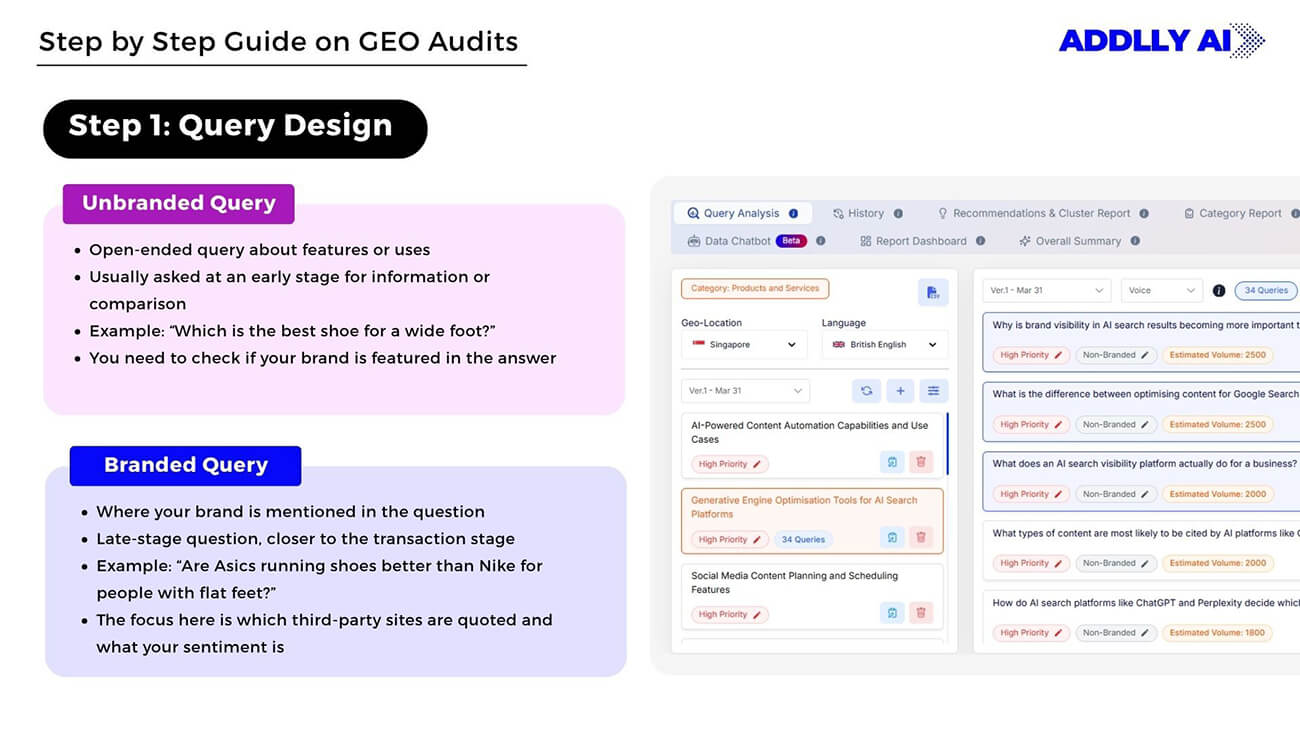
A GEO audit is only as good as the queries you run. In Addlly AI, queries are not random prompts. They are structured inputs that simulate how real users ask questions across AI platforms. The goal here is simple: capture how your brand appears across different stages of intent. That is why Addlly AI separates queries into branded and native categories. Together, they give you a complete view of discovery, consideration, and comparison. This approach is aligned with how a structured GEO audit checklist is built, where query design forms the foundation of reliable insights.
Native/ Organic Queries: Early-Stage Discovery Analysis
Native or organic queries reflect how users search when they are not looking for a specific company. These are high-intent, problem-led questions where AI platforms decide which brands to introduce.
For example, instead of searching for your brand, a user might ask:
- “Best tools for AI search optimization”
- “How to improve visibility in ChatGPT”
- “Top platforms for content optimization in AI search”
These queries help you answer a critical question:
Does your brand appear when the category is being explored?
If you are missing here, it means AI platforms are not associating your brand with the problem space yet.
When adding organic queries in Addlly AI:
- Focus on category-level and problem-based questions
- Use natural, conversational phrasing
- Avoid stuffing keywords or making them sound like SEO queries
- Cover different variations of the same intent
This is where most brands discover their biggest visibility gaps.
Branded Queries: Evaluating Competitive Positioning
Branded queries measure how your brand is positioned when it is already part of the conversation. These queries typically include your brand name or your competitors’.
Examples include:
- “What is Addlly AI used for?”
- “Addlly AI vs other GEO tools”
- “Best alternatives to Addlly AI”
These queries help you understand:
- How AI platforms describe your brand
- Whether your strengths are being communicated correctly
- How you compare against competitors in AI-generated answers
Branded queries are less about discovery and more about control over narrative. If AI responses misrepresent your product or favor competitors, this is where you will see it clearly.
When selecting branded queries:
- Choose the ones that include your brand name and key competitors
- Add comparison-based queries
- Include use-case driven questions
- Select Test variations in phrasing to see how responses change
How to Select Queries for GEO Analysis
The quality of your GEO audit depends on the queries you choose. In Addlly AI, users are not manually structuring queries. Instead, they are selecting from a set of queries designed to reflect real user intent across AI platforms.
A strong query selection should still follow a clear pattern, ensuring that you are covering different contexts in which your brand may appear.
In Addlly AI, an effective query set usually:
- Mixes unbranded and branded queries
- Covers different stages of the user journey
- Uses clear, natural language
- Reflects how users typically ask questions on AI platforms
Think of your query selection as a testing framework. You are not trying to prove a point. You are trying to observe how AI systems respond across different contexts.
A simple way to approach query selection:
- Start with problem-based queries
- Include solution-oriented queries
- Add brand-specific and comparison queries
Once the right queries are selected, the rest of the GEO audit becomes far more reliable. Every insight you get later depends on the quality and relevance of this step. You can see how this connects to a complete GEO audit tool workflow, where selected queries directly influence the outputs you analyze.
Step 2: Selecting LLM Platforms for Analysis
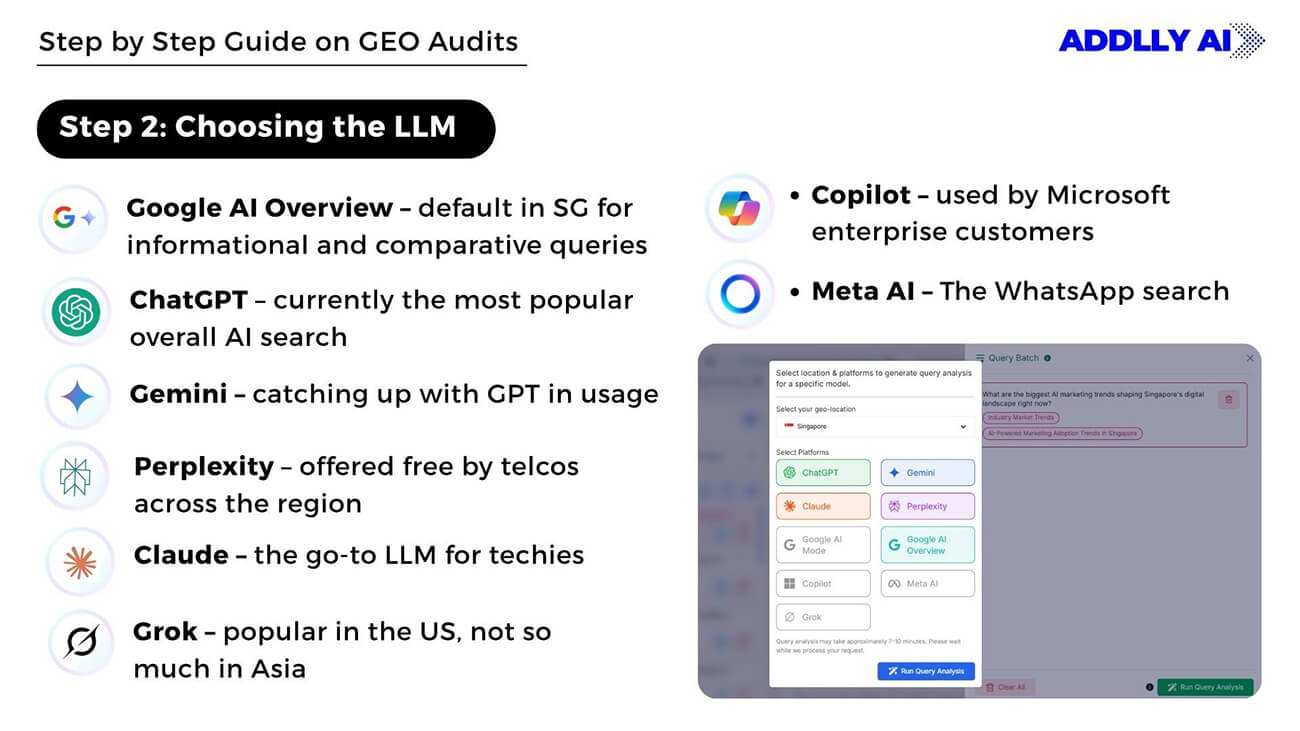
Once your queries are ready, the next step is choosing where to run them. In Addlly AI, this means selecting the LLM platforms that will generate responses for your audit. This step matters because AI search is not uniform. Different platforms produce different answers, cite different sources, and rank brands differently. Your visibility can vary significantly from one platform to another, so selecting the right mix gives you a more accurate picture of where you actually stand.
Supported Platforms in Addlly AI
Addlly AI allows you to run your queries across multiple leading AI platforms. These typically include systems like ChatGPT, Claude, Gemini, and Perplexity, where users actively search for recommendations, comparisons, and solutions.
Each platform has its own way of:
- Interpreting queries
- Selecting sources
- Generating responses
- Referencing brands
This means your brand might appear strongly on one platform and be completely absent on another. Running your audit across multiple platforms ensures you are not relying on a single source of truth.
When selecting platforms inside Addlly AI:
- Choose platforms where your target audience is active
- Include at least two to three platforms for comparison
- Avoid limiting your analysis to just one ecosystem
Step 3: Running Query Analysis in Addlly AI
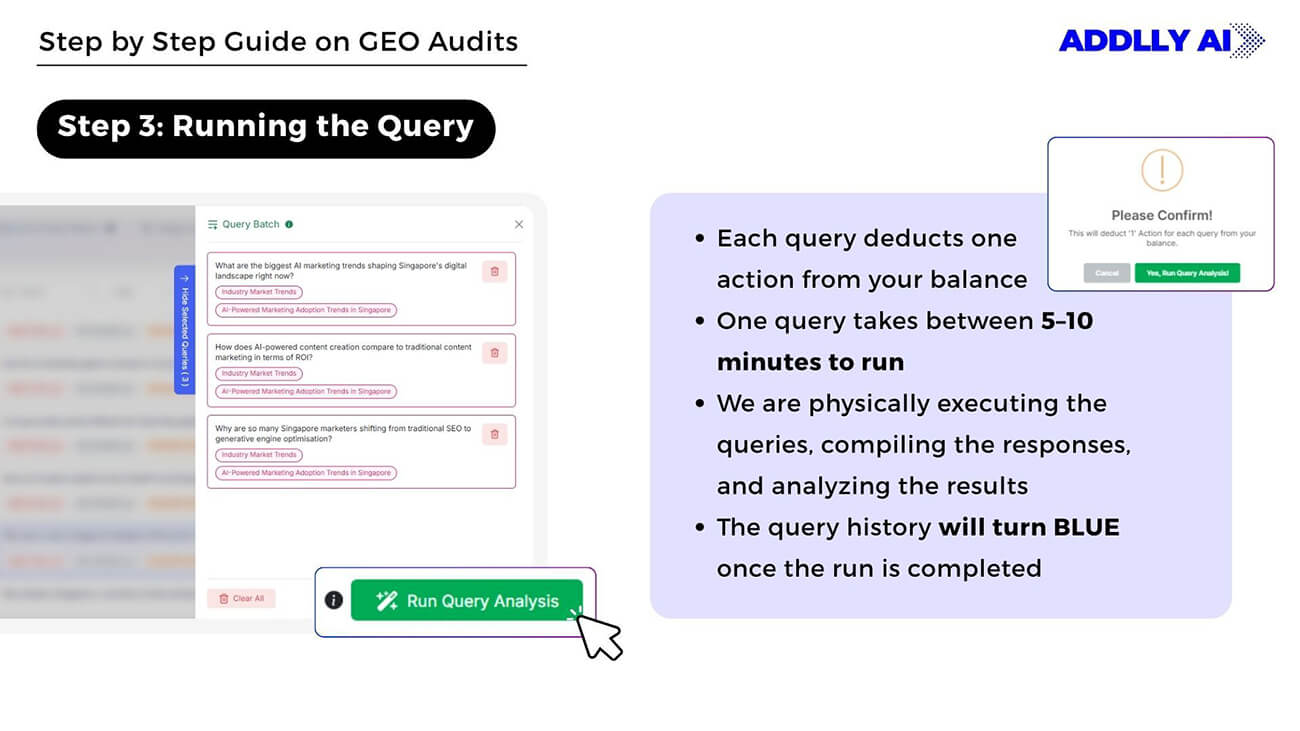
After setting up your queries and selecting the platforms, the next step is to run the analysis. This is where Addlly AI executes your inputs across different LLMs and collects responses in a structured format. At this stage, you are no longer planning. You are generating real data that will define how your brand is being represented across AI systems.
How to Execute a Query Cluster
In Addlly AI, queries are executed in batches rather than individually. This allows you to test multiple queries across multiple platforms in one run.
To execute a batch:
- Add your finalized list of queries
- Select the LLM platforms you want to analyze
- Initiate the run using the query analysis option
Once triggered, Addlly AI sends each query to each selected platform and captures the responses in a consistent format. This makes it easier to compare how different platforms respond to the same input.
A well-structured batch typically:
- Includes both branded and unbranded queries
- Covers different user intents
- Runs across multiple platforms at once
Understanding Query Processing Time and Usage
Query analysis takes time because each query is processed across multiple platforms. The total duration depends on how many queries you are running and how many platforms you have selected.
Processing time is influenced by:
- The number of queries in your batch
- The number of platforms selected
- The complexity of the queries
Larger batches will take longer, as multiple combinations are being processed. It is better to focus on relevant, well-structured queries instead of increasing volume unnecessarily.
From a usage perspective:
- Each query-platform combination contributes to overall usage
- Adding more platforms increases coverage
- Balanced batches help maintain efficiency
Tracking Query Status and Completion
Once the analysis starts, Addlly AI provides clear visibility into the status of your queries. This allows you to monitor progress without guessing whether the run is complete.
You can track:
- Queries that are in progress
- Queries that are completed
- Any queries that may require attention
It is important to wait until all queries are fully processed before moving to the next step. Complete data ensures your analysis reflects the full picture of your brand’s visibility across platforms.
Step 4: Analyzing GEO Audit Results
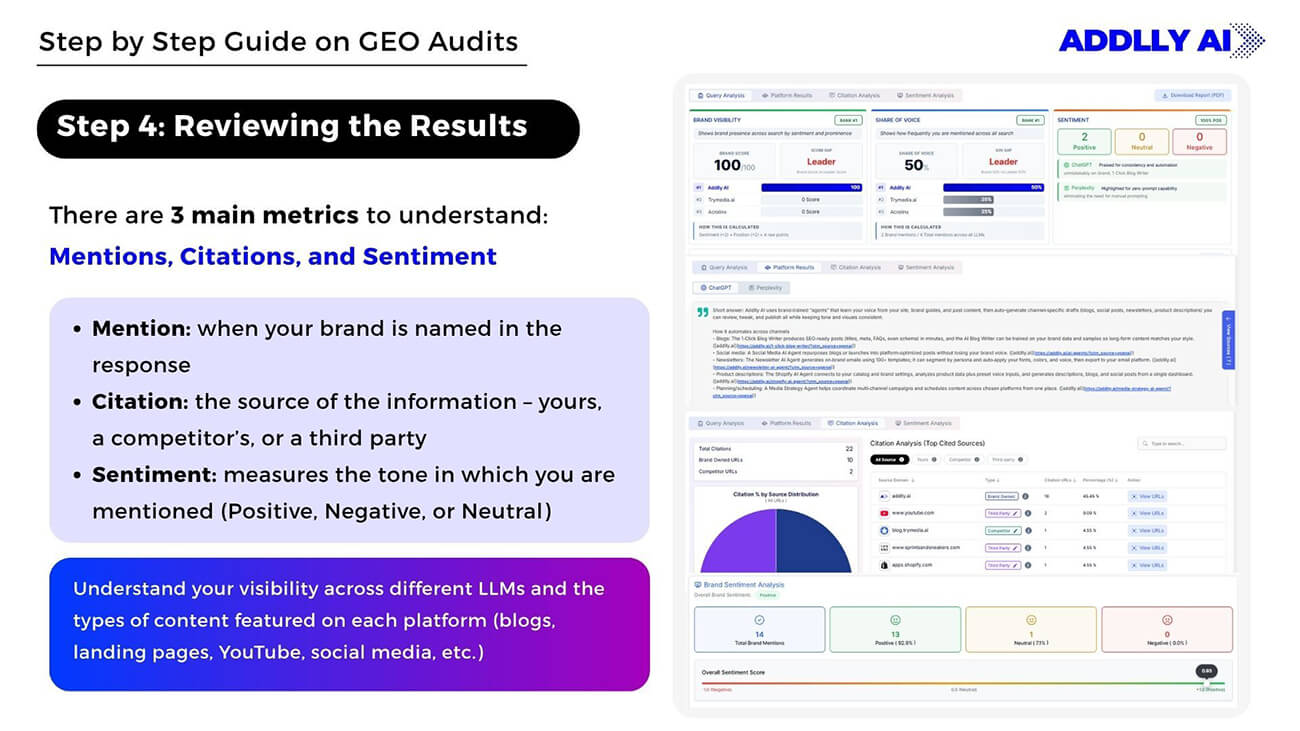
This is where the audit starts making sense. Once your queries have been processed, Addlly AI organizes the responses into clear signals that show how your brand appears across AI platforms. Instead of reading raw answers one by one, you are looking at structured insights that reflect visibility, positioning, and perception. These signals align closely with how performance is measured in kpis to track for GEO and AEO, giving you a more grounded way to interpret results.
Understanding Brand Mentions in AI Responses
Mentions tell you whether your brand is being included in AI-generated answers at all. This is the most direct signal of visibility.
When you review mentions, look at:
- How often your brand appears across queries
- Which types of queries trigger your brand
- Whether you appear alongside competitors
If your brand is missing from relevant queries, it usually means AI platforms are not strongly associating you with that topic yet. Frequent mentions, especially across high-intent queries, indicate stronger category alignment.
Analyzing Citations across Sources
Citations show where AI platforms are pulling information from when they mention your brand. This gives you insight into which sources are influencing how your brand is represented.
While analyzing citations, focus on:
- Which domains are being referenced
- Whether your own content is cited
- Which third-party sources appear consistently
Patterns in citations often reflect how AI systems prioritize sources, which is closely tied to how AI search ranking factors work across different platforms.
Evaluating Sentiment Distribution
Sentiment helps you understand how your brand is being described in AI responses. It reflects whether your positioning is being interpreted correctly.
When reviewing sentiment:
- Look for consistency across platforms
- Identify whether your strengths are clearly reflected
- Watch for neutral or unclear positioning
Strong sentiment alignment usually indicates that your messaging and external signals are consistent. Mixed sentiment often points to gaps in how your brand is being understood.
Measuring Share of Voice across LLMs
Share of voice gives you a comparative view of your visibility against competitors. It shows how often your brand is included relative to others across platforms.
When analyzing share of voice:
- Compare your mentions with competitors
- Identify platform-specific gaps
- Prioritize where visibility is low
This helps you focus on areas where improvement will have the most impact, rather than trying to optimize everything at once.
Step 5: Generating Actionable Insights
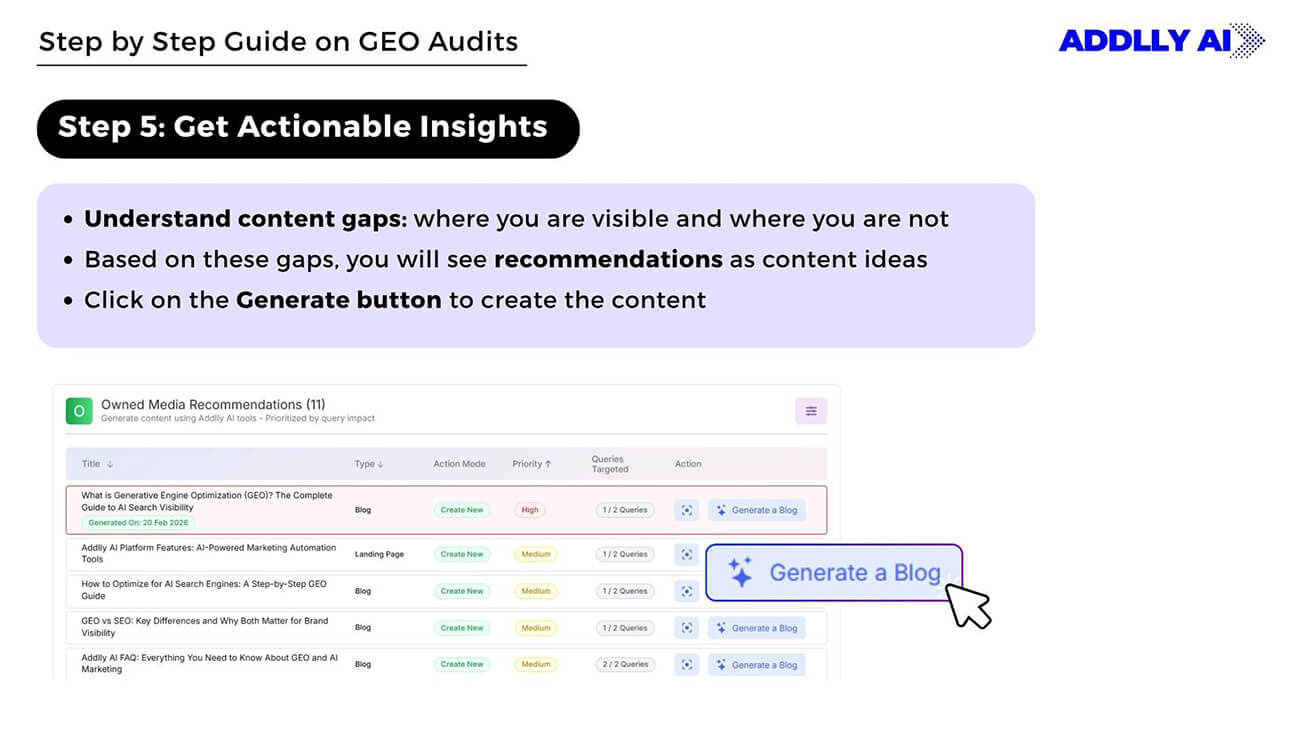
Running a GEO audit is only useful if it leads to action. By this stage, you already know where your brand appears, how it is positioned, and where gaps exist. The next step is to convert these findings into clear decisions. Addlly AI helps you move from observation to execution by connecting audit results directly with content opportunities.
Identifying Content Gaps from Audit Results
Content gaps become visible when you compare queries with your presence in AI responses. If certain high-intent queries do not include your brand, it usually means you are missing relevant or discoverable content in that area.
While identifying gaps, focus on:
- Queries where competitors are mentioned but you are not
- Topics where your brand appears inconsistently
- Areas where citations come from third-party sources instead of your own content
These gaps often reflect missing coverage, weak authority, or content that is not aligned with how AI platforms interpret queries. Addressing them is a core part of improving visibility through content creation for GEO.
Using Recommendations to Guide Content Strategy
Addlly AI provides recommendations based on your audit results, helping you understand what to create next and why. These are not generic suggestions. They are directly tied to how your brand is currently performing across queries and platforms.
When using recommendations:
- Prioritize queries with high visibility potential
- Focus on topics where competitors are consistently present
- Align content with the language and structure seen in AI responses
This approach ensures that your strategy is grounded in actual data rather than assumptions. Over time, this also improves how your content aligns with how to optimize your content for AI answer engines, making it more likely to be picked up in AI-generated responses.
Generating Content Directly from GEO Insights
Once you know what to create, the next step is execution. Addlly AI allows you to generate content directly from your audit insights, reducing the gap between analysis and action.
This helps you:
- Create content tailored to specific queries
- Align messaging with how AI platforms frame answers
- Build content that is more likely to be cited and referenced
Instead of starting from scratch, you are building on real data. Every piece of content is informed by how AI systems already interpret your category, your competitors, and your brand.
Best Practices for Interpreting GEO Audit Results in Addlly AI
Interpreting a GEO audit is about understanding patterns across multiple signals rather than looking at isolated outputs. Addlly AI organizes results into clear dimensions so you can evaluate visibility, positioning, and performance in a structured way. When you read the data through the right lenses, it becomes easier to identify what is working, where gaps exist, and what needs to change.
-
Visibility and Share of Voice
Focus on how often your brand appears across queries and how it compares to competitors. Look at consistency across different query types and platforms. Strong visibility across high-intent queries indicates that your brand is well associated with the category. -
Sentiment and Positioning
Evaluate how your brand is being described in AI responses. Pay attention to whether your strengths are clearly reflected and whether the tone remains consistent across platforms. This helps you understand how your brand is perceived, not just whether it is mentioned. -
LLM-Level Performance
Analyze how your brand performs across different AI platforms. Some LLMs may surface your brand more frequently, while others may favor competitors. These differences help you identify platform-specific gaps and opportunities. -
Sources and Citations
Review where AI platforms are pulling information from when referencing your brand. Strong visibility supported by credible sources improves reliability. If competitors are backed by stronger citations, it signals where your content or authority needs improvement.
Summary
A GEO audit in Addlly AI gives you a clear view of how your brand appears across AI search platforms by analyzing real queries, mentions, citations, sentiment, and share of voice. By designing the right queries, selecting relevant platforms, and running structured analysis, you can uncover visibility gaps and understand how AI systems position your brand. The real value comes from turning these insights into action, identifying content opportunities, refining your strategy, and creating content aligned with how AI surfaces information. With a consistent approach, GEO audits become a reliable way to improve and maintain your presence in AI-driven search environments.