
How Does Addlly AI Use GEO to Help Brands Show Up in AI Answers?
Addlly AI helps brands show up in AI answers by revealing where visibility is weak and why competitors are being cited. The audit then turns those findings into actions teams can implement.
That is the practical role of Generative Engine Optimization, or GEO. It examines how a brand is represented in AI-led discovery and identifies what can be changed to improve its visibility.
Traditional SEO asks whether a page ranks in search results. GEO asks a different question: Is your brand part of the answer when customers ask AI?
For enterprise marketing teams, finding the answer is only the first step. They also need to understand what is driving the result and what they should do about it.
Addlly AI connects those stages. Its GEO Audit Agent measures AI search visibility and examines the sources influencing answers. It compares the brand with competitors, then translates the findings into recommendations that can be implemented through content or technical changes.
GEO does not stop at another visibility score or dashboard. It becomes a way to understand where a brand is losing ground and what can be done to improve its position.
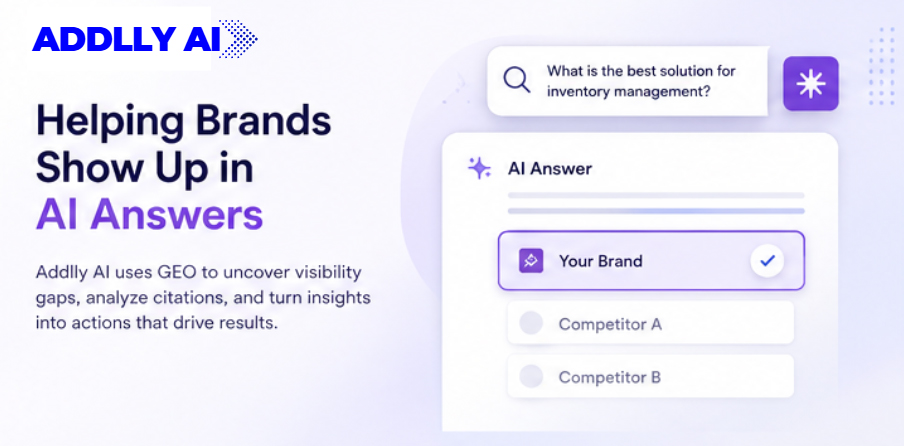
Why Does Showing Up in AI Answers Matter?
People are no longer relying only on traditional search results to discover brands or products.
Increasingly, they ask direct questions in AI-powered tools and receive a summarised answer rather than a page of links.
They may ask which product suits a particular need. They might compare two brands or ask what to consider before buying.
This changes what visibility means.
A brand can rank well in traditional search and still be absent from an AI-generated answer. Relevant information may already exist on its website, but it may not be clear enough for AI systems to use.
Competitors may appear more often because their content answers the question better. In other cases, third-party sources cited by AI engines may reinforce the competitor’s position.
For brands, the question is no longer only:
“Can customers find us in search?”
It is also:
“Are we part of the answer when customers ask AI?”
This is where GEO becomes important.
GEO helps brands understand where they appear across AI-led discovery and why visibility may be weak. It looks beyond rankings to examine mentions and citations. Competitive performance provides context for what those results mean.
The aim is not to produce more content for AI.
It is to make sure useful and credible information about the brand is available when AI systems answer questions relevant to the business.
How Does Addlly AI Support GEO?
Addlly AI connects GEO measurement with action.
Instead of running an audit and leaving marketing teams to interpret a dashboard, the GEO Audit Agent establishes where the brand currently stands. The findings then show which areas deserve attention.
1. Audit AI Search Visibility
A GEO program should begin by understanding what is already happening across AI search.
Addlly AI’s GEO Audit Agent analyses relevant queries to identify where a brand appears and where it does not.
Teams can see:
- where the brand is mentioned
- where competitors have stronger visibility
- which questions produce weak results
- where the brand is absent from commercially important conversations
This creates a baseline for AI search visibility.
It also avoids making decisions based on a handful of manually tested prompts, which rarely provide a reliable picture of performance.
2. Map Citations and Sources
Being mentioned in an AI answer matters. Understanding why a brand appears is more useful.
Addlly AI’s citation analysis examines the sources AI engines use when answering relevant questions.
It can show whether an AI platform is citing the brand’s website or relying on a third-party source. It can also reveal where competitors are earning citations instead.
This turns a broad problem, such as “low AI visibility,” into something teams can investigate.
If competitors consistently appear because particular sources are being cited, that evidence can guide the action plan.
3. Benchmark AI Share of Voice Against Competitors
A visibility score in isolation can be misleading.
A brand’s mentions may increase while competitors improve faster.
Addlly AI compares visibility against the competitive set so teams can see which brands dominate important topics and where the biggest gaps lie.
This can also reveal cases where a challenger brand appears frequently in AI answers despite having weaker traditional search visibility.
AI search can therefore change the competitive picture. Brands that dominate Google do not necessarily dominate AI-generated answers.
4. Review Brand Sentiment and Positioning
Visibility alone is not enough.
A brand may appear frequently but still be described in a way that does not reflect its intended positioning.
Addlly AI analyzes how the brand is represented in AI-generated answers. Teams can assess sentiment and check whether important brand attributes are accurately reflected.
This matters for enterprise brands with complex product ranges or carefully defined positioning.
If AI systems repeatedly associate a brand with outdated information or incorrect attributes, increasing mentions will not solve the underlying problem.
The issue may instead lie in the information AI systems are finding.
5. Diagnose Content or Technical Gaps
Once the visibility data is understood, the next step is finding the cause.
A GEO gap does not automatically mean another article is needed.
An existing product page may provide too little useful information. Important customer questions may not be answered on the website. Product terminology may vary between pages.
The issue can also be technical. Important information may not be clearly represented through schema or other structured signals.
Addlly AI connects these findings with specific actions, which might include:
- strengthening an existing product or category page
- answering a missing customer question
- improving how important information is structured
- updating outdated content
- clarifying product or category terminology
- improving schema markup
This helps teams address the actual weakness rather than assuming more content is always the answer.
6. Turn GEO Findings into a Prioritized Action Plan
A long list of issues is not helpful if everything appears equally urgent.
Addlly AI helps teams turn audit findings into priorities based on business importance and current visibility.
A brand might focus first on a priority product category where competitors dominate AI recommendations. Another may find that weak citation visibility around high-intent questions deserves immediate attention.
The resulting plan shows which pages should be improved first and where genuinely new content is required.
Technical recommendations can be included in the same plan rather than becoming a separate GEO exercise.
What Does Addlly AI Measure in a GEO Audit?
A useful GEO audit needs to look beyond one visibility score.
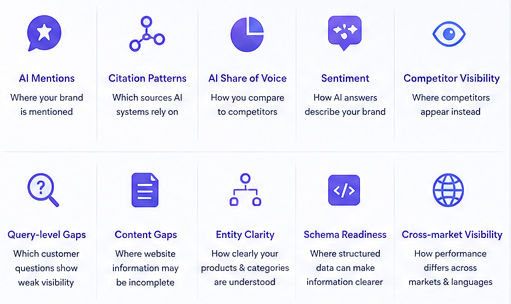
Taken together, these signals show where visibility is being won or lost.
More importantly, they provide evidence for deciding what should happen next.
GEO vs Traditional SEO
SEO and GEO are closely connected, but they measure different parts of search discovery.
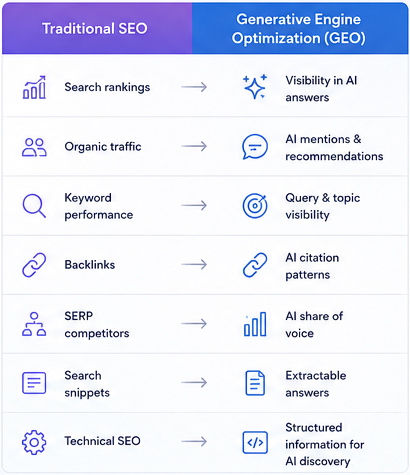
A strong SEO foundation can support GEO, but good Google rankings do not automatically translate into strong AI visibility.
A brand may rank well for a search term yet rarely appear when the same customer need is expressed as a conversational question.
This is why organizations increasingly need to measure both.
How Enterprise Marketing Teams Are Implementing GEO Recommendations from Addlly AI Audits
Once an Addlly AI GEO Audit identifies where visibility is being lost, the next question is practical: who will implement the recommendations and how?
Not all enterprise marketing teams need the same operating model.
Some have large internal content teams. Others already work with SEO or digital agencies. Some need additional support to move from recommendations to implementation.
Addlly AI can work within each of these models.
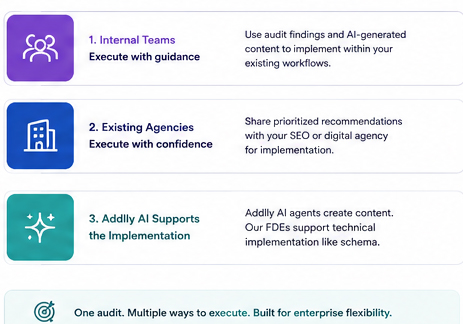
Model 1: Internal Teams Implement the Recommendations
For enterprises with established marketing teams, Addlly AI can provide the audit findings and prioritized recommendations for internal execution.
Addlly AI agents can also support content creation or rewrites based on the identified gaps.
The internal team can then review the output, make any necessary edits, and manage publishing through its existing approval process.
This model allows the organization to retain control over execution while using the GEO Audit to determine priorities.
Model 2: Existing Agencies Implement the Recommendations
Many enterprise brands already have SEO, content, or digital agencies responsible for website execution.
In this model, Addlly AI identifies the GEO gaps and provides the recommendations. The client’s existing agency can then carry out the work within its current remit.
This avoids replacing established agency relationships simply to implement GEO.
It also gives the agency a clear evidence base for deciding which pages need attention and what the optimization should address.
Model 3: Addlly AI Supports the Implementation
Some teams want Addlly AI to take a more active role after the audit.
Where implementation support is included in the scope, Addlly AI’s brand-trained agents can help create or optimize content based on the audit recommendations.
Technical implementation can also be supported. An Addlly AI Forward Deployed Engineer, or FDE, can work with the client’s technical team on areas such as schema implementation, where required.
This creates a more structured path from identifying a GEO problem to implementing the recommended change.
How Do Teams Decide What to Implement First?
Regardless of which operating model is used, the audit should determine the sequence of work.
Start with commercially important topics.
Not every visibility gap deserves equal attention. Priority products and categories come first. High-intent customer questions may also warrant early action.
Improve existing pages before creating new ones.
A page may already contain useful information, but may need more depth or a clearer structure. Strengthening that asset often addresses the GEO gap without creating another page.
Use citation mapping to understand off-site influence.
AI-generated answers may rely on sources beyond the brand’s website. Citation analysis can show where competitors are benefiting from stronger external sources, which may change the recommended action.
Create supporting content only when a genuine gap exists.
Supporting articles or FAQs can strengthen a topic when important questions are not being answered elsewhere. The goal is useful coverage, not a larger content count.
Keep brand terminology consistent during execution.
Product names should remain consistent across relevant pages. The same principle applies to category definitions and approved claims.
Address schema alongside the content recommendation.
If the audit identifies a structured-data problem, it should be handled as part of the implementation rather than left in a separate technical report.
How Do Teams Know Whether the Changes Worked?
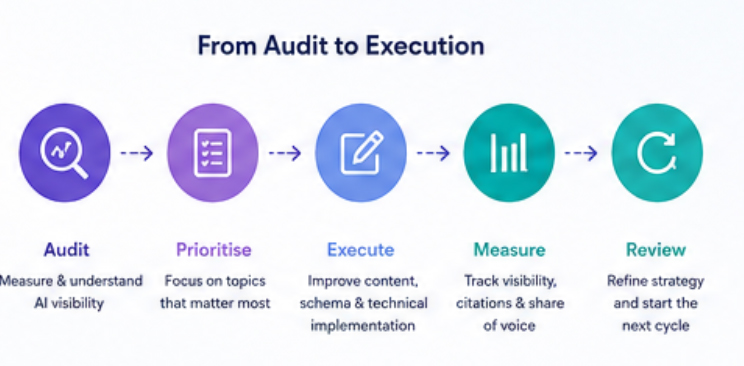
Implementation should be followed by remeasurement.
A later GEO audit can show whether visibility improved for the targeted queries and whether the brand gained ground against competitors.
Teams should also consider citation patterns rather than relying solely on an overall visibility score.
If a recommendation proves effective, the finding can inform the next round of optimization. If visibility remains limited, the audit provides new evidence on what to investigate next.
This creates a practical GEO operating cycle:
Can Addlly AI Support GEO Across Different Markets?
AI search visibility can vary considerably between markets.
A brand may perform strongly in one country and be barely visible in another because the available sources differ. Customer questions can differ, and language adds another layer.
Translating a successful English page does not necessarily mean it will answer what customers ask elsewhere.
Addlly AI supports GEO analysis and content workflows across different markets and languages. This allows regional teams to work from local visibility data rather than applying a single global set of assumptions everywhere.
For enterprises managing several brands or product categories internationally, this makes it possible to identify where the GEO problem is global and where a market needs a different response.
GEO Should Be an Ongoing Operating Process
Generative Engine Optimization is unlikely to be solved through a single audit.
Competitor content changes. AI platforms alter how they retrieve information. New sources begin influencing answers.
Brands, therefore, need a repeatable way to measure visibility and decide when action is required.
Addlly AI connects the audit with implementation so GEO can become part of an ongoing marketing workflow rather than a one-off report.
The objective is not to produce content simply because AI search exists.
It is to ensure that when customers ask questions relevant to the business, the brand has a better chance of being accurately understood and considered.
FAQs
How Does Addlly AI Help Brands Show Up in AI Answers?
Addlly AI helps brands improve AI visibility by identifying where they appear, where competitors are stronger, and which sources influence AI answers. The platform then turns those findings into prioritized GEO actions. Depending on the gap, teams can improve existing content, create new assets, strengthen schema, or address positioning issues.
What Does the Addlly AI GEO Audit Measure?
How Is Addlly AI Different from a GEO Monitoring Tool?
Addlly AI goes beyond monitoring by connecting AI visibility data with planning and execution. Instead of only showing where a brand appears in AI answers, it helps teams understand why gaps exist, prioritize what should change, and use relevant agents to improve content, schema, ecommerce pages, landing pages, and other digital assets.
How Do Enterprise Marketing Teams Implement Recommendations from an Addlly AI GEO Audit?
Does Addlly AI Help with GEO Content and Schema Implementation?
Can Addlly AI Support GEO Across Multiple Markets and Languages?
How Should Enterprises Measure Whether GEO Is Improving?
Enterprises should measure GEO by tracking changes in AI mentions, citation patterns, AI Share of Voice, sentiment, and competitor visibility over time. Re-running the audit after implementation helps show whether targeted improvements are working. Teams should also review query-level performance so they can identify which changes created progress and where further optimization is needed.
Does GEO Always Require Creating New Content?
No. A GEO Audit may show that improving an existing page is more valuable than creating something new. A product, category, or landing page may need clearer structure, stronger topic coverage, better terminology, or improved schema. New content should be created only when the audit identifies a genuine gap that existing assets cannot address.