
How AI Marketing Agents Work as Your 24/7 Marketing Team
Addlly AI marketing agents are designed to support always-on marketing workflows across planning, creation, audits, optimization, and publishing. Instead of relying on separate tools and manual handoffs for each task, teams can use specialized agents that work from the same brand inputs, content rules, and workflow logic. This makes it easier to keep marketing active across channels, languages, and content types without having to rebuild the process each time.
This matters even more as visibility expands beyond traditional search. Brands still need strong SEO, but they also need content that performs well in AI-driven discovery environments such as answer engines, summaries, and assistant-led experiences. Addlly AI agents help support both by making it easier to plan, create, and improve content continuously. This guide explains how these agents work together as a 24/7 marketing team and how they support modern workflows across SEO, GEO, social, email, and campaign execution.
What Are AI Marketing Agents?
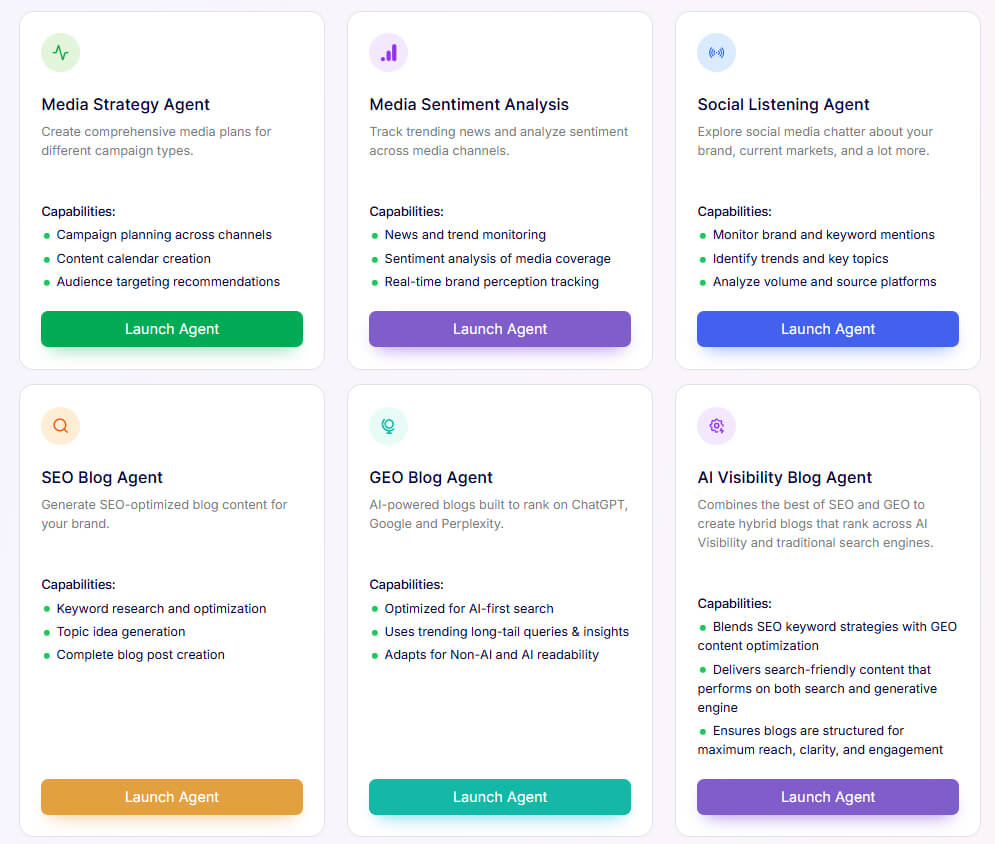
AI marketing agents are specialized systems designed to handle specific marketing functions inside a structured workflow. Rather than acting like a single general-purpose assistant, each agent supports a defined role, such as campaign planning, blog creation, GEO auditing, social publishing, or sentiment monitoring.
In Addlly AI, these agents work from validated brand settings, training inputs, and business goals. That allows them to produce more consistent outputs across tasks and helps teams move from strategy to execution with less manual effort. Instead of treating every asset as a one-off request, agents help create repeatable workflows that can stay active over time.
Custom-Trained Agents vs Generic AI Tools
Generic AI tools are useful for drafting and brainstorming, but they often require repeated prompting and manual refinement for every task. Addlly AI agents work from your validated brand setup, training inputs, and workflow structure, which makes them better suited for repeatable marketing execution across blogs, social posts, campaigns, audits, and email content.
Agentic Workflows vs Traditional Task Management
Traditional marketing execution often relies on multiple tools, multiple rounds of approval, and manual coordination across teams. One person plans the campaign, another writes the blog, another adapts it for social, and someone else reviews performance later. That process can work, but it often creates delays, duplicated effort, and inconsistent messaging.
Agentic workflows are more connected. Instead of treating every task as a separate project, Addlly AI agents can support linked steps inside the same workflow. A strategy agent can define a campaign direction, a writing agent can turn it into content, a GEO or SEO agent can improve discoverability, and a social or email agent can adapt the same message for other channels. Humans still guide the priorities and review outputs, but the workflow becomes easier to maintain across the full content cycle.
What Makes a 24/7 Marketing Workflow Work
A 24/7 marketing workflow is not just about generating more content. It depends on having agents that can support visibility, localization, and ongoing performance improvement without requiring the team to restart from scratch every time. In Addlly AI, that usually comes down to three areas: SEO and GEO support, multi-language and multi-market execution, and continuous monitoring and adjustment.
SEO and GEO Optimization
SEO and GEO are both essential parts of always-on visibility. SEO helps brands stay visible in traditional search engines, while GEO helps brands improve how they appear in AI-generated answers, summaries, and answer-engine experiences. Together, they support a broader visibility strategy across both search and AI discovery.
Addlly AI agents can support this by helping teams audit content, improve structure, identify visibility gaps, and generate or rewrite content for different discovery environments. This makes it easier to maintain discoverability over time rather than relying on one-time optimization efforts.
Multi-Language and Multi-Market Coverage
Always-on marketing often means publishing across multiple markets. That requires more than direct translation. Content needs to reflect regional language, local context, and market-specific priorities while still staying aligned with the brand.
Addlly AI agents support multi-language workflows by helping teams adapt content for different regions and formats. This is useful for newsletters, blog content, product descriptions, and social posts where the same campaign theme may need to be localized across multiple audiences.
Performance Monitoring and Adjustment
A 24/7 marketing workflow also depends on visibility into performance. Teams need to know when rankings change, when sentiment shifts, when visibility drops, or when content needs updating. That is where monitoring and audit-focused agents become important.
By supporting audits, performance checks, and continuous optimization, Addlly AI agents help teams respond more quickly to changes instead of waiting for a full manual review cycle.
Core AI Agent Types and Their Marketing Functions
Addlly AI includes several categories of agents that work together across the content and visibility workflow. Each one plays a different role in keeping marketing active and aligned.
Strategy and Campaign Planning Agents
These agents help teams move from business goals to campaign direction. They organize themes, channels, messages, and formats before content production begins.
Key capabilities
- Build campaign strategies from goals and audience inputs
- Support content calendars and planning workflows
- Recommend channel-specific ideas and formats
- Align messaging across campaign assets
Best for
- Planning multi-channel campaigns
- Organizing publishing priorities
- Giving teams a clearer starting point before content creation begins
Why it matters: When strategy is clearer at the beginning, blogs, social posts, newsletters, and other downstream assets are easier to align and execute consistently.
Content Creation and SEO/GEO Audit Agents
These agents support content production, visibility improvement, and content optimization. They help teams generate new assets, rewrite existing content, and audit performance across both search and AI-driven discovery environments.
Key capabilities
- Create SEO and GEO blog drafts
- Rewrite content for stronger AI visibility
- Generate product descriptions, newsletters, and social copy
- Audit SEO performance and identify optimization gaps
- Audit GEO readiness for AI answer environments
Best for
- Scaling content production
- Improving search and AI visibility
- Updating content based on performance or discoverability needs
Why it matters: This is the part of the agent ecosystem where the GEO and AI visibility angle is strongest. These agents help teams support both traditional rankings and answer-engine discoverability, which is increasingly important as user discovery behavior changes.

Social Listening and Sentiment Agents
These agents help teams understand how topics, keywords, and audience conversations are changing across platforms. They can surface trends, sentiment shifts, and signals that inform campaign planning and content updates.
Key capabilities
- Monitor sentiment and keyword movement
- Identify trending or emerging topics
- Support faster reaction to audience shifts
- Feed insight back into campaign and content decisions
Best for
- Brands that need timely social insight
- Campaign teams monitoring response and conversation trends
- Improving relevance across fast-moving topics
Why it matters: Listening agents help always-on marketing stay responsive. They make it easier to connect market feedback to content and strategy, rather than relying solely on delayed reporting.
Measuring the Impact of an AI Agent Team
The impact of an AI agent team should be measured across both efficiency and visibility. Faster production is important, but it is only part of the value. Teams should also look at output quality, consistency, discoverability, and how well workflows scale over time.
Useful metrics can include:
- Time saved per asset
- Output volume
- Edit and approval rate
- Cost per asset
- SEO performance changes
- GEO or AI visibility improvements
- Localization accuracy
- Campaign turnaround time
This gives teams a more complete picture of whether agents are improving how marketing operates, not just how quickly drafts are created.
FAQs
How do AI marketing agents maintain brand consistency?
Addlly AI agents work from validated brand settings, training inputs, and workflow structure. This helps them produce outputs that are more aligned with your approved tone, messaging, and business context across blogs, social posts, newsletters, and other assets.
What tasks can AI marketing agents automate?
They can support campaign planning, blog creation, content rewriting, SEO and GEO audits, social post generation, newsletter creation, product content, and performance-related optimization tasks. The exact role depends on the agent and the workflow it supports.
How quickly can teams see gains from using AI agents?
That depends on the workflow, but teams often see the fastest gains in tasks that are repeated often, such as blog production, newsletters, social content, and audits. The clearest early benefits usually show up in time saved, output volume, and workflow consistency.
Do AI marketing agents replace human marketers?
No. Human teams still set goals, approve direction, review outputs, and make strategic decisions. Agents support execution by handling repeatable tasks and helping workflows run more smoothly across content creation, optimization, and publishing.
Can agents support multilingual campaigns?
Yes. Addlly AI agents can support multi-language and multi-market workflows, which makes them useful for global teams that need to adapt content by region while keeping messaging aligned with the same broader brand and campaign direction.
How do agents support AI visibility specifically?
Agents support AI visibility by helping teams create and improve content that is easier for AI systems to interpret, structure, and reference. This includes GEO audits, rewrites, stronger topic clarity, and content designed for modern answer-engine discovery.