
Customizing Addlly AI Agents for Your Brand Voice
Brand voice training helps Addlly AI agents create outputs that stay aligned with your messaging, tone, and positioning across formats. A strong voice foundation helps Addlly AI agents create content that better reflects your brand across SEO, GEO, and AI visibility workflows. This guide explains how brand voice training works, what agents learn, how to validate their understanding, and how to keep your voice up to date over time.
Start with Your Brand Voice Foundation
Before Addlly AI agents can create content that feels consistent across blogs, social posts, emails, and other formats, they need a clear understanding of how your brand communicates. A validated brand voice helps the platform reflect your tone, positioning, and messaging standards across every workflow.
In Addlly AI, brand voice setup is part of the onboarding and training process. Once your voice is established, that same foundation can support multiple agents and content types without requiring separate setup for each workflow.
The quality of these materials matters more than volume. The more representative and up-to-date your examples are, the more accurately the agents can learn your voice. Addlly AI also looks at how you describe products, how formal or informal your language is, how you structure different types of content, and how your messaging may vary by audience or channel.
How Addlly AI Agents Learn Your Brand?
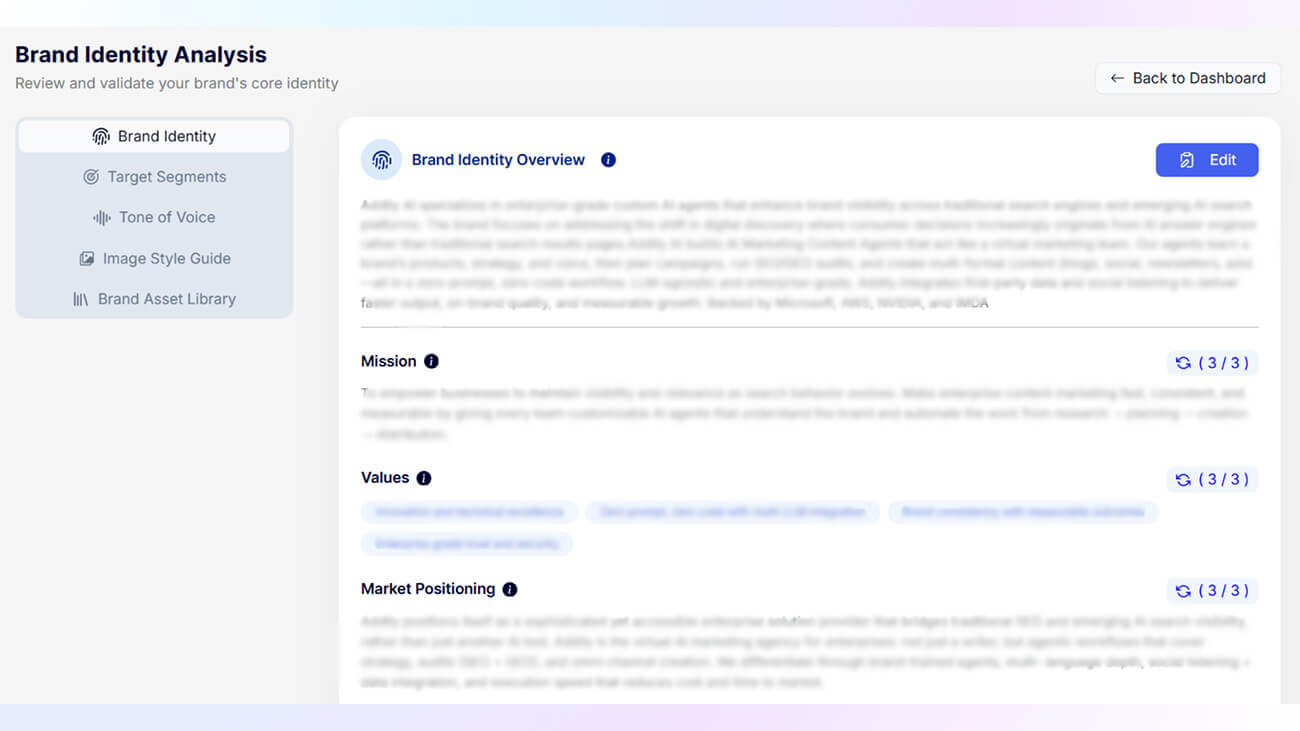
During onboarding, Addlly AI begins collecting signals from your brand materials through the Brand Voice section in your dashboard.
Once uploaded, the Addlly AI analyzes these materials and starts building a working understanding of your brand voice, structure, and content patterns. That voice foundation can then be applied across other Addlly AI agents and workflows without needing to start from scratch each time.
What the AI Agents Actually Pick Up?
Addlly AI agents analyze patterns in how your brand communicates and use those signals to guide future outputs.
This includes:
- Preferred phrasing and sentence structure
- Tone and level of formality across channels
- Product naming conventions and positioning language
- Voice consistency across markets or sub-brands
- Formatting patterns for different content types
- Signals around language, claims, or styles your brand avoids
This is also where brand clarity becomes especially useful. When your phrasing, positioning, and structure are more consistent, your content is easier to align across teams and easier for AI systems to interpret more clearly in search summaries, answer engines, and other AI-generated surfaces.
How to Set Up Your Addlly AI Onboarding Dashboard
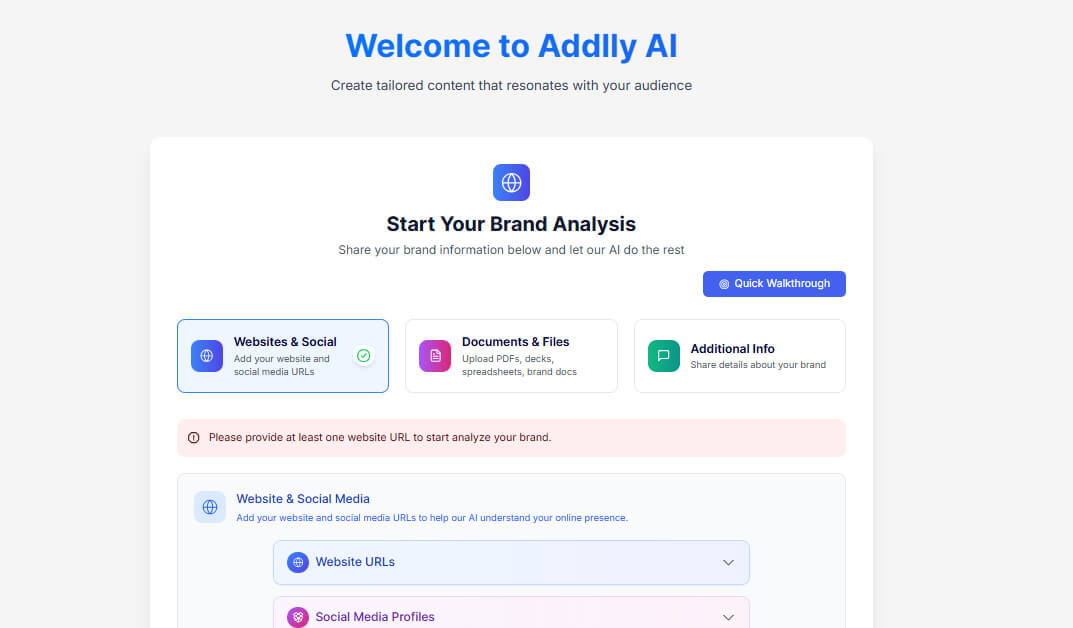
Setting up your Addlly AI onboarding dashboard is the first step in training your agents to understand your brand. This is where you connect your brand inputs, define key context, and activate the foundation that powers all downstream content generation.
Step 1: Access the Onboarding Dashboard
Once you log in to Addlly AI, navigate to the Onboarding Dashboard from your main workspace. This is your central setup area where all brand training begins.
Step 2: Input Your Brand Information
Start by adding your core brand inputs. These typically include:
- Your official website URL
- Linked social media accounts
- Brand guidelines or existing style documents
- Image style guide
- Core company details (mission, vision, and values)
These inputs help the system understand your brand at a structural level, not just stylistic tone.
Step 3: Review Initial Brand Interpretation
After submission, Addlly AI will generate an initial understanding of your brand voice and structure. You can view this in the dashboard to ensure the system has captured your tone and messaging correctly.
Step 4: Validate Your Setup
Once everything looks aligned, validate your onboarding setup. This confirms your brand foundation and ensures Addlly AI agents are correctly trained to apply your brand voice across all content workflows.
Validate Your Brand Voice
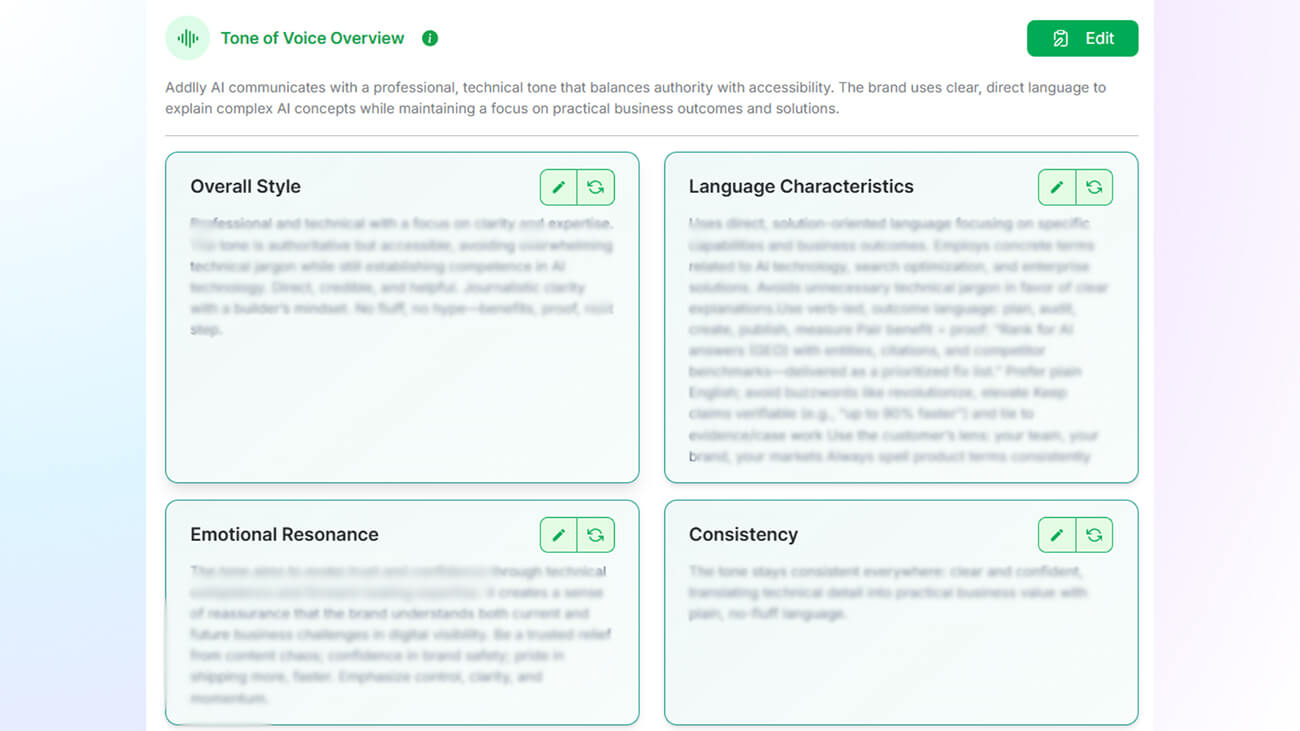
Validating how Addlly AI interprets your brand voice helps confirm that the platform is applying the right tone, phrasing, and structure before you begin creating content at scale.
If something feels off, you can adjust it. You may want to correct tone mismatches, refine phrasing, or upload a few more examples to give the agents better context. Small updates at this stage can improve consistency across future blogs, social posts, newsletters, campaign assets, and other outputs created in Addlly AI.
This step is important because it helps turn a general voice model into one that better aligns with your actual brand.
Where Brand Voice Gets Applied?
Once your brand voice is trained and validated, Addlly AI agents can apply it across multiple content workflows without requiring separate retraining for each format.
This includes:
- Social media posts
- SEO blogs
- GEO blogs and rewrites
- Product descriptions
- Campaign copy
- Emails and newsletters
- Ad copy
- Internal communications or policy drafts
Because the system is working from your real content patterns and approved voice signals, outputs are more likely to feel brand-aligned from the first draft. This reduces the need for constant prompt tweaks or repeated tone corrections across channels.
How to Review or Update Your Brand Voice?
Your brand voice may change over time as your company grows, launches new products, enters new markets, or updates its messaging. Addlly AI is designed to adapt to that change. You can return to the Brand Voice section in your dashboard at any time and upload newer materials that better reflect your current tone, phrasing, or positioning.
This can be useful when:
- Your social tone becomes more conversational
- You launch a new product line with different naming conventions
- Your value proposition or messaging framework changes
- A rebrand or campaign shift changes how you want the brand to sound
Once new materials are uploaded and properly tagged, agents can begin adapting behind the scenes. There is no need to retrain from scratch. If you need more support, Addlly AI also offers a guided voice review process to help identify gaps, choose better reference materials, and keep your agents aligned with the latest version of your brand.
Why Brand Voice Training Matters?
Many AI tools can produce grammatically correct content, but the output often feels generic or disconnected from how a real brand communicates. That usually leads to more editing, more prompt adjustments, and more time spent rewriting content to make it feel usable.
Custom-trained Addlly AI agents help reduce that problem by working from your real brand materials rather than relying only on general language patterns. This makes it easier to generate content that stays closer to your tone, phrasing, and messaging from the start. The result is less rework, more consistency across teams and channels, and a stronger content foundation for both traditional publishing and AI-driven discovery. When brand language is clearer and more consistent, it is also easier to maintain recognizable positioning across SEO, GEO, and AI visibility workflows.
FAQs
What kind of content should I upload to train the agents?
Upload content that best reflects how you want your brand to sound today. Useful examples include blogs, emails, campaign copy, social captions, product pages, and other materials that clearly show your current tone, phrasing, and messaging approach.
Will the agents learn what not to write?
Yes. In addition to learning preferred patterns, the agents can pick up signals around language, claims, or styles that your brand avoids or downplays. This helps reduce off-brand phrasing and supports stronger consistency across future outputs.
What if I am unsure what content to use for training?
If you are unsure what to upload, start with content that best reflects your current brand voice across a few key formats. You can also request a guided voice review to help identify stronger examples and close any gaps in your training inputs.
Do the agents copy my content word-for-word?
No. Addlly AI agents analyze patterns in your content, but they do not simply duplicate the source material. The goal is to generate new content that reflects your tone, structure, and brand language without copying your original text directly.
Do I need to retrain every agent separately?
No. Once your brand voice foundation is in place, it can support multiple Addlly AI agents across the platform. This helps keep your content more consistent across different workflows without requiring a separate voice setup for each one.
How often should I update my brand voice?
Update it whenever your messaging changes in a meaningful way. This might happen after a rebrand, a new product launch, a shift in tone, or a change in how your brand communicates across channels or markets.
Can the agents handle different tones for different channels?
Yes. Addlly AI can learn how your tone varies by format or channel, such as a more conversational style for social content and a more structured tone for product or website copy. The more representative your training examples are, the better this works.
Can voice training support multiple markets or sub-brands?
Yes. If your uploaded materials include examples from different markets or sub-brands, the agents can learn patterns across those variations. This is especially useful for companies managing regional messaging or multiple product lines under one broader brand structure.